TUC president and POA leader STEVE GILLAN speaks to Ben Chacko on the eve of Congress 2026


 Latest editorial
Peace is vital for the people of Iran
STEVE BISHOP considers the prospects for a settlement of the conflict and how the demands of both sides are being viewed
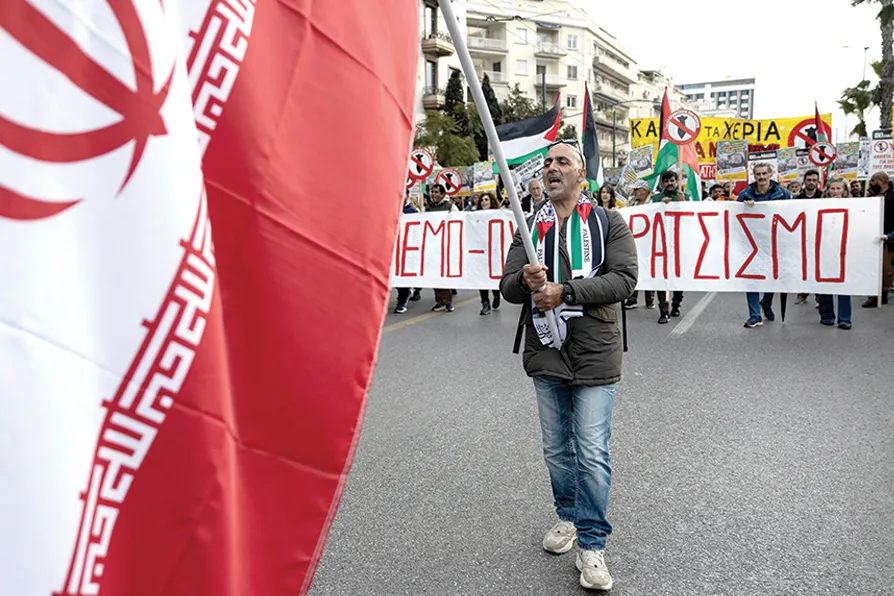 WORLWIDE REVULSION: Protest in Athens, Greece, last Saturday, against the US and Israeli war against Iran

DOUG NICHOLLS welcomes a turning point at this year’s Congress, where many motions call for a co-ordinated plan to revive British industry, a perspective outlined in his new book
HOPE VIRGO of campaign Dump the Scales warns MPs voting today they should be alert to the threat legalised assisted death poses to people with eating disorders
The Together Alliance is hosting two summits, North and South, to build power and plan action against the scourge of racism peddled by the right. DANIEL KEBEDE urges mass participation
The drift toward militarisation in Europe is not inevitable, left-wing and peace movements can preserve sovereignty and prevent war, says DÁIRE HUGHES MP
Whatever differences exist among international sympathisers of the Bolivarian revolution about its current trajectory, they should unite against the imperialist power that is the source of an enforced retreat, argues ROGER D HARRIS
Trade unions need to step up and force a turn in the policies of the labour movement to effectively confront the far-right threat, argues NICK WRIGHT





THE unprovoked attack upon Iran by the Israeli Defence Force (IDF) backed by the US on February 28 has already resulted in thousands of deaths over the past month and the destruction of large parts of the Iranian capital, Tehran, and major cities in Iran. (The US-based Human Rights Activists News Agency has documented at least 7,007 deaths and was reviewing an additional 11,744).
The latest deadline set for an attack upon Iran’s power generation infrastructure by Donald Trump is Easter Monday, April 6. This follows from Trump’s initial announcement on March 21 that Iran had 48 hours to open the Strait of Hormuz or the US would destroy Iran’s “various power plants, starting with the biggest one first!”
This was swiftly followed by a further announcement on March 23, suspending any action against Iranian power plants for five days, claiming that “very good and productive” conversations have taken place between the US and Iran regarding a “complete and total resolution of hostilities in the Middle East.”
That deadline was subsequently revised further to the April 6 date.
This shifting of goalposts is indicative of the US approach to the war, with unclear objectives and little clear idea of what would constitute “success” in their terms.
Eliminating Iran’s capability to build a nuclear weapon has been one claim; destroying its ballistic missile capability another; bombing the leadership into submission, or such weakness that the people will rise up and overthrow the Islamic Republic, has been asserted at various moments.
On the one hand Trump has stated that he does not want the US to be engaged in a ground war, on the other, 3,500 troops on the USS Tripoli have just added to US military capacity in the Gulf.
The deployment is by no means on the same scale as that launched for the invasion of Iraq but there may be sufficient capability to seize key vantage points, such as Kharg Island, in order to immobilise Iran’s capacity to generate revenue through oil sales.
Even such a limited military ambition has significant flaws however, bringing US troops under fire from the Iranian mainland, as well as activating Iran’s threat to close the Strait of Hormuz completely, with all the consequences for world economic chaos that would imply.
There is no doubt that Trump has boxed himself into a corner.
In spite of the overwhelming imbalance in military might between the US/Israeli axis and Iran, the impact of Iran’s response has shaken the world economy. The reliance of the Gulf states on desalination plants to provide water for the population is significant, as are the oil and gas revenues which underpin their economies.
Iran targeting these facilities is a major concern for the energy-rich dictatorships in the region.
In addition, the Israeli Defence Force (IDF) appears to be marching to its own drumbeat with ongoing waves of attacks by Israeli jets upon Tehran underlining the claim by IDF spokesman General Effie Defrin that: “We are expected to face several more weeks of fighting against Iran and Hezbollah. With each passing day, we are weakening the terror regime more and more. We will not allow the terror regime and its proxies to pose a threat to the state of Israel.”
In a video message on March 23 Benjamin Netanyahu confirmed the position that Israel would press on with its fundamentalist mission, stating: “We are continuing to strike in both Iran and Lebanon. We are smashing the missile programme and the nuclear programme, and we continue to deal severe blows to Hezbollah.”
Netanyahu gave no indication that the IDF would be winding down its aggression against Iran or its allies in the region any time soon. In addition, it is widely reported that the de facto leader of Saudi Arabia, Mohammed bin Salman, has been pressing the US to continue action against Iran, in order to strengthen Saudi clams to lead the Islamic world.
Trump meanwhile continues to insist that talks with Iran are underway, even though this is consistently denied by the Iranian side.
The uncertainty about whether talks are on or off, and whether the US is likely to step up its action in the region, is reflected in the volatility of international oil prices which have see-sawed in recent weeks as announcements by the US president have veered one way then another.
Mediation of some sort through Pakistan has been mooted but it is unclear what the terms for any discussions will be and whether Iran and the US-Israeli axis are fully committed.
Currently the US has proposed a 15-point plan to end the war. Their demands centre on the main rationale US officials have given for starting the war: to stop the country building nuclear weapons and to eliminate the threat of its missile programme.
The proposals request that Iran must “commit never to pursue nuclear weapons,” pledge to dismantle nuclear facilities and hand over the enriched amounts of uranium it possesses to the International Atomic Energy Agency (IAEA), the UN nuclear watchdog, which is to monitor the issue going forward.
According to the proposals, Iran would agree to limit its missile programme in range and quantity. Additionally, Iran would stop funding regional allies as part of its self-proclaimed Axis of Resistance. Iran would also be required to reopen the Strait of Hormuz so it could function as a “free maritime corridor.”
If these conditions were fulfilled all international sanctions would be lifted on Iran, according to the US plan.
Iran has countered with a five-point plan of its own, while not accepting the terms of the US plan as reported. For Iran there must be a complete halt to “aggression and assassinations by the enemy.” Several top Iranian officials have been killed since the first day of the war when a massive Israeli air strike on Tehran killed supreme leader Ayatollah Ali Khamenei.
Other conditions include “concrete mechanisms to ensure that the war is not reimposed on the Islamic Republic,” as well as demands for the payment of war damages and reparations, and the right to remain solely in charge of the Strait of Hormuz.
Tehran also wants Israel to end attacks on Iranian allies in the region.
Given that attacks upon Iran in June last year and on February 28 this year were launched during negotiations which were deemed to be making progress, there is little doubt that the Iranian side will be sceptical about US and Israeli intentions.
At the same time, while belligerence is the default position of the Israeli regime, the US is more aware of pressure from Nato allies to reach a settlement due to the wider international economic impact.
Whatever the outcome of current discussions there is no doubt that the Iranian people are already the losers, caught between the rock of an increasingly hard-line theocratic dictatorship and the combined military might of the US and Israel.
An outcome which results in an immediate ceasefire and a clear way forward to end the war is the only way they will be able to see any real possibility of change.
The Demand for Peace in Iran: The Struggle for Democracy, Trade Union Rights and Human Rights is a Codir fringe meeting taking place at NEU conference today from 12.45-1.45pm in Syndicate 2 at the Brighton Centre. Speakers include Esmaeil Abdi, former imprisoned teacher and Iranian teachers’ trade union activist; Dr Azar Sepehr of the Democratic Organisation of Iranian Women; Louise Regan, NEU national executive member and chair of international committee; Joe Gill, journalist, Middle East Eye; Jamshid Ahmadi, Codir assistant general secretary; chair: Sarah Kilpatrick NEU deputy general secretary.
