While riding the No 3 bus in Glasgow MATT KERR has ample time to dissect the moribund Scottish Labour decline into near oblivion and watch intriguing bus passenger dynamics


 Latest editorial

The cold calculus of empire
A recent Financial Times column on the Iran war exemplifies how the Western elite worldview is more concerned with strategy and power than legality or human life, writes ANDREW MURRAY
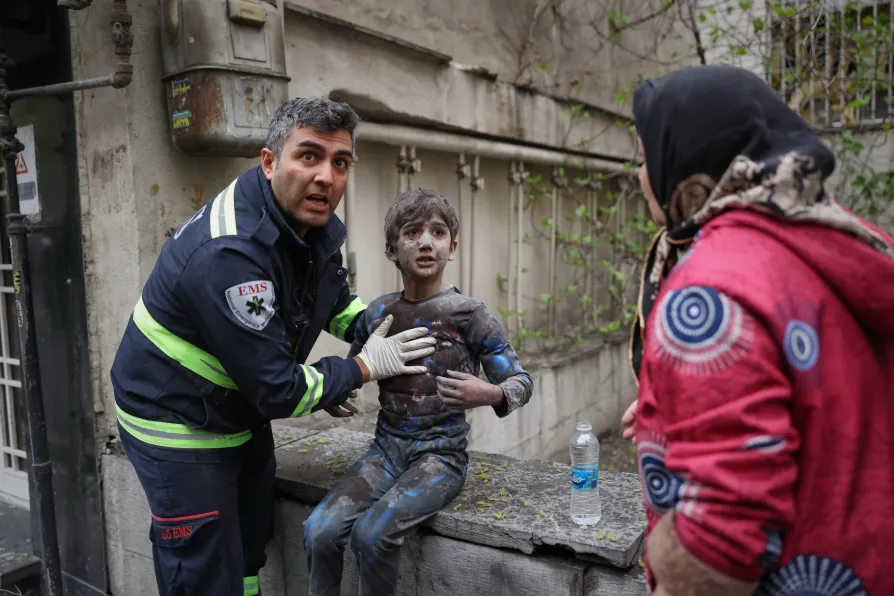 A first responder assists an injured boy following a strike that hit a residential building amid the U.S.-Israeli military campaign in Tehran, Iran, March 28, 2026
The best wildfire service may begin with the community, argues KOMAL RAJ ARYAL
Dignity is important to all humans, argues the Marx Memorial Library and Workers’ School, but it does not come about automatically. In a less than perfect world, dignity can accompany suffering, but the collective dignity of working people is achieved through acting together to change the world.
The US aim to reshape the existing order in the Middle East needs to be resolutely resisted, argues PAYAM SOLHTALAB
Concessions to Washington by the post-Maduro leadership in Caracas are designed to preserve the core of the Bolivarian Revolution not betray it, argue Roger D Harris, Francisco Dominguez and Mara Paez Victor. How the solidarity movement responds is critical
ALMA EGAN suggests four days out that bring the region’s history of protest to life





PATRICK FOULIS has done us all a favour.
No, I didn’t know who he is either. Turns out he is a former foreign editor of the Economist magazine, the intellectual headquarters of global neoliberalism and Anglo-American imperialism.
That make a lot of sense in the context of a column that Foulis wrote about the Iran war in the Financial Times last week.
It exposed the concerns of the London-Washington elite about how the aggression — not that he called it that — in the Gulf is going.
It also revealed the morality of the warmongers. It is necessary to quote his article at some length. He addresses what he described as the “shortcomings” of the war. First up, it “lacks bipartisan support and is unpopular with voters. It has ruptured relations with Nato.”
Next: “If it is sustained, surging oil prices will boost Russia’s revenues by over $80 billion a year … US military resources have been drawn away from Asia, supposedly the priority.
“Munitions that would be essential in a war with China have been run down … Cheap drones blowing up data centres in the UAE and gas plants are staggeringly expensive to stop. The war has cost America $9bn a week.”
Let us deconstruct all that a little. The problem with the war is not the evident illegality of the US-Israeli attack.
Indeed, Foulis asserts that “a disregard for the UN, and most allies, makes decision-making faster.”
Still less are the thousands of deaths, including the 160 primary schoolgirls slaughtered in a US missile strike, worthy of a Foulis mention.
The danger of the soaring oil price is not that it will impoverish millions across the globe through its impact on fuel and food prices but that it might assist Nato’s Russian rivals.
Also deplorable is that Donald Trump’s erratic bellicosity has divided the US ruling class within itself and split the Nato alliance which has long been the major expression and extension of US military power.
Worst of all as per Foulis, the present regional conflict “with unclear objectives” is using up munitions — specifically missiles and interceptors — which need to be saved for an impending, and even bigger, war against China.
The man from the Economist may be wandering in a moral desert of his own making, but he has consolations.
“America’s strengths have been on awesome display,” he writes, also counting the targeted killing of Iran’s leaders on the credit side.
He concludes, after much more of these calculations, that “much of the world still has no clear alternative to relying on America,” with China in no present situation to replace it, as if that was Beijing’s ambition.
The musings of Foulis indicate a direction of travel, towards a world even worse than today’s, with wars that would dwarf the present conflicts in the Gulf and Ukraine in their human losses and economic crises.
But he worries that the floundering aggression against Iran, which President Trump can neither explain why he started nor how he plans to stop, will get in the way of the larger march towards catastrophe.
The history of the Economist is of being catastrophically wrong about everything, from backing the slaveowners’ rebellion in the US civil war to supporting Pinochet fascism in the 1970s, and then conceding the error and expressing regret decades later.
The workers’ movement was, of course, right both times and at the time in the examples cited — similar political clarity is needed in opposing Trumpian gangster imperialism’s war drive today.
Stop the arms build-up impoverishing the country. Demand a ceasefire in the Gulf and Ukraine, and an end to any British involvement in any case. Oppose the “Global Britain” imperial pretensions of Keir Starmer and the rest of the British Establishment.
We cannot wait for the subsequent apology from whatever AI bot is generating Economist editorials — not the hardest programme to write — at the end of this century. The Foulis folly will mean there is no-one left to read them.
A party in limbo: war delays the inevitable reckoning for Labour
IT MAY BE that the war has ridden to Keir Starmer’s rescue. The conflict will not do anything for Labour’s vote in the crucial May elections, which seems beyond hope or help — but it could well stay the hand of Labour’s putative leadership-change insurrectionists.
In truth, they do not take much staying. “Soft left” is not an invented or abusive category but a fair description of a political reality. Their every plot is accompanied, and simultaneously, by the scrupulous preparation of reasons to abort it.
As arguments for vacillation go, the war is serviceable. It has plunged British diplomacy, torn between fealty to Trump and Washington and alarm at where this time-honoured liaison could be leading, into chaos.
And it threatens fresh impetus to the intractable cost-of-living crisis which social democracy is intellectually ill-equipped to deal with. No likely contender to succeed Starmer has indicated that they will consign Rachel Reeves’s “iron-clad fiscal rules” to history. Only the unavailable Andy Burnham has broached the matter.
So, Streeting, Rayner et al, may argue — right now, who needs this grief? There are still three years to go before the next general election in any case. Time enough for more opportune circumstances to mature.
There is always a better moment, and then again it may never arrive. The better moment in this case was probably after the Gorton and Denton by-election disaster for Labour, which finally blew up the whole Starmer-McSweeney political strategy.
Acting then might have spared some of the Labour MSPs, Senedd members, councillors the electoral immolation on May 4 that seems now unavoidable.
The twin dangers now are either that Starmer contrives to hang on indefinitely, lurching from one expedient to the next, or that Labour is so eviscerated that it ceases to be a plausible national party of government in the future at all. Correct, these are not mutually exclusive dangers.
Some may hope that Starmer can be reincarnated in some more electorally desirable form or other. It is true that he may win points for being far more robust in challenging Tory-Reform racism than when the egregious Morgan McSweeney was at his elbow, and he is also, and with no justification at all, winning plaudits for purportedly keeping Britain out of the Iran war.
However, the main lines of policy on the economy, on authoritarianism, on militarisation and war have not been altered. In terms of grappling with the realities of unconstrained Trump imperialism, Starmer still lags behind Spain’s Pedro Sanchez and Canada’s Mark Carney within Nato-world.
Nor can he overcome his inherent lack of purposefulness, his default setting to dither and his instinctive deferral to the status quo on whatever problem is presented to him. These weaknesses will not disappear as miraculously as McSweeney’s phone.
There is thus scant objective reason for hope, but we are dealing with a whole heap of parliamentary subjectivities here.
It may be that the disaster on May 4 will be on a sufficient scale to overcome doubts and hesitations among Labour MPs. The party faces coming third in Wales and losing most of its local government seats in London, for so long two of the party’s most reliable strongholds on election nights.
However, for all that fortune favours the brave it also mandates that (s)he who fights and runs away lives to fight another day. In my long observation of these matters, those who wish to avoid combat are never stuck for a justification sufficient for themselves.
Whether the Labour Party can live to fight another day is in doubt, as indeed is the related question of who it would fight for if it survived. “At our best when we are Labour” is a ringing slogan, but it sinks into meaninglessness the longer “Labour” means poverty, police repression and war. The balance is surely still in favour of doing the deed ere long.
