
After months of uncertainty over printing and distribution, the first Scottish-printed edition of the Morning Star is soon to roll off the presses


Why we must celebrate and support workers in struggle
Gloucestershire’s phlebotomists have brought their historic strike to a close after almost a year of action, leaving a legacy of determination – and a clear lesson about the power of solidarity in the face of anti-union laws and austerity, says FBU general secretary STEVE WRIGHT
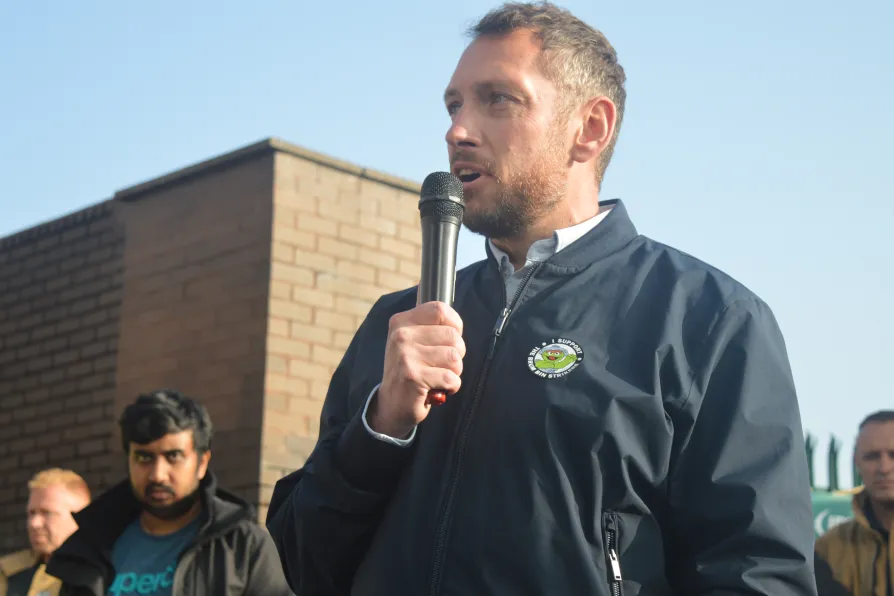
 STANDING IN SOLIDARITY: FBU leader Steve Wright. Pic: Henry Fowler
Some thinkers and authors on the right are openly discussing the possibility that the historically successful party of the British ruling class may be exhausted
Class struggle is the motor of history but the direction and detail of change at any time and place is the outcome of many factors, suggests the Marx Memorial Library and Workers’ School
Merseyside’s proud tradition of internationalism is being kept alive through events organised by trade unionists and allies in the region, writes ROBERT MACDONALD
JOHNNIE HUNTER reports from the German Communist Party’s (DKP) weekly Unsere Zeit (Our Newspaper)-organised Peace Days festival in Berlin last weekend
Les Preger was one of Manchester’s first volunteers to volunteer in support of republican Spain, writes his daughter JANEY PREGER
TONY BURKE surveys the shifting political landscape and the challenges Labour needs to address if it is to prevail in the 2028 federal elections





MARCH 10 2026 will go down as a historic date in Gloucestershire — and potentially across the whole country. It marks the end of the of strike action by 37 phlebotomists.
A near full year of struggle. The longest strike by directly employed staff in NHS history.
It was not the longest NHS strike ever. That distinction, as far as we know, belongs to the Hillingdon Hospital cleaners’ strike, which began on October 1 1995 and ended on October 29 2000, when Nupe/Unison steward Malkiat Bilku walked back into work alongside Alan Keen MP.
Long disputes shape our movement. They frame our collective memory and define the aims, strategy and tactics needed to win. From Grunwick to the miners’ strike of 1984-85, what you do in these moments is remembered — not as private reflection, but as part of the living history of working-class struggle etched across generations.
It is no accident that such prolonged strikes have become more common in recent decades. Anti-trade union laws — reballoting requirements, conciliation hurdles, minimum service levels and the misuse of agency staff to undermine striking workers — are designed to exhaust, divide and outlast us.
In recent years we have seen the ongoing action of BMA resident doctors fighting for pay restoration, alongside the Birmingham bin workers, now well beyond a year in dispute. These fights are complex, difficult and demand greater solidarity and practical support from all of us.
This means taking active steps to bring more workers into struggle — through disputes in their own workplaces, especially across those key supply chains — so that pressure is applied to employers at every stage and from every direction.
As a national trade union, we are part of a broader working-class movement. That means supporting, mobilising and organising wherever workers take a stand. That is why we were proud national supporters of the 365th day of action on March 17, and would have stood again with the Gloucestershire phlebotomists — a group of workers whose determination has already inspired others to win rebanding in their own hospitals, the central demand of this dispute.
We have come to know these phlebotomists well. They have attended our internal union events and we have spent time with members and reps on the ground. As firefighters, we understand the importance of specialist roles within the NHS and across public services. We cannot allow publicly funded organisations to treat workers with such disregard.
But solidarity alone is not enough. As a movement — at leadership level and among the rank and file — we must co-ordinate our struggles more closely. We must move beyond sectional disputes and individual battles with ministers towards a united movement that builds joint strategies to reject austerity and war, demand investment and wage growth, and fights for a fundamental restructuring of the economy around workers’ needs.
For unions affiliated to the Labour Party, including the FBU, there are additional forums for this co-ordination.
Alongside that, our support for initiatives such as the Together alliance and projects like Strike Map strengthens collective action. Joint work makes all unions stronger and shows workers that our movement is united, relevant and powerful — something worth being part of.
Across the fire and rescue service, as in much of the public sector, 14 years of austerity and decades of neoliberal cuts to spending and regulation have left services weakened and communities less safe. We are entering a period of intensified struggle ourselves.
Last month in Oxfordshire, our whole union came together to support comrades balloting against further cuts — on top of the 12,000 firefighter posts lost since 2010 — cuts that we and the fire chiefs have said threaten public safety. Oxfordshire firefighters are now balloting to reject these cuts.
Through our national Cuts Kill campaign, we will need the full strength of our movement behind us — and the solidarity we have shown to others over the past year returned with equal determination and force. Our own longest national strike, in 1977-78, lasted nine weeks — far shorter than the disputes mentioned above — yet it came at enormous cost, with many firefighters forced to claim state benefits to survive. But that sacrifice mattered. The strike secured a pay formula that delivered sustained wage growth for the next 25 years, proving that even the hardest struggles can win gains that shape a generation.
In moments of crisis, organisation creates opportunity. This period offers the chance to renew our movement through action that delivers real results — not managed decline or cosmetic adjustments to failure.
We call on the movement to recognise, applaud and celebrate the epic struggle of the phlebotomists, and to channel that energy into organising at work and building workplaces capable of taking strike action.
There may be setbacks; there may be only partial victories. But it is only through this level of militant, collective struggle that workers create the conditions to win. It cannot be a fear of not winning a dispute or partial victory that stop us taking meaningful strike action.
We call on the entire movement to follow the example of the Gloucestershire phlebotomists: take a stand, take action, and stand in solidarity with striking workers everywhere.
