KEN COCKBURN traces the one original language – that of the Yamnaya pastoral nomads – from which all European and Indian languages derive


 Latest editorial
A refugee’s despair
MARJ MAYO recommends a lyrical and disturbing account of the tragic suicide in Venice of Pateh Sabally, a refugee from the Gambia
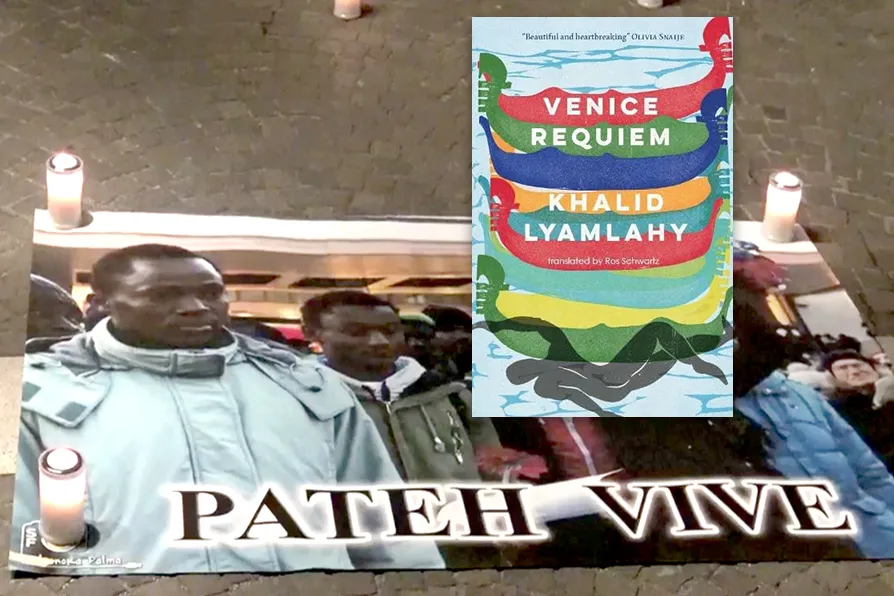 Memorial to Pateh Sabally, Venice 2017 [Pic: Loredana Spadon]
PAUL DONOVAN is fascinated by the debunking of the iconic British war hero
ALEX HALL recommends a searing panorama of our global predicament
Comics are not just superheroes and spandex – it can be public art, telling public stories, suggests HARRIET EARLE
ALEXEI SAYLE speaks to Angus Reid about a lifetime of protest, how to hone political art – and what to do now
The bard serenades the Diggers of Wigan and their festive followers





Venice Requiem
Khalid Lyamlahy (translated by Ros Schwartz), Small Axes, £12.99
AS the Morning Star coverage of the Cranston Inquiry Report concluded (Morning Star, February 6, 2026) refugees have been dehumanised by successive governments, resulting in lives being needlessly lost. Small Boat’s fictionalised account of the loss of 27 lives in the Channel highlights precisely these conclusions, pointing to the wider issues of personal and collective responsibility.
Small Axes’ more recent publication, Venice Requiem, explores these issues in similar ways, if more poetically than philosophically, perhaps. Written by Khalid Lyamlahy, (a Moroccan author who was originally published in French), Venice Requiem tells the true story of a 22-year-old Gambian refugee who committed suicide by plunging into the Grand Canal in Venice, in January 2017.
This is the story of an individual refugee’s despair, rather than the story of a group of refugees, seeking sanctuary with (sadly misplaced) hope. But both books share a similar focus on the ways in which refugees become dehumanised by officialdom, raising disturbing questions about the complicity of others, including, but not only, those who, for whatever reasons, failed to intervene to save them.
The first part of Venice Requiem is addressed to Pateh Sabally, the Gambian refugee who took his own life. Lyamlahy imagines Pateh’s route from the Gambia, eventually reaching Sicily and then travelling on, via Milan, to Venice. Why Venice anyway, a city associated with the arts, but also with death? And what might Pateh have been thinking and feeling as he moved from the station to the Grand Canal, before finally putting down his backpack and leaping into those icy waters?
The second part moves on to the author’s own visit to Venice. Having done his research, Lyamlahy wanted to see the place and imagine the story for himself, however disturbing this might be. “Where does your tragedy end and the shame of the world begin?” he wonders, before moving into further detail about what actually happened that January day.
Apparently, the first witnesses were confused about what was going on. But didn’t it occur to anyone to take action? There were cries subsequently, calling for someone to throw Pateh a life belt. And lifebelts were eventually thrown. But Pateh may have been in too much shock to be able to reach them.
By this time there were sounds of laughter and jeering too. Why can’t you swim? This was followed by cries of “Go back home” and “Let him die.” Apparently a lifeguard was about to jump in but was dissuaded and a motor boat passed right by but didn’t stop.
Subsequent official investigations identified a range of issues and views. Had there been negligence — a failure to assist a person in danger, for instance? Or was this all a lot of fuss about nothing? One person reflected that if a dog had fallen into the canal, more than one person would have dived straight in to save it. But no-one dived into the canal to save an African refugee. Reflecting on the situation afterwards though, a priest concluded that it was pointless to argue about what could have been done to save Pateh. Better to focus on opening our arms to migrants in the here and now.
Although this is a very upsetting book it is also very readable, very descriptive – and very fluently translated. The author interweaves Pateh’s story with his own reflections on Venice and its cultural history, comparing and contrasting this with Banjul, concluding that this was where he planned to go next.
This is a very short book (just over a hundred pages), lyrical and easy to read. But it does pose some disturbing questions, with so many implications for morality and culture both in Europe and beyond. Pateh’s bequest to Venice was “a cracked mirror in which the entire world can see its smugness reflected.”
Highly recommended.
