ROB WARZYNIAK wades knee deep through a pile of ‘dead canaries’ of Trumpist policies which exacerbated the horrors of US capitalism domestically


 Latest editorial

From nuclear deal to open war: how Washington and Tel Aviv escalated the Iran conflict
With this attack on Iran, Trump and Netanyahu are taking a reckless leap toward escalation. The region is balancing on the brink of a major war that could undermine the global economy and nuclear security, says MARC VANDEPITTE
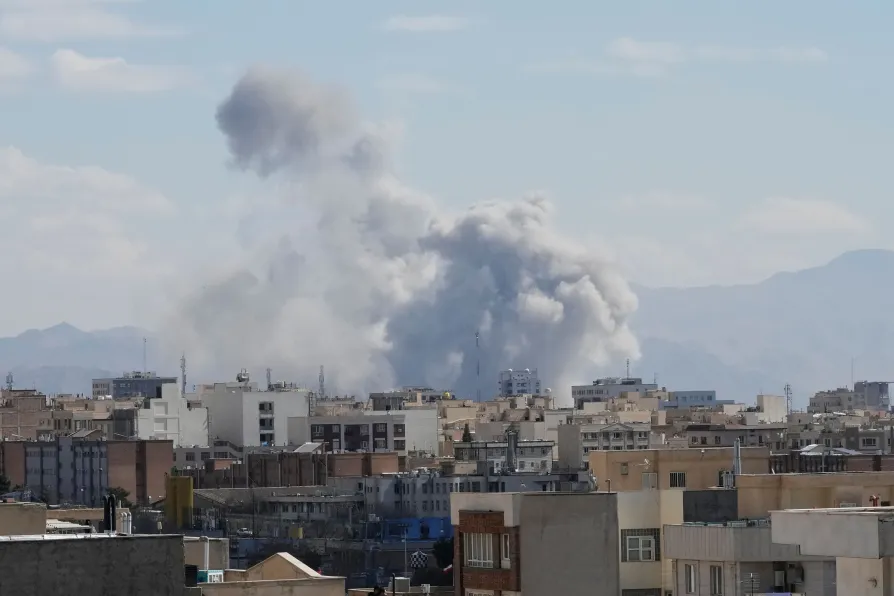 DESTRUCTION: Smoke rises up after a strike in Tehran, Iran yesterday
Without evidence or Nato consultations Berlin’s answer to the Leipzig incident is a rupture of relations. SEVIM DAGDELEN examines why
FRANCISCO DOMINGUEZ introduces the background to a conference on defending Latin America’s sovereignty
The glacier collapse in Nepal is yet another warning that a warming planet is making Himalayan disasters more frequent and destructive – but the countries facing the greatest risks are often those least responsible, says LI YANG
Nick Blair is set to benefit from a hugely lucrative contract to ‘virtually’ train the British army for its next war. Like father, like son, writes SOLOMON HUGHES
Even when tragedy strikes, Western media cannot resist the opportunity to turn it into a sordid propaganda opportunity, as the Nepal-China border tragedy shows, writes CARLOS MARTINEZ
Trade unions should be at the heart of the anti-racist push for reparations for the historic legacy and continuing impact of slavery, writes ROGER McKENZIE





ON FEBRUARY 28, the United States and Israel launched a joint series of bombings on cities and military targets in Iran. In the process, the highest spiritual leader, Ayatollah Ali Khamenei, was killed. Iran responded with missile attacks on Israel and on US targets in the region.
The attack began several hours after Donald Trump had said that he was “not happy” with the latest negotiations with Iran regarding the nuclear programme. The attack is being presented as a “preventive action against the Iranian threat.”
Trump announced “major combat operations” and called on Iranians to take over their government. Israel spoke of necessary self-defence against an imminent danger.
An Israeli defence official admitted that the operation had been planned for months and that the launch date had been set weeks ago. This occurred while negotiations over the nuclear file were still ongoing in Geneva. The military operation is being carried out in full co-ordination between the US and Israel. In the past 13 months, Trump and Netanyahu have met seven times.
The deal that Washington itself blew up
In 2015, the Joint Comprehensive Plan of Action (JCPOA) was concluded between Iran, the US and other major powers. Iran limited its nuclear activities and accepted strict inspections in exchange for the lifting of international sanctions.
The International Atomic Energy Agency repeatedly confirmed that Iran was complying with the agreements. Yet, in 2018, Trump unilaterally withdrew the US from the deal. He called it “the worst deal ever” and reinstated heavy sanctions against Tehran.
Since then, Washington has pursued a policy of “maximum pressure.” Today, the US demands full nuclear surrender, including the cessation of low-level uranium enrichment for civilian use. For Iran, this is unacceptable, especially in the face of a nuclear-armed Israel that tolerates no international oversight.
Economic strangulation and street protests
The bombings are the military climax of a years-long economic war. US Secretary of the Treasury Scott Bessent openly admitted that Washington deliberately created a dollar shortage in Iran to destabilise the economy.
This led to the collapse of one of the country’s largest banks, hyperinflation and a freefall of the Iranian currency.
Bessent had previously praised this approach at the World Economic Forum in Davos as “economic statecraft” and “maximum pressure,” in which no shot is fired but the economy collapses. Under Trump, this strategy has been maintained to hit the population so hard that it brings down its own rulers.
The economic turmoil indeed led to protests. But what began as economic discontent and a legitimate call for democracy — against corruption and religious paternalism — soon turned into a violent confrontation between security forces and armed groups.
Through social media, the Israeli intelligence service, Mossad, called on Iranians to “take to the streets together” and declared that it stood “on your side on the ground.” An Israeli media outlet, seen as close to Prime Minister Benjamin Netanyahu, reported that “foreign actors” had armed anti-government demonstrators in Iran.
Young people were paid to create chaos and weapons were confiscated. The number of casualties quickly rose into the thousands, according to various sources. What began as legitimate and peaceful protests thus became a pawn in a broader strategy to turn internal tensions into regime change.
The US and Israel hoped to achieve that goal through a colour revolution, but it failed. Now that this path has stalled, they appear to be deploying major military means.
Oil industry sees ‘greatest opportunity’
Behind the ideological rhetoric about “democracy” and Iran as a “threat to national security” lie the hard interests of the fossil fuel industry. At a summit of the American Petroleum Institute, a possible fall of the Iranian regime was described as “the greatest opportunity” for the oil industry.
Energy consultant Bob McNally outlined a future in which US companies would quickly return to Iran, resulting in immediate oil profits. A “beautiful day for the industry,” it was said behind closed doors.
Role of Israel
Israel’s role in this escalation is often underplayed. Netanyahu fiercely opposed the 2015 nuclear agreement and even addressed the US Congress to block it.
After Trump’s withdrawal from the deal, Israel carried out a campaign of cyberattacks, sabotage and targeted assassinations against Iranian targets. The ultimate goal, according to analysts and strategists, is regime change in Tehran and the strengthening of Israel’s regional dominance.
Region on the brink of escalation
The United States has carried out an unprecedented military build-up around Iran, with aircraft carriers, destroyers, air defence systems, and tens of thousands of troops. Experts compare the scale to the preparations for the Iraq war in 2003.
After the successful military operation in Venezuela two months ago, Trump feels overconfident and victorious. But Iran is not Iraq or Venezuela. The country has about 90 million inhabitants and can block the Strait of Hormuz, which is crucial for a significant portion of the global oil trade. And it appears that this is happening.
A prolonged war would cause oil prices to explode and disrupt the global economy. Iran also possesses hypersonic and other high-speed missiles that, according to Western analyses, are difficult to intercept and can threaten sensitive targets in Israel and US bases in the region.
This could lead to a dangerous escalation in which the use of nuclear weapons is not excluded. The joint attack by Israel and the US is a particularly dangerous gamble that could quickly expand into a regional conflict in an area where several countries possess nuclear weapons.
If the US or Israel were to resort to nuclear weapons out of desperation to avert a defeat against Iran, it would be disastrous. A nuclear conflict in the oil-rich Gulf region would have an enormous impact on the global economy.
This war could also prompt Iran to rush to obtain nuclear weapons. Although Tehran says it does not want this, the Revolutionary Guard could decide to do so in the face of impending downfall.
Vassal imperialism
Iran has asked the UN security council to convene an emergency session. According to Tehran, the attacks violate the UN Charter and constitute “criminal military aggression.” Trump, for his part, speaks of a large-scale operation. Iran says it sought diplomacy but is now ready for military defence.
French President Emmanuel Macron also called for an emergency meeting of the UN security council. He emphasised that the current escalation is dangerous for international peace and security and must be stopped.
Britain, France and Germany called for a resumption of negotiations between the US and Iran and condemned the Iranian attacks on countries in the region. They gave no comment on the US and Israeli attacks on Iran on Saturday, February 28. Once again, the masks fall.
A striking detail is that in a text message to Trump at the end of January, Macron had written that they can do “great things on Iran.” A fine example of vassal imperialism.
