by Her Excellency Ismara Mercedes Vargas Walter, Ambassador of the Republic of Cuba to the United Kingdom


 Latest editorial

Why the NEU special conference is debating our approach to organising TAs
This weekend, the NEU holds a special conference to debate changing its approach to organising teaching assistants, which a 2017 TUC agreement forbids. General secretary DANIEL KEBEDE outlines the choices before delegates
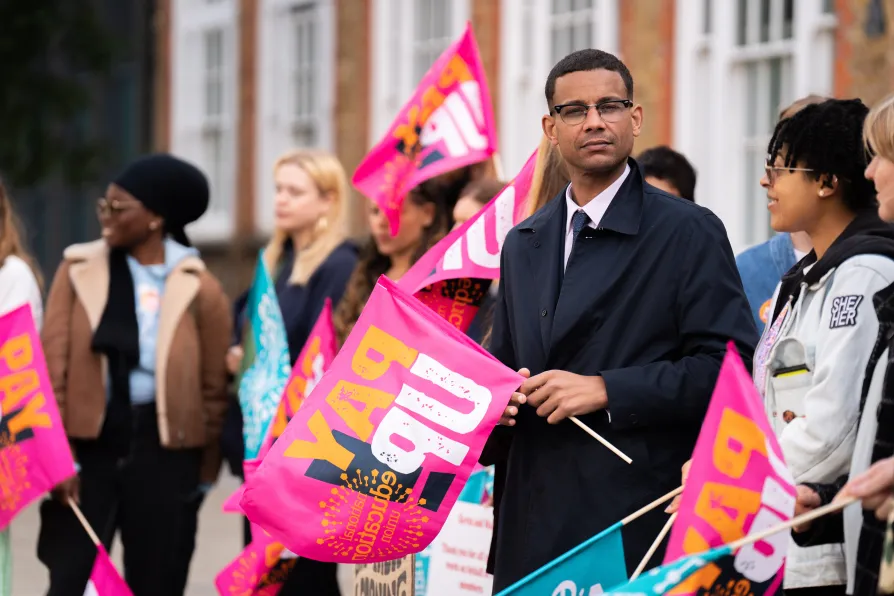 Daniel Kebede, the General Secretary of the National Education Union (NEU), joins a picket line at Regent High School in north west London, July 5, 2023

DR STEPHEN WILKINSON assesses the life and legacy of a revolutionary giant
On the centenary of Fidel Castro’s birth, Communist Party international secretary KEVAN NELSON salutes the ongoing example of a revolutionary people facing a brutal US siege
ALEX GORDON and LORRAINE DOUGLAS report from Havana, Cuba, where they represented the Communist Party of Britain at the 24th International Meeting of Communist and Workers’ Parties on August 7-8
The best tribute to Fidel is to stand with the Cuban Revolution today as the Trump regime tries to starve it to death, argues Cuba Solidarity Campaign communications manager NATASHA HICKMAN
JOE DWYER of Sinn Fein reflects on the links between the Irish and Cuban struggles for independence and on Castro’s personal engagement with the cause of Irish freedom





AHEAD of our special conference on Saturday, I believe it is important to set out my position clearly and carefully, so that members understand the context in which we are operating and there is no ambiguity about what is, and what is not, being debated.
Let me be absolutely clear from the outset: we should never advocate for leaving the TUC, and that is not the question before conference. Nor is this a debate about whether trade unions should work together. Of course we should. Unity matters, and it always will.
What is under discussion is how that unity is made real in the world of work as it exists today — and whether existing arrangements enable us to organise effectively, defend our members, and build power for working people in schools.
As someone whose first experience in education was as a member of school support staff, supporting children with Send (special educational needs) before becoming a teacher, I know first‑hand the historic divisions that have existed between teachers and support staff. But I also know how much that reality has changed.
Funding pressures, workforce shortages and academisation have reshaped our schools. Teachers and support staff now work ever more closely together, with classroom, pastoral and Send responsibilities increasingly shared rather than separated.
The world of work has changed rapidly, and nowhere is this more evident than in education. Academisation and privatisation mean that the majority of schools are no longer under local authority control. The structures that once governed employment relations no longer reflect the lived reality of staff working in schools today.
That is why, as a union, we welcome the establishment of the School Support Staff Negotiating Body (SSSNB). It re‑establishes a national, statutory voice for school support staff on pay, terms and conditions, and recognises the vital, skilled work they do in keeping our schools running.
But a serious question must be asked: what legitimacy can the SSSNB have when the NEU — the second largest union representing school support staff in England — is excluded from it?
This exclusion is not a decision of the Secretary of State, Bridget Phillipson. It is a decision taken by the NJC unions — GMB, Unite and Unison — who have chosen to deny the NEU an unmediated voice at the bargaining table. A position for which there is no moral justification.
When faced with difficult questions, there is a temptation to retreat into what feels familiar: to frame this as an argument about institutional boundaries, about who sits where, who speaks for whom, and who has the right to do what.
But that approach will not deliver for support staff, most of whom are not in a trade union at all, and it will not build power for education workers more broadly.
At the centre of Saturday’s debate is the 2017 TUC agreement governing the NEU’s relationship to school support staff.
That agreement is no longer fit for purpose. It explicitly states that the NEU “should undertake no action that could be regarded as organising activity on behalf of school support staff.”
Had we abided by that agreement we would not have been able to save jobs at Arthur Terry Learning Partnership, we would not have secured years of back pay for support staff at Cathedral Schools Trust, we would not have been successful in many other disputes where have secured jobs and better working conditions for members.
This agreement restricts the NEU from being the union we are — and the union our members need us to be.
As general secretary, I have consistently sought a negotiated resolution to this situation. The NEU has put forward serious, constructive proposals: joint membership arrangements for support staff; pro‑rata distribution of subscriptions to NJC unions; and other models for joint working. Three of the four unions involved — NEU, Unite and Unison – reached agreement on joint working principles. Those principles were ultimately not agreed by GMB, who insist that the outdated 2017 agreement must remain unchanged.
The choice before our special conference is therefore not between open organising and some new, viable framework for joint working. It is a choice between open, active organising and recruitment — or remaining bound by an agreement that no longer reflects the reality of education today.
This is not a question of whether we value unity — we do and always will. The question is how that unity is made real in the schools of today, not the schools of decades past.
If the trade union movement cannot respond to the realities facing workers now, in education and beyond, then it risks becoming something our children encounter only in textbooks.
But if we are prepared to rethink how we work together, to move beyond competitive trade unionism and towards practical, collective solutions, then that will strengthen our movement and deliver real gains for workers everywhere.
What must guide us in all of this is a simple principle: we must centre workers. In our case, that means a low‑paid, predominantly female section of the education workforce — school support staff — who deserve effective representation, a strong voice, and trade unions that are prepared to work together and stand up for them.
That is the context in which Saturday’s debate takes place, and it is in that spirit that I am setting out my position clearly and honestly.
