The 25th anniversary meeting of the Shanghai Co-operation Organisation in the Kyrgyz capital may offer a glimmer of hope that international relations do not need to be defined by endless confrontation, writes KENNY COYLE


 Latest editorial

Building class unity: trial and error in China’s communist revolution
In Part 4 of her look at the Chinese revolution JENNY CLEGG addresses the relationship between the Peasant Movement and the National Movement
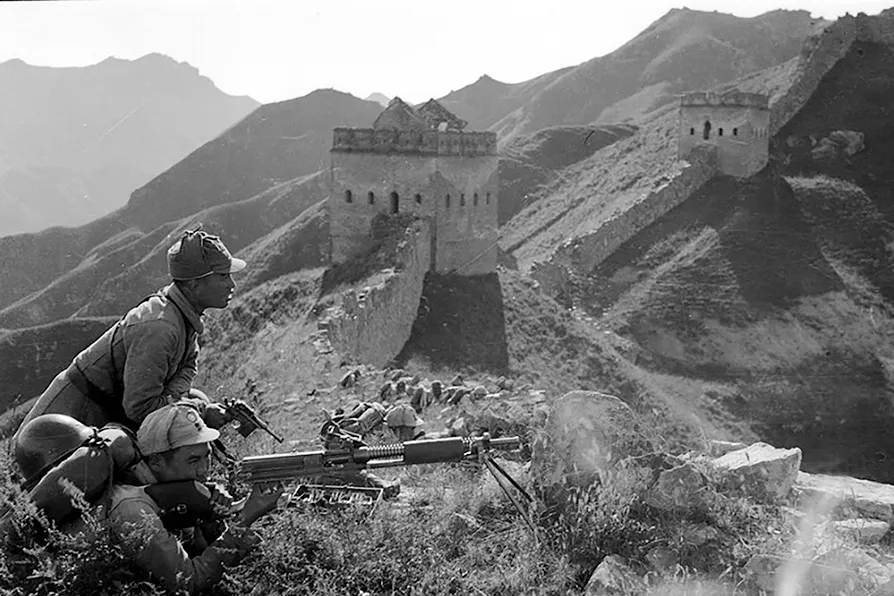 DEFEATING JAPAN IS A PRIORITY: Eighth Route Army fighting on Futuyu Great Wall in Laiyuan, Hebei, China, 1938 / Pic: Sha Fei/CC
The artist, who has just died, is embedded in the subconscious of the Palestinian people
The five young men killed in the A66 crash were responsible for a devastating tragedy — but the crash should force us to ask difficult questions about wider society, argues RENATA MEDEIROS MIRRA
The unwillingness of the British political elite to acknowledge that we are on the edge of a direct conflict with Russia leaves the peace movement with an urgent and onerous task
Committee for the Defence of the Iranian People’s Rights general secretary GAWAIN LITTLE discusses the impact of the US-Israeli war on the Iranian people and economy
Capitalism has extracted itself from crisis before, argues PRABHAT PATNAIK – but through methods no longer available. So it is turning to authoritarianism, militarism and neocolonialism





PREOCCUPIED with the Stalin-Trotsky controversy over the KMT-CPC United Front and the role of the national bourgeoisie, Western Marxists have rather neglected consideration of the peasants.
In this, the real reason for the CPC’s success has been obscured, namely its ability to bridge the contradictions between town and countryside by grasping the dynamics of class interactions between the national and peasant movements.
Stalin, advocating the United Front, considered the national bourgeoisie to constitute a revolutionary force against imperialism; Trotsky claimed they were essentially agents of foreign capital. However, as Mao saw it, they in fact vacillated between the two positions — anti-imperialist but also liable to capitulation to reaction.
Imperialist subordination of China produced a pattern of twisted growth, with a weak and dependent national capitalist class. Reliant on loans from foreign banks, Chinese businesses at the same time not only lacked the capacity to compete in international markets but also faced restricted growth in domestic markets given the increasing impoverishment of the peasants.
Urban businesses then had an interest in land reform to expand internal demand and to secure the supply of raw materials. However, these domestic capitalists lack the strength to pursue reforms necessary for their own advancement, nor was there a basis for a rural reform alliance given the rich peasants remained partially rooted in feudal exploitation.
Meanwhile supply lines to the towns and cities were vulnerable as the rural masses on the margins of subsistence would frequently “block the roads” against the transport of grain from the villages.
For the modern urban reformers, such behaviours were down to peasant “backwardness.” Worse yet, in a rural upsurge, peasants would go to extremes, confiscating all private property — “gathering all oxen, manure, ploughs and pigs for public use.”
This caused the national bourgeoisie, many of whom retained feudal properties alongside their urban businesses, to take fright. The 1927 revolution fell apart because the nationalist and peasant movements pulled in different directions.
While the vacillations of the national bourgeoisie were in part influenced by the imperialists’ strategies of aggression or co-option, peasant behaviours also had their effect.
The persistence of peasant traditions was a condition of China’s stagnation under feudalism. Mao’s understanding of this was key in finding ways to resolve the contradictions between the two parts of the revolution.
Critical of attitudes of urban disdain within the party which blamed peasant backwardness for the difficulties of rural work, Mao appreciated peasant protectionism as not so much an anti-urban retreat into rural isolation but rather a reaction against the parasitic drain of the towns on the countryside.
At the same time, he rejected “absolute egalitarianism” which drove not only the national bourgeoise but also the intermediate class of rich and well to do middle peasants to the side of the landlords and the big bourgeoisie.
While the peasants had their own beliefs and methods of protest, town and countryside were not entirely separate worlds: what complicated matters was that differing approaches in land policy impacted on the different sections of the peasants in different ways.
Mao was to identify the problems as lying in mistaken policies of the party in the shifting context of the national situation: the tendency towards Rightism — giving too much leeway to capitalist interests — when in alliance with the national bourgeoisie, and the tendency towards Leftism — directing the struggle against capitalism as well as feudalism and imperialism — when relations broke down.
In their in-depth village studies of land reform in 1946/7, the Crooks and William Hinton were to reveal the ways in which these errors were reproduced in the party’s rural work.
Under the United Front, the CPC had moderated land policies to consolidate a broad class unity against Japanese aggression. This had given rise to a Rightist “middle peasant line” emphasising improvements in market conditions for the better-off surplus-producing households only to cause frustration amongst those too poor to take advantage of these limited reforms. This set the stage for a peasant backlash once the United Front broke down.
As CPC policy returned to radical land confiscations to completely eradicate feudal property, a peasant upsurge saw attacks on other forms of wealth — acts of extremism compounded by a Leftist egalitarian “poor peasant line” pursued under the slogan “to each man, land, a house and a horse” which extended confiscation to wealthier middle peasants to benefit the poor.
To correct Rightist errors, the CPC sought to mobilise the poor together with the middle peasants from the start while Leftist errors were to be contained by including middle peasants in the process of land confiscation and redistribution.
Rather than completely equalising households, CPC reforms were to result in an uneven distribution in landholdings, providing a certain minimum subsistence guarantee for poor peasants while also lifting middle peasants from the margins of subsistence to producing a surplus even though they received less land than the poor.
Eradicating the feudal land monopoly, CPC village programmes transformed the use of surplus from land speculation and extravagance towards productive investment.
Catering to both poor and middle peasant interests, while encouraging the rich peasants to invest in production, separating them from the landlords, the CPC set out a new basis for town and countryside exchange.
Reforms unleashed production by the rich and better-off middle peasants, however this was done without benefiting capitalism more than was necessary. Poor peasants were kept engaged in rural economic development, united with middle peasant in mutual aid teams sharing labour and tools.
This unity of the majority ensured peasant leadership over the direction of rural transformation avoiding the dangers of elite revival, the downfall of previous rural rebellions.
The policies of the nationalist reformers based on urban business interests had proven inadequate in meeting the subsistence needs of the impoverished rural population. Efforts to boost surplus-producing households to supply industry only exacerbated contradictions among the peasants playing into the hands of the traditional rural elites.
Unable to establish stability in the countryside, the national bourgeoisie vacillated between reform to open up the domestic market and reliance on local landlords to maintain social order in the villages in the face of their failures.
It was only the CPC that, acting in the interests of the working class in mobilising the poor peasants, was able to bring the national and agrarian movements together.
Key here was the recognition of how different urban classes, favouring different land reform policies and approaches, exerted an influence of peasant consciousness and behaviour and vice versa.
As the CPC plotted out a sequenced approach, taking down adversaries one by one while at each stage preparing the ground for the next, it co-ordinated the two movements together.
Moderating land reform policies in the face of Japan’s expanded aggression so as to encourage landlords to support the war economy, it kept the poor and middle peasants mobilised together to prepare for the elimination of landlordism once Japan had been defeated.
Through measures addressing their needs for survival at least in part, while offering further hope for the future, the CPC was able to influence the poor peasants, containing rural extremes in the anti-feudal struggle. In this way, and by further ensuring the flow of supplies to the towns and cities, the CPC gained the confidence of the national bourgeoisie, containing their vacillations.
Mobilising the broad peasant classes united with the working class in alliance with the national bourgeoisie, the CPC came to lead a force capable of defeating both imperialism and feudalism, bringing the revolution to victory.
Opening up new forms of interchange between the cities and the countryside, the revolution was to realise its overall democratic goals of independence, unlocking new directions for development to pave the way for a socialist future.
Join Jenny Clegg and a range of experts for the book launch of Storming the Heavens at the Marx Memorial Library and online on Saturday February 14, 3-5pm; register at tinyurl.com/StormingHeavens.
Storming the Heavens is available from the Morning Star’s online shop.

Similar stories

Nature as well as society works dialectically, asserts the Marx Memorial Library and Workers’ School

BEN CHACKO welcomes a masterful analysis that puts class struggle back at the heart of our understanding of China’s revolution
In part II of a serialisation of his new book, JOHN McINALLY explores how witch-hunting drives took hold in the Civil Service as the cold war emerged in the wake of WWII

STEPHEN BELL reports from a delegation that traced the steps of China’s socialist revolution from its first modest meetings to the Red Army’s epic 9,000km battle to create the modern nation that today defies every capitalist assumption