A California union’s decision to host a meeting about US policy towards Cuba has prompted a congressional probe and renewed attacks on international solidarity, writes CAMERON HARRISON



Mediterranean dockworkers mobilise across 21 ports in unprecedented anti-war strike
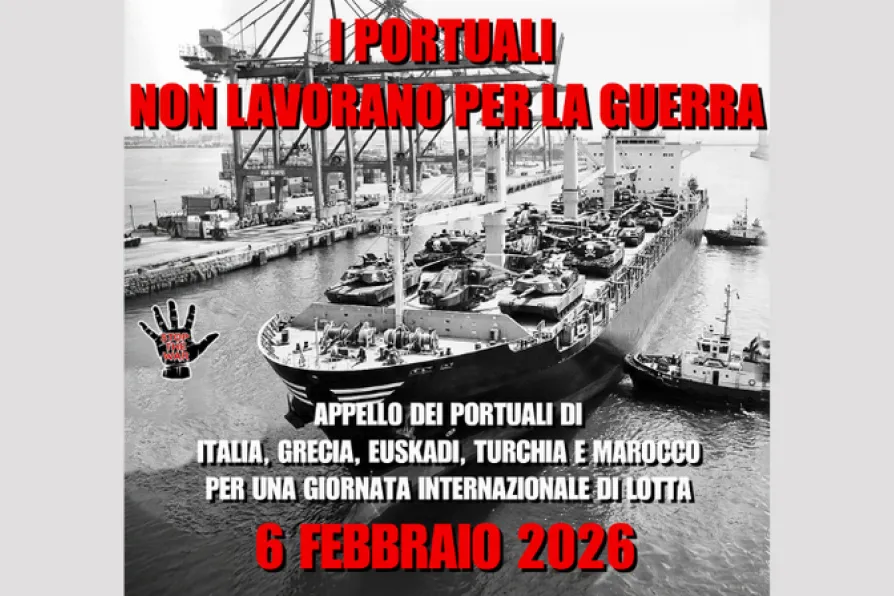
Dockers from Italy, Greece and beyond will stage co-ordinated port blockades on February 6, declaring ‘we don’t work for war’ – in a call in solidarity with Palestine. ALFIO BERNABEI reports

The Baltic state is set to reverse its constitutional prohibition on nuclear weapons and foreign bases as part of accelerated Nato war preparations, warns TOM UNTERRAINER
Long-term underfunding and state neglect, while simultaneously probation services have been undermined, have intensified the prison crises, argues SOLOMON HUGHES
Holyrood incompetence has cost jobs and put the future of Clydeside’s Ferguson Marine shipyard into jeopardy. Its future should have been assured, argues KENNY MACASKILL
With the agitated debate now raging in the media about the early release schemes, Prison Officers Association general secretary STEVE GILLAN gives the view of those who work in the sector
The hounding of the late Jason Arday is an all too familiar experience for many black people. ROGER McKENZIE calls for collective action to combat what can feel like personal isolation





DOCKWORKERS in 21 ports throughout the Mediterranean will mobilise for an international demonstration on February 6 to protest against rearmament and in solidarity with Palestine.
The joint day of action, described as unprecedented in its scope and broadness, was confirmed after a meeting at the Genoa headquarters of the grassroots union USB, (Unione Sindacale di Base) which helped bring about the anti-war general strikes and demonstrations in Italy last year.
On that occasion the USB’s political demands were stated in a declaration issued on September 26 headed: “Dockworkers Don’t Work for War.”
They included to “end the genocide of the Palestinian people by Israel, openly supported by its allies, the USA, Nato and the EU; to open stable humanitarian aid corridors; to reject the EU rearmament plan; and to claim European and Mediterranean ports as ports of peace.”
In this latest announcement headed “Dockworkers don’t work for wars,” the USB states: “The workers’ struggle against war and arms trafficking will resume on February 6. At least 21 ports across the Mediterranean will mobilise for the international strike, with more to come.
“Some of the major Mediterranean ports, such as Piraeus, Bilbao, Tangier and Antalya, will participate. In Italy, the ports of Genoa, Trieste, Livorno, Ancona, Civitavecchia, Ravenna, Salerno, Bari, Crotone and Palermo have joined to date, but others are still coming forward.”
The statement continues: “Never more than at this moment, when governments are guided by the doctrine of aggression, exploitation and theft of labour, exploitation of the environment and of natural resources, have workers so strongly positioned themselves as a force that rejects war as the only option: they do so within the framework of building an increasingly broad and courageous network of international solidarity.
“February 6 will not be the end point, but another step in an increasingly widespread and connected struggle among workers around the world to stop wars and give us all a future.”
In Genoa, the strike will begin with a picket line at 6.30pm at the San Benigno crossing, which is open to the public. The Turkish and Greek ports will begin “one hour later” due to time differences. The other ports, however, will hold “port blockades and demonstrations from 6pm onward,” at the same time.
Jose Nivoi, a USB representative, said: “The mobilisation, led primarily by Italian and Greek dockworkers, is also a test for those who have chosen not to officially join at this time, despite having participated in the organising process and sharing its momentum, like the French. An international strike like this has never been held before. It’s the first time that dockworkers act on demands which are not just strictly labour-related, but also ethical and political. The purpose of the blockades is to impact port operations to make it clear that workers will not be complicit in the war economy.”
Carlo Tombola, president of the Observatory on Weapons in European and Mediterranean ports, (The Weapon Watch), said: “When we began to address the arms supply chain with CALP (the Genoa-based dockworkers’ collective) what became clear was the disproportion between the international war supply chain and the union struggles divided among individual ports. What was missing was the counterpart we are seeing today, worthy of this international dimension.”
For Tombola, maintaining this co-ordination isn’t just a matter of strikes, but also serves to “reveal military logistics chains” and demonstrate “where we’ve come. The message must be conveyed that war affects everyone’s interests, except those who profit from it.”
Francesco Staccioli, of the Italian Socialist Party, drew attention to “a single mechanism” in which “war and exploitation” intertwine: “War is the other side of the coin of the exploitation of workers and resources.”
He extended the front beyond ports and called the railways into question: he spoke of “trains loaded with weapons,” which should be “blocked like ships.”
