ROB WARZYNIAK wades knee deep through a pile of ‘dead canaries’ of Trumpist policies which exacerbated the horrors of US capitalism domestically


 Latest editorial

Iran: Caught Between Popular Protest and Foreign Threat
While Iranians take to the streets en masse to protest sky-high inflation, Trump and Netanyahu are threatening military intervention. The Iranian population is trapped between a repressive regime, a suffocating economic war from the outside, and a history of dark alliances, argues MARC VANDEPITTE
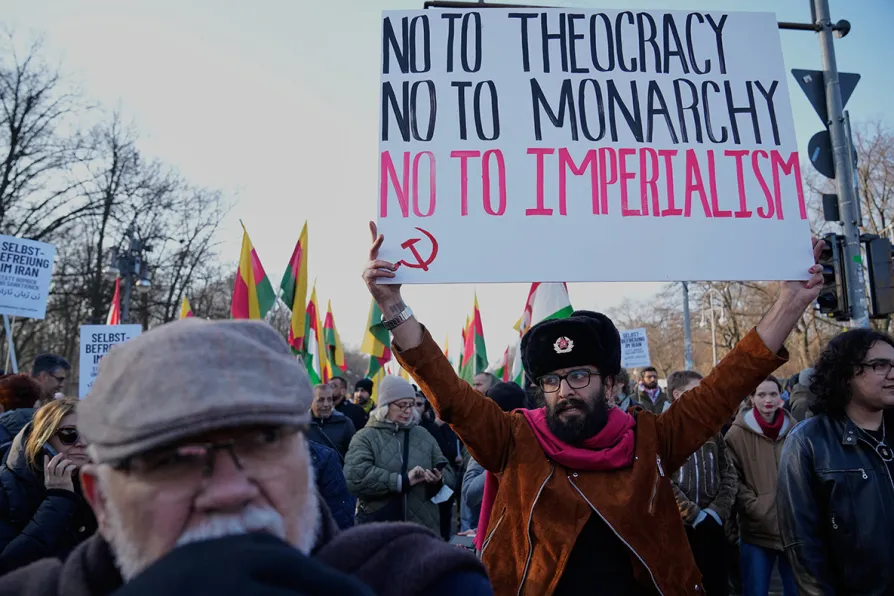 Protesters participate in a demonstration in support of the nationwide mass protests in Iran against the government, in Berlin, Germany, January 18, 2026
Without evidence or Nato consultations Berlin’s answer to the Leipzig incident is a rupture of relations. SEVIM DAGDELEN examines why
FRANCISCO DOMINGUEZ introduces the background to a conference on defending Latin America’s sovereignty
The glacier collapse in Nepal is yet another warning that a warming planet is making Himalayan disasters more frequent and destructive – but the countries facing the greatest risks are often those least responsible, says LI YANG
Nick Blair is set to benefit from a hugely lucrative contract to ‘virtually’ train the British army for its next war. Like father, like son, writes SOLOMON HUGHES
Even when tragedy strikes, Western media cannot resist the opportunity to turn it into a sordid propaganda opportunity, as the Nepal-China border tragedy shows, writes CARLOS MARTINEZ
Trade unions should be at the heart of the anti-racist push for reparations for the historic legacy and continuing impact of slavery, writes ROGER McKENZIE





THE protests in Iran are rooted in deep economic misery. The national currency, the rial, has completely collapsed and is now at a historic low of more than 1.3 million against the dollar. For the ordinary Iranian, this means that basic necessities such as food and medicine have become almost unaffordable.
In cities such as Tehran, Mashhad, and Isfahan, demonstrators are demanding direct action. What began in the bazaars as a protest against price increases has grown into a nationwide movement against failing policy. The price of food has risen by 70 percent over the past year, pushing more and more families deep below the poverty line.
President Pezeshkian acknowledges the economic malaise and states that peaceful protest is constitutionally protected. He promises reforms to the monetary and banking systems to protect purchasing power and has asked the authorities to show the greatest restraint toward demonstrators.
At the same time, the state has largely shut down the internet and mobile networks to hinder the organisation of protests. This digital blackout makes it very difficult for the outside world to follow the situation closely.
In any case, events are turning violent. According to AP News, since the start of the protests, at least 544 people have already been killed, including dozens of members of the security services. A mosque in Tehran was set on fire. The gap between the government and the street seems wider than ever.
Roots of political Islamism
In Iran, religious leaders hold sway. This has deep historical roots. In 1979, the revolution was led by religious figures, which is not surprising. Under the Shah, political parties, trade unions, and left-wing or liberal opposition groups were harshly repressed; arrests, censorship, and infiltration made durable organising almost impossible.
The mosques and the networks surrounding clerics were relatively “sheltered” because they served religious and social functions that the regime could not simply ban without a major societal backlash.
Moreover, clerics had a ready-made organisational apparatus (sermons, religious holidays, charity, local networks) through which they could spread messages quickly and mobilise people. As a result, the mosque became not only a place of faith but also one of the few remaining spaces where the opposition could gather, co-ordinate, and build legitimacy.
But we must look further back than the revolution of 1979. Iran expert Hamed Pasandideh points out that the rise of political Islamism in the region was no coincidence. Western colonial powers, and especially Great Britain, saw it as an opportunity to increase their influence.
As early as the 19th century, prominent Islamic leaders such as Al-Afghani sought support in London for a pan-Islamic alliance. The common goal was to curb Russia’s influence in Central Asia.
In other words, the West had no problem with religious groups as long as they served as a buffer against their own enemies. The current theocracy has deeper colonial roots than many people think.
Economic sanctions and military threat
It is impossible to see this crisis in isolation from international geopolitics. Since the US, under Donald Trump, unilaterally withdrew from the nuclear deal, Washington has pursued a policy of “maximum pressure” on Iran. These unilateral sanctions not only block the export of oil but also prevent the import of essential goods such as life-saving medicines.
The European Union, in turn, has also issued sanctions against Iran. The Iranian government rightly calls these sanctions a “crime against humanity” because they destroy the daily lives of millions of innocent citizens.
The economic stranglehold of these sanctions causes the inflation and scarcity that are now driving Iranians into the streets. It is a cynical form of economic warfare.
President Trump added fuel to the fire at the start of the protests. He declared on social media that the US is “ready” to “come to the rescue” of the Iranians and threatened hard military blows if the violence continues. Senators such as Lindsey Graham go one step further, openly calling for the liquidation of Iranian leaders. According to the Belgian-Iranian political scientist Elly Mansoury, the US and Israel are trying to take complete control of the region through military escalation.
This warlike language undermines the legitimate demands of the demonstrators. It gives the government in Tehran the opportunity to portray every protest as a plot by foreign powers – or, as Supreme Leader Khamenei said in Friday prayers, as the work of “mercenaries.”
He claims they are destroying the streets to please the US president. The Iranian government also points to the role of the Israeli intelligence service, Mossad, and the exiled crown prince, Reza Pahlavi, who calls for resistance from the US.
There are indeed reports of armed groups committing violence. This is also evident from the fact that more than 40 members of the security services have been killed. However, progressive organisations such as the human rights organisation Codir indicate that the discontent is real and widely supported.
A large part of the population is fed up with corruption and repressive policies. They want change that truly benefits them – which is to say, not a new puppet of Washington or a return to the monarchy of the shah.
Strange alliances
The principle that “the enemy of my enemy is my friend” runs like a red thread through Iranian history. In 1953, the religious elite helped overthrow the democratic prime minister Mosaddegh, who wanted to nationalise oil. The clergy and Western intelligence services found common ground in their shared dislike of left-wing nationalism.
Also, during the bloody war with Iraq in the 1980s, the enmity with the West turned out to be less absolute than the slogans suggested. Behind the scenes, Khomeini’s regime bought weapons via Israel and the US. That war served the interests of Western powers perfectly: two strong Muslim countries completely exhausted each other for years.
Although Iran shouts “Death to America,” internally it follows an economic policy that looks suspiciously similar to that of the West. Since the 1990s, Tehran has pursued an aggressive neoliberal course. State-owned companies were privatised, making a small elite of clerics and military men fabulously rich, while social security was dismantled.
Both the so-called “reformers” and the hardliners adhere to the principles of the free market. While economic sanctions weigh very heavily, the current economic malaise is not only the result of sanctions but also of the government’s own choices. The dollarisation of the economy and the lack of job security are the bitter fruits of a system that protects the rich and ignores the poor.
Necessity of radical change
Iran finds itself at a crossroads. In the past, the country has been an important support for the Palestinian resistance and the resistance against the “Greater Israel” project. However, entering into and winning an external conflict is impossible if you simultaneously strangle your own population economically and violently impose a strict traditional lifestyle upon them.
The legitimacy of the government will continue to crumble as long as a neoliberal course disrupts society and clerical patronising and repression continue.
Hamed Pasandideh argues that Iran can only stand firm against the imperialism of Israel and the US if it breaks with its own corrupt system. There is a need for an economy based on justice and human needs, not on privatisations. The conservative straitjacket must also be discarded.
Without the support of an empowered and prosperous people, the resistance against the US and Israel remains an empty shell.
What next?
In the past, there have been several major waves of protest in Iran. They have never succeeded in turning the tide. The main reason for this is a divided and poorly organised opposition. The organisation is horizontal and decentralised, building on small social media networks. The demonstrators have no real figurehead who can stand against the current rulers.
Today, foreign interference adds to the complexity. As indicated above, the threat of war from the US and Israel undermines the credibility of the opposition.
There is, therefore, a real chance that the current protests will die out, as previous waves did. It is, however, noticeable that the waves of protest are occurring more frequently, their resonance is growing, and the level of violence continues to increase.
In the long term, this is unsustainable for the Iranian government. Removing the religious leadership, as now demanded by the demonstrators, can be a step in the right direction, but it is certainly not sufficient. Beyond ending religious patronising, an answer must be found for social dismantling, and more democratic space must be created.
Then there is the risk of war. With the threat of a military attack from Israel and the US, there is – once again – a chance of a large-scale conflict in the region. Iran has stated that it will bombard Israel with missiles if it is attacked. In June 2025, it demonstrated that it is capable of striking the heart of Israel.
Real solidarity with the Iranian population means supporting their struggle for bread and democracy, while simultaneously strongly opposing every form of foreign military intervention. The sovereignty of Iran must be respected. The fate of the country belongs to the people in the streets, not to the strategists in the White House.
In that context, European and American sanctions against the country must also be viewed critically. Besides necessary internal reforms, lifting those sanctions would be the most effective way to directly relieve the pressure on the population.
One thing is certain: the Iranian population still faces a difficult period.
