


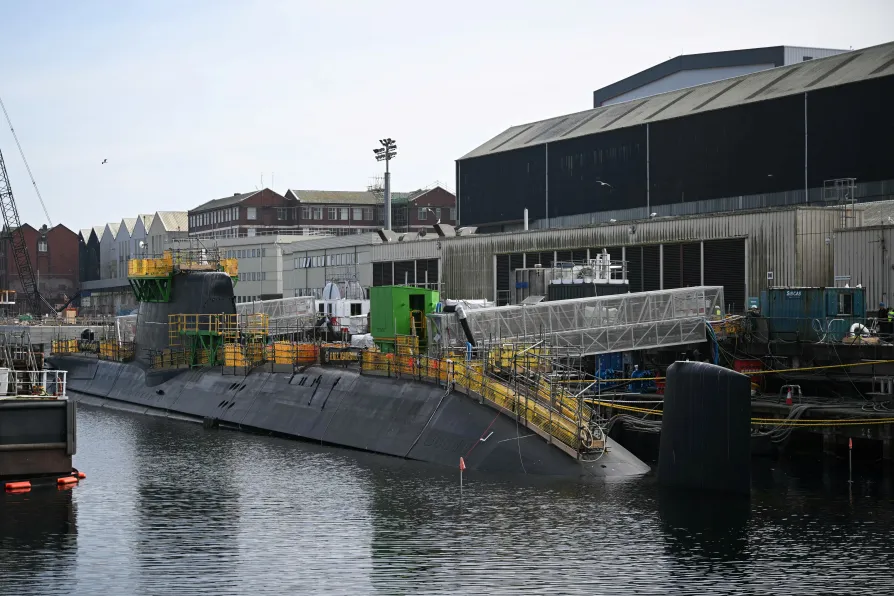
 HMS Agamemnon nuclear submarine at the BAE system factory, Barrow-in-Furness, Cumbria, north west England, March 20 2025





SCRATCH a liberal and find an imperialist. After decades in which the Liberal Democrat Party — and before that the Liberal Party — was as happily wedded to Britain’s so-called “independent” nuclear deterrent as was, and is, Labour.
Scratch a British imperialist and you find a US poodle. Britain’s nuclear strike force of now ageing submarines carries nuclear missiles that are built and serviced in the US and subject to a communications and launch regime effectively under the control of Washington.
The purpose of Ed Davey’s underwater version of the British gunboat up the Yangtze is to modify Britain’s active but subordinate position in a now eroding US hegemony with a notionally independent strike force.
Why? We can mark the point at which the ability of the British ruling class to take decisions substantially different from the US (and in the projection of a British imperial interest distinct from that of the US) as either the 1956 US interdiction to the French, Israeli, British Suez adventure or the 1953 US takeover of the project to derail Iran’s independence-minded Mossadegh. Or both.
The limits of US hegemonic power are now daily demonstrated by the Iranian missiles reaching Israel’s cities as much as by the deepening US budget crisis. The wild behaviour of the Trump administration signifies the deep erosion of the advantages the dollar enjoyed as the medium in which global oil transactions were conducted. The quiet power that this entailed was always — as necessity commanded — buttressed by direct military intervention or organised subversion but this combination is no longer guaranteed to work its magic.
It has escaped no-one’s attention — especially in the global South — that both Iran and Venezuela are oil-producing countries. That the US is forced into extreme measures to keep its end up is a sign not of unchallenged power but its opposite.
When Davey told the BBC: “When we’ve got presidents in the White House like Donald Trump, totally unreliable, I don’t think we can have our nuclear deterrent dependent on the mood at breakfast of the person in the Oval Office,” he is not so much striking a blow for the defence of our homeland but rather for the more direct projection of British imperialist power abroad.
The labour movement should be wary of falling in behind such liberal opportunism. The main interest of the British people does not lie in finding a new accommodation with Donald Trump or any of his likely successors as does Keir Starmer seem to lean towards. Nor does it lie with that unprincipled alliance of selected European Union states — also favoured by the British Prime Minister — that want to intensify and internationalise the conflict in Ukraine.
Davey wants to spend the money to replace Trident in the next decades: “here in the UK, not in the US.”
Starmer and his War Minister John Healey are in lockstep with Germany’s Chancellor Friedrich Merz in demanding an increase in “defence” spending to facilitate the confrontation with Russia. Trade unionists in the military production sector should bear in mind that securing the relative stability of their vastly unproductive jobs will come at the runaway insecurity of their families. Merz is at least straightforward in saying quite explicitly that Germany cannot afford both increased military spending and the welfare state.
If this is true of the relatively productive manufacturing economy of Germany, consider how much more devastating to the remnants of our privatised and underfunded welfare state will be untrammelled war spending.The territorial defence of our country is not the same as the global projection of the imperial power of big business and the City.
