Green Party deputy leader MOTHIN ALI, who will speak at the International Anti-War Conference in London on June 20, says Britain needs to rethink its priorities – and its allies


 Latest editorial
What relevance does Engels’ Socialism, Utopian & Scientific have to revolutionary theory and practice today?
Engels’ call for a structured, systematic, critique of capitalism and for a strategy for securing something better remains as relevant today as it did a century and a half ago, declares the Marx Memorial Library and Workers’ School
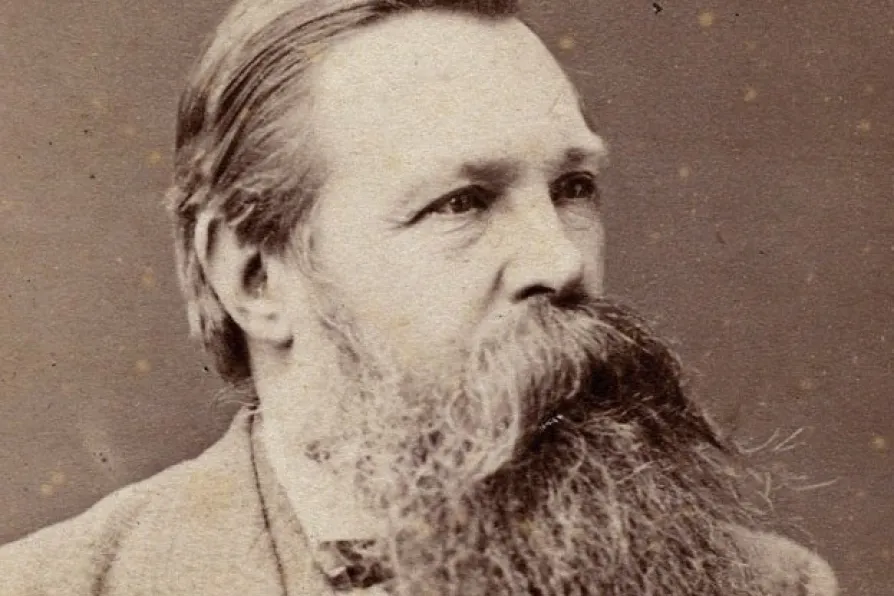 INSIGHTS: Engels pictured in 1877

From Global Counsel to Arden, SOLOMON HUGHES finds firms linked to discredited politicians are still calling the shots in Britain
KEVIN COURTNEY explains why Reform UK is no friend to workers or trade unions, but just another party of the super-rich
EMMA DENT COAD explains why she is stepping down from the council after 20 years and how the legacy of the fire still haunts the area
While international attention focuses on ceasefire frameworks, Israel is openly advancing plans for a permanent expansion of its control over Gaza, writes RAMZY BAROUD
Researchers PAUL HOLDEN and JESSICA MURRAY are calling for whistleblowers and documentary records to uncover how Labour Together helped build the parliamentary majority that now dominates the Labour Party





ENGELS’ Socialism: Utopian and Scientific is a condensed and accessible account of the historical development of socialism.
It outlines the essentials of Marxist historical materialism, political economy and philosophy in order to distinguish ‘scientific socialism’ (Marxism) from earlier “utopian socialism.”
Socialism: Utopian and Scientific (SUS) was first published as pamphlet in French in 1880 based on translations by Paul Lafargue (Karl Marx’s son-in-law) of chapters of Engels’ larger work Herr Eugen Duhring’s Revolution in Science (more usually known as Anti-Duhring) published in German in 1878.
It was written to challenge idealistic and perfectionist socialists who, in Engels’ words, “do not claim to emancipate a particular class to begin with, but all humanity at once” and who saw socialism as “the expression of absolute truth, reason and justice, [which] has only to be discovered to conquer the entire world by virtue of its own power.”
Following the French version’s success, a German edition Die Entwicklung des Sozialismus von der Utopie zur Wissenschaft — literally “the development of socialism from utopia to science” was published in 1883, followed by a series of eight editions in other languages and eventually an English edition in 1892.
SUS effectively doubles as a condensed and accessible introduction to the whole of Marx and Engels writings. As published SUS has three sections: on utopian socialism, on dialectics, and on historical materialism.
Part I. The Development of Utopian Socialism includes an account of socialist thought from early socialists including Henri de Saint-Simon, Charles Fourier and Robert Owen — all idealists who imagined perfect societies based on reason, cooperation, and morality. Engels praises their humanitarian motives but points out that they failed to understand capitalism’s underlying material and economic foundations; they relied on appeals to people’s better natures rather than on an analysis of the economic forces driving history and the centrality of class struggle.
Part II. The Science of Dialectics incorporates elements of Engels’ ongoing work on dialectical materialism: that change is inherent in everything, that it is driven by internal contradictions and that their resolution leads to something qualitatively as well as quantitatively new. It includes two famous phrases; that “Nature is the proof of dialectics, and it must be said for modern science that it has furnished this proof with very rich materials increasingly daily” and that socialism is “no longer an accidental discovery of this or that ingenious brain, but the necessary outcome of the struggle between two historically developed classes — the proletariat and the bourgeoisie.”
Part III. Historical Materialism, outlines the basis of the Marxist conception of history — “historical materialism” — the understanding that the forces and relations of production (how people get their living and who controls this) ultimately underpin political systems, social institutions, and the dominant ideas of every society. Historical change is driven ultimately by struggles between opposing classes, oppressor and oppressed: within capitalism between the “bourgeoisie” and the “proletariat.” It includes a discussion of economic cycles, of the inherent wastefulness of capitalism, the nature of the state (and its “dying out” under socialism) and the need for revolution. Socialism, Engels argues, is ultimately, a necessary outcome of capitalist development. Capitalism, by creating large-scale industry and an industrial working class, involves contradictions and conflicts which lead to crises and ultimately to the conditions for its replacement by something better: the collective ownership of the means of production.
Most editions of SUS also include an introduction by Engels and that to the 1892 English edition includes an interesting account of the role of religion in the establishment of capitalism and the development of an English middle class. It includes, hopefully, that “in England too, the working-people have begun to move again.”
On its publication, SUS had a major impact in making Marxism accessible. It positioned socialism not just as a utopian dream or an arbitrary consequence of struggle, but as the logical and necessary outcome of history.
The distinction between “utopian” and “scientific” socialism was particularly resonant at a time of rapid scientific and technological change. It helped to unify the proliferating socialist and workers’ parties — including the German SDP — around a coherent core, distinct from anarchist, liberal and rival socialist currents. It acted as a call to action, not just analysis, to be led by a revolutionary and Marxist socialist party.
The principal relevance and value of SUS today is three-fold. In the first place, much socialism retains its “utopian” features — the (often implicit) assumption that once people see the potential benefits of socialism they would embrace its principles at least. SUS emphasises that capitalism is inherently exploitative/oppressive, that part of that oppression is itself ideological, preventing people from seeing how they are exploited, and that attempts to improve things would be — and have been throughout history — met resistance.
Secondly SUS remains today a readable and accessible introduction to, and overview of Marxism, linking dialectics to historical materialism and political economy. In doing this it also provides an historical perspective on the development of Marxism itself, showing it not as the product just of inspired insight or analysis but as the necessary outcome of the progression of socialist ideas.
Readers in England and Ireland will find the discussion of the ideas of Robert Owen (for example) particularly interesting. Owen is praised for his moral values, commitment and determination to put his ideas into practice (as in New Lanark) but more so for his transition from a philanthropist — “the most popular man in Europe” to a communist, “banished from official society” despite which, declared Engels, “Every social movement, every real advance in England on behalf of the workers links itself on to the name of Robert Owen.”
Finally, SUS emphasises that the term “scientific” socialism does not imply any similarities of Marxism to the natural sciences (something that is even more true today). Marx himself declared that he adopted the phrase “scientific socialism” “only in opposition to utopian socialism, which wants to attach the people to new illusions, instead of limiting its science to an understanding of social arrangements made by people” and Engels’ SUS provides the systematic argument for this position.
The term scientific (in the original German) refers to the entire research and analysis process, not the English translation that we today associate with a laboratory.
“Scientific socialism” is a translation from the German of “wissenschaftlich sozialismus.” “Wissenschaft” is a concept broader than “science,” incorporating research, theory, understanding and competence. That’s why you can have “Kunstwissenschaft” in German but not “scientific art” in English. So neither Marx nor Engels meant “scientific” in the narrow sense that it is often used today.
Unfortunately we don’t have an equivalent term to wissenschaftlich in English — so we’re probably stuck with it.
Engels’ call for the unity of theory and practice; for a structured, systematic, critique of capitalism and for a strategy for securing something better, remains as relevant today as it did then.
The Marx Memorial Library and Workers’ School website www.marx-memorial-library.org.uk has details of a rich ongoing programme of events and courses and Socialism, Utopian & Scientific is the focus of the next online “Introducing a Marxist Classic” discussion session on Tuesday March 17 at 7pm. The full text can be read on tinyurl.com/Socialism-Utopian-Scientific and tinyurl.com/SocialismUtopianScientificpdf takes you to a downloadable pdf.
