TUC president and POA leader STEVE GILLAN speaks to Ben Chacko on the eve of Congress 2026


 Latest editorial
The left must defend the right to protest against state clampdown on dissent
The tightening of protest rights reflects a broader shift toward repression in Britain’s strained liberal democracy. Socialists and trade unionists must be ready to resist further attacks on our freedoms, warns JOHN McINALLY
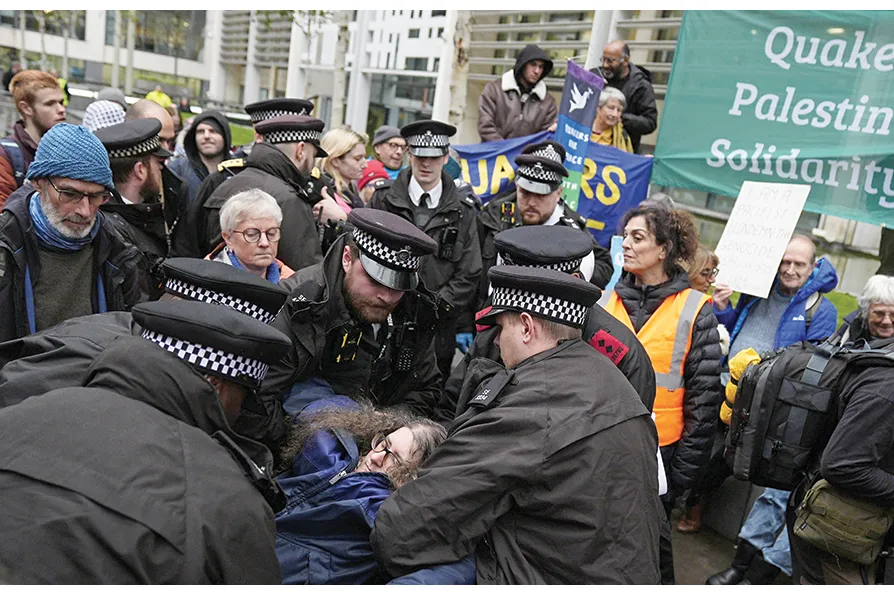 PROTEST UNDER THREAT: Police drag away a protester taking part in a Defend Our Juries demo in support of Palestine Action outside the Home Office last November

DOUG NICHOLLS welcomes a turning point at this year’s Congress, where many motions call for a co-ordinated plan to revive British industry, a perspective outlined in his new book
HOPE VIRGO of campaign Dump the Scales warns MPs voting today they should be alert to the threat legalised assisted death poses to people with eating disorders
The Together Alliance is hosting two summits, North and South, to build power and plan action against the scourge of racism peddled by the right. DANIEL KEBEDE urges mass participation
The drift toward militarisation in Europe is not inevitable, left-wing and peace movements can preserve sovereignty and prevent war, says DÁIRE HUGHES MP
Whatever differences exist among international sympathisers of the Bolivarian revolution about its current trajectory, they should unite against the imperialist power that is the source of an enforced retreat, argues ROGER D HARRIS
Trade unions need to step up and force a turn in the policies of the labour movement to effectively confront the far-right threat, argues NICK WRIGHT





IN A BARELY noticed announcement, the British Parliament human rights committee asks how can “we protect the right to protest while ensuring public safety, security and respect for the rights of others?” going on to say it has “launched an inquiry examining the rights to protest, the limits upon it and the impact of recent changes in the law.”
This does not happen in a vacuum. The right to protest is already being curtailed through recent legislation like the Police, Crime, Sentencing and Courts Act and the Public Order Act, which Starmer’s Labour government has promised to strengthen.
The state is also “creating facts on the ground” by curtailing march routes, based on politically motivated complaints over safety and offence, and only this week the annual Al-Quds Day/Jerusalem Day march has been cancelled. Al Quds Day is an international day in support of Palestine that is often celebrated on the last Friday of Ramadan. It was established in 1979 by Ayatollah Khomeini.
Organisers of the pro-Palestine marches are being dragged through the courts and Palestine Action protesters and Irish rappers Kneecap have been similarly targeted.
Beneath its democratic veneer, the highly centralised British state, with the backing of the media in particular, has never hesitated to impose the most repressive measures in times of international and domestic crisis — for example, in attempting to silence anti-genocide protests or through its extensive anti-trade union laws.
The current wave of repression is no passing or temporary phenomenon — it is now a permanent and defining feature and strategic imperative of the ruling class and its governments.
Since the election of Margaret Thatcher every government has pursued the same core policies: cuts, privatisation, austerity, support for US imperialism and repression.
Whoever you vote for, you get the same government.
Distrust and even downright hatred of the Establishment and the political class — the Westminster parasitic political class above all — have led to a catastrophic collapse in authority and legitimacy. The Epstein crisis has fuelled this process.
All liberal democracies are witnessing increased state repression.
Liberal democracy has been the Western capitalist countries’ most reliable form of governance and political control and authority, administratively cheap and based on commonly shared values: democracy, universal suffrage, free speech, freedom of assembly, right to dissent and protest and so on.
Liberal values were, and are, based on individual rights elevated above collective rights. Every time the working class, since its birth in the Industrial Revolution itself, fought for its rights — most importantly, the right to strike — the liberal state always asserted the individual right of private property over the collective rights and demands of the working class; often with bullets, truncheons and the full force of “democratic” law and legislation.
In this age of extended reaction, characteristic of capitalist degeneration, the hallowed “values” upon which liberal democracy drew its legitimacy are being systematically stripped away as the Starmers, Macrons and Merzs attempt to enforce compliance and silence in a desperate attempt to reassert authority and control.
None of democracies’ “freedoms” were won for the working class without struggle. They are now under increasing threat.
Socialists, communists and trade unionists must consciously and actively be the strongest opponents of liberal authoritarianism. They must be the most committed defenders of free speech, the rights to protest, free assembly and more: the right to proportional representation, local and devolved democracy and the right to national self-determination.
A failure to defend democracy from a class perspective will inevitably lead to the government and state extending anti-strike legislation, in the so-called “national interest,” in the event of public-sector strikes.
But the labour and trade union movement must look to itself too. The embrace of hyper-individual liberal identity politics across the movement which led to demands of “No Debate,” the silencing and even witch-hunting of mainly women socialists arguing for their sex-based rights has given a golden opportunity for the right wing to cynically position themselves as the true champions of free speech.
Claiming legitimately held opinions can make people “feel unsafe” — an idiocy blurted unthinkingly by some “socialists” — has been eagerly seized upon by those seeking to ban pro-Palestine marches and has, under the cover of “hate crime” legislation, as in Australia, allowed the state to arrest anti-genocide and anti-war demonstrators.
Labour MPs, with a few honourable exceptions, have supported or enabled genocide in Gaza and the unprovoked war on Iran, capitulating to yet more attacks on the right to protest won’t lose them a night’s sleep.
Every trade union and the TUC itself should mobilise in order to give evidence to the parliamentary human rights committee as a matter of priority — because we can be sure others will — in order to demand greater restrictions on the right to protest.
But the main mobilisation must be in building the anti-war movement in our unions, communities and on our streets.
John McInally’s book A State of Struggle, published by Manifesto Press (£25) discusses, among many other trade union issues, the question of repression and the unions in the liberal democracies.
