
The UK Prime Minister may have the regal touch in northern England, but he’s been wrong-footed on the constitutional challenges posed by the Celtic Alliance of first ministers from Scotland, Wales and Northern Ireland, argues KENNY MacASKILL

Mass mobilisation needed as far right surges across Britain
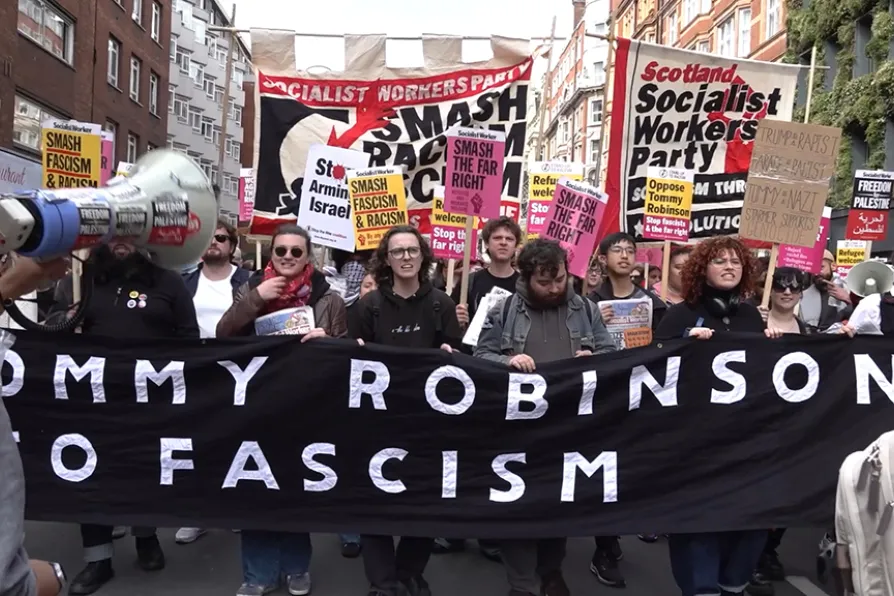
From the streets of London to towns across the country, far-right groups are growing stronger than ever. The newly launched Together alliance is calling on citizens, unions, and activists to unite on March 28 2026, to confront racism, defend communities, and reclaim Britain from extremist politics. SABBY DHALU calls on readers to be there

NEIRLAY ANDRADE, a member of the Communist Party of Venezuela’s political committee, outlines her party’s position on the crisis facing the country
A look at Taylor Wimpey’s accounts shows why Labour’s market-led housing strategy won’t deliver more, cheaper homes, as promised, says SOLOMON HUGHES
DAVID HORSLEY remembers the remarkable life and death of US black revolutionary George Jackson, whose politically passionate prison letters were published as Soledad Brother
Cuban trade union federation CTC leader OSNAY MIGUEL COLINA speaks to Ben Chacko about life and work under a crippling US siege
A part of the British empire’s network of slavery, today the Caribbean island of Nevis faces a new form of exploitation in the form of crypto-colonialism, CLAUDIA WEBBE writes
Challenges from the unscrupulous misuse of AI to steal actors’ voice and physical likenesses is being met with a firm union response, writes LYNDA ROOKE





BRITAIN has witnessed the re-emergence of a militant far-right street movement on an unprecedented scale.
This resurgence reached a peak in September, when “Tommy Robinson” led what became the largest far-right demonstration in British history under the slogan “Unite the Kingdom.”
Against this backdrop, the launch of Together — a campaign seeking to build the broadest possible alliance against the far right — and its announcement of a national demonstration on Saturday March 28 2026, are both timely and necessary in response to this historic threat.
Across the world, the far right has grown increasingly emboldened one year into Donald Trump’s second presidency.
Economic conditions in Britain mirror those fuelling far-right growth in the US and Europe: prolonged stagnation, rising inflation, and falling living standards.
For the first time in the post-war era, far-right parties are simultaneously leading opinion polls in Europe’s three largest economies: Germany, France, and Britain.
Trump’s return to power followed a period in which the Biden administration, much like Britain’s current Labour government, failed to deliver meaningful improvements in living standards and repeatedly conceded ground to the “Make America Great Again” (Maga) movement’s anti-immigration narrative.
This experience offers clear lessons for Labour: appeasing the far right does not weaken it — it strengthens it.
Today’s far-right mobilisations present challenges far greater than in previous periods. The 2008 global financial crisis marked the beginning of a sustained assault on working people.
Governments in the US and Europe responded by attacking living standards, diverting resources away from productive investment, and prioritising corporate profits. The result has been nearly two decades of stagnation.
In Britain, over £100 billion was borrowed to rescue the banking system, but the cost was imposed on society through deep cuts to welfare and public services.
While real wages rose steadily between 1970 and 2007, they have stagnated since. Workers today are no better off than they were two decades ago. According to the Institute for Fiscal Studies, the average worker was better off in 2007 than in 2022.
The economic outlook is therefore much worse than when the National Front was on the march in the 1970s.
This sustained erosion of living standards has been accompanied by an escalation of racism. Migrants, refugees and Muslims have been cynically blamed for political and economic decisions made by those in power.
A Labour government continuing along the same economic and political trajectory has created the conditions for the unprecedented growth of the far right.
The toxic racist campaign against people seeking asylum over the summer helped create the political climate that boosted turnout at the Unite the Kingdom demonstration. Despite claims of “local concern,” fascist organisations such as Homeland, Patriotic Alternative, and Ukip played central roles in organising often violent protests against hotels housing asylum-seekers.
These groups exploited individual cases of sexual violence to incite racism, fear and division, falsely presenting refugees as uniquely or disproportionately responsible for such crimes.
Reform UK responded by launching an overtly racist political campaign in support of these demonstrations, advocating policies aimed at dismantling asylum and refugee rights, including calls for mass deportations.
Senior Conservative figures such as Robert Jenrick and Suella Braverman also spoke at some of these events, attempting — unsuccessfully — to outflank Reform UK.
Meanwhile, the Labour government refrained from endorsing the demonstrations but announced near-daily concessions to the far-right agenda.
This convergence of political forces produced one of the most poisonous racist climates in modern British history.
Far-right activists co-ordinated a nationwide mobilisation under the banner “Operation Raise the Colours,” promoting racial hatred while cloaking it in the language of patriotism.
The consequences were severe: a surge in racist violence, including racially motivated sexual assaults against Sikh women in the West Midlands. It was within this context that Britain’s largest-ever far-right mobilisation took place.
The September demonstration led by Robinson projected an explicitly hard-right message, amplified internationally by figures such as Elon Musk, who effectively agitated for a fascist coup in Britain.
This underlines the danger of allowing the movement to grow unchecked.
This is a decisive moment. That is why I am proud to be involved in initiating the Together alliance, which has called a united national demonstration against the far right on Saturday March 28 2026.
Together is supported by a broad coalition, including Sir Lenny Henry; actors Christopher Eccleston, Mark Rylance, and David Harewood; musicians Paloma Faith and Leigh-Anne Pinnock; the TUC and affiliated trade unions; NGOs such as Friends of the Earth, Amnesty International UK, and Greenpeace; and campaigns including Stand Up to Racism, the Palestine Solidarity Campaign, and Stop Trump UK.
The far right poses an existential threat to trade unions, women, Muslim, Jewish, Christian, Sikh, Hindu, African, Asian, Caribbean and Gypsy, Roma and Traveller communities; LGBT+, disabled people, climate justice, anti-war and Palestine solidarity movements; and all progressive political forces.
History teaches us that unity and mass mobilisation are essential. We are the many. They are the few. On March 28, we must demonstrate that reality.
Another so-called Unite the Kingdom demonstration has now been called for Saturday May 16 — the day traditionally marked by the Palestine movement as the anniversary of the 1948 Nakba.
This is a deliberate provocation by a movement whose current incarnation emerged, in part, as a racist backlash to the Palestine solidarity movement.
The previous Robinson street movement in 2018 was defeated through mass mobilisations led by Stand Up to Racism, Unite the Union, and others. Emboldened by then-home secretary Suella Braverman’s baseless claims of “two-tier policing” and her attacks on Palestine solidarity demonstrations in 2023, the movement has re-emerged larger and more dangerous than before.
Robinson’s call for a demonstration on May 16 represents a serious threat. It comes as the government seeks to introduce sweeping new police powers to restrict protests on the basis of their so-called “cumulative impact,” through an amendment to the Crime and Policing Bill.
A likely strong showing for Reform UK in the 2026 local elections in England, as well as elections to the Scottish Parliament and Welsh Senedd two weeks earlier, almost certainly influenced the choice of date. We must therefore mobilise decisively — both on March 28 and on May 16 — to defeat the scourge of the far right.
Sabby Dhalu is co-convener of Stand Up to Racism.
