


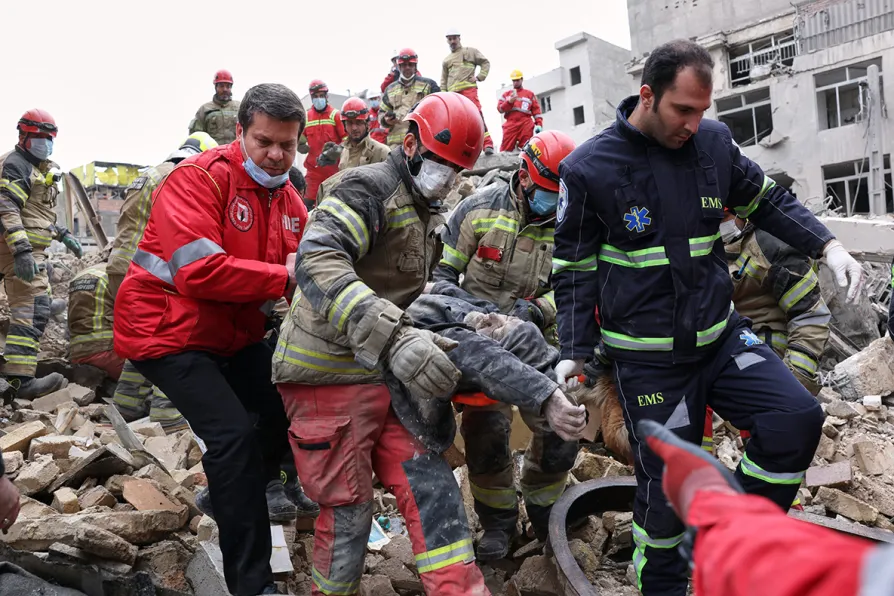
 Rescue workers carry a severely injured man after pulling him from the rubble following a strike in southern Tehran, Iran, March 13, 2026





GERMAN revolutionary socialist Karl Liebknecht, who was shot in the back by Freikorps forces in Berlin’s Tiergarten in January 1919, described imperialism and militarism as destructive forces acting as a “cyclone” and a “vampire.”
He stated: “Capitalism is war; socialism is peace.”
Today, Liebknecht’s words are prescient precisely because the cyclone of death and destruction displayed by US imperialism’s vampiric mission to suck up wealth around the world, from Venezuela to Iran, contrasts with the real achievements of socialist China, which has not been at war since 1979.
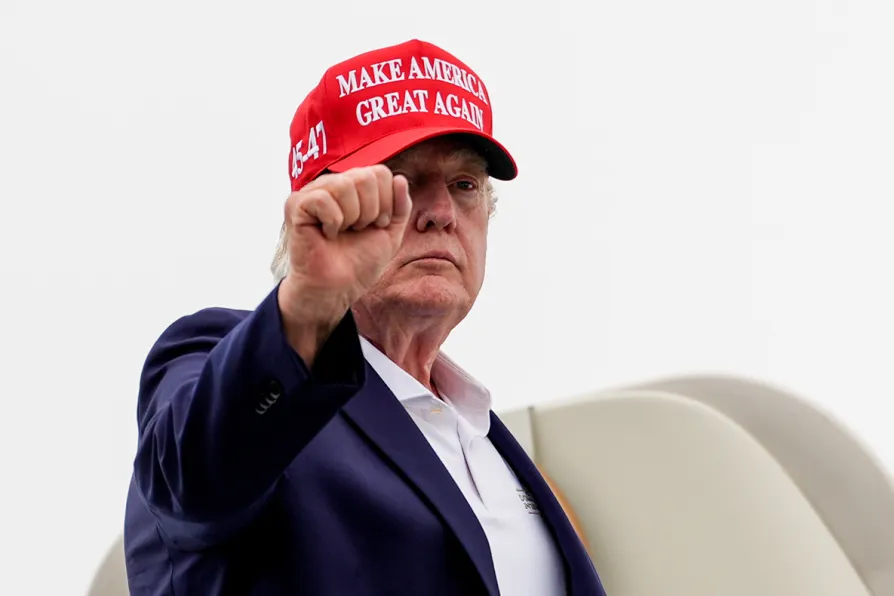
The permanent state of war extolled by Donald Trump’s grotesque demand to boost Pentagon spending by 150 per cent to $1.5 trillion to create his “dream military,” constitutes more military spending than the military budgets of China, Russia and Iran combined.
Yet with global stock markets inflated by vast quantities of fictitious capital, Trump’s militarist boasts assume a critical role in keeping share prices high.
In Europe too, militarism is the strategic choice of political elites. In November 2025, the EU introduced its Military Mobility Package for swift and efficient movement of military assets and personnel across borders through a “Military Schengen” — war without frontiers.
A year ago in March 2025, EU Commission president Ursula von der Leyen announced “ReArm Europe” — subsequently rebranded as “Security Action for Europe” because “Safe” sounds much nicer — €800bn of EU military spending for war in Ukraine.
The EU’s private capital loans of €150bn to fund this spending bonanza leaves member states to raise the bulk of the arms package. Yet, EU rearmament is already running into trouble.
Yesterday, Polish President Karol Nawrocki vetoed €44bn in EU funding for military spending, saying Brussels should not control Poland’s military procurement.
Nawrocki called Safe “a massive foreign loan for 45 years in a foreign currency, with interest costs that could reach up to 180bn zlotys ($48bn). Poles will therefore have to pay back twice the value of the loan, and Western banks and financial institutions will profit from it.”
More than half the EU €150bn Safe loans have now been delayed. However, the headline-grabbing announcements of increased arms spending by Trump, von der Leyen, Macron, Merz and Starmer all underline the extent of state capture by the arms industry today.
The demand to boost share prices of arms and technology firms through increased state military spending is a phenomenon recognised as long ago as 1961 by US president Dwight D Eisenhower, who warned of the dangers of the military industrial complex when he described the “conjunction of an immense military establishment and a large arms industry.”
Today, arms firms are merging with the financial technology sector, focussing on AI, autonomy, big data and cybersecurity and acquiring tech companies to integrate these capabilities into weapons systems.
The European Defence Fund and the EU Defence Equity Facility drive private capital into arms research and production and create collaborations and mergers between finance capitalists and the arms industry.
Yet, there is little popular support for this amoral and degenerate industry. European rearmament has accelerated deindustrialisation and falling living standards in Europe.
Despite the enthusiasm of generals, arms dealers and bourgeois politicians for cutting public education, healthcare, housing and civil infrastructure investment to pay for arms spending, no European government has yet succeeded in the wholesale switch of public spending from welfare to warfare necessary to satisfy their demands.
This weekend’s Stop the War Coalition conference in London is a welcome opportunity to reinforce the message that adorns the masthead of this newspaper, “For Peace and Socialism.”
The demand that increasingly unites trade unionists and peace campaigners across the world, is for welfare, not warfare.
