IAN LAVERY MP warns that decades of neoliberal policies have left former industrial communities behind — but a renewed Labour commitment to working people could change the political landscape


The radical who invented Robin Hood
MAT COWARD tells how 18th-century scholar and revolutionary democrat Joseph Ritson turned a medieval outlaw into England’s people’s hero — soon to be gracing panto halls around the nation
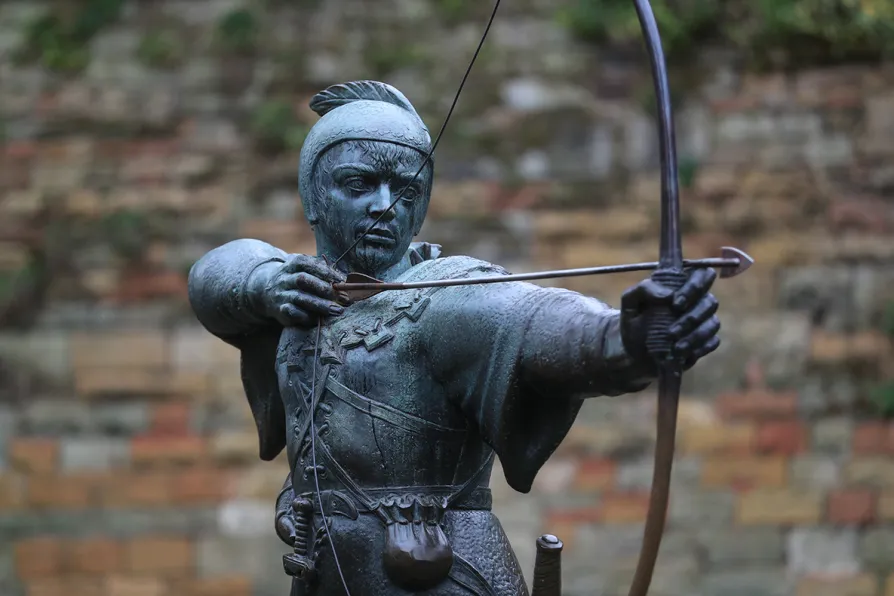
 The Robin Hood statue in Nottingham

PAOLO SANTALUCIA reports on how an Italian region defies US pressure to end a Cuban doctors programme
HENRY FOWLER outlines the GFTU’s new 2026-27 education programme and argues that investing in trade union education is essential to building worker power, developing leaders and strengthening collective action
We need a government that invests in saving lives not destroying them, argues SOPHIE BOLT
More expensive by weight than gold, saffron is surprisingly simple to grow. MAT COWARD explains
The public inquiry is the result of more than a decade of determined campaigning. Now, those who fought for justice want the full story of government involvement and police conduct to be told, says KATE FLANNERY
The Durham Miners’ Gala is a celebration of working-class culture, but also a call to action — to rebuild workers’ collective strength, says KIM JOHNSON MP





ROUND about now, at theatres all over Britain, a pantomime called Robin Hood is either rehearsing or opening.
Everyone in the English-speaking world knows who Robin was — a valiant medieval outlaw who stole from the rich to give to the poor. And the reason we’ve all heard of him is a man named Joseph Ritson: 18th-century lawyer, antiquary, revolutionary democrat and all-round eccentric.
He’s the one who dyed the Robin Hood legend red, so thoroughly that even the worst modern TV version can’t rinse it away.
Ritson was born of humble peasant stock in 1752 at Stockton-on-Tees. As a teenager he was apprenticed to a lawyer, and spent most of his adult life living in London and working at conveyancing.
He was successful at the law, but his greater passion was for historic British literature. He became a recognised Shakespeare scholar, always determined to go back to original sources and ruthlessly attack misattributions, rewrites and later edits. His outspoken, and sometimes intemperate criticisms of other scholars made him a controversial figure.
His many enemies — and some of his allies — often mocked Ritson for the vegetarian diet which he had adopted as a youth. In a surviving letter to his sister, he warns that “you will certainly find yourself healthier, and if you have either conscience or humanity, happier, in abstaining from animal food than you could possibly be in depriving, by the indulgence of an unnatural appetite and the adherence to a barbarous custom, hundreds, if not thousands, of innocent creatures of their lives, to the enjoyment of which they have as good a right as yourself.”
He was also an atheist and indeed, at the time of his death, claimed to be “writing a pamphlet proving Jesus Christ an impostor.”
Ritson’s rebel political views came on him gradually as he got older; one of the key moments was his decision to take a long holiday in Paris — during the French Revolution. What he experienced there convinced him that republicanism, egalitarianism and democracy were the way forward for the human race.
It was, he thought, inevitable and entirely desirable that France’s revolution would spread to Britain. Unlike many other British radicals, who abandoned their support for France during the Terror, Ritson never lost his faith in the French example.
This revolutionary outlook came together in 1795 with his love of medieval British poetry, songs and ballads, and a mission to track down and preserve their purest, uncorrupted texts, when he published the work for which he is remembered.
His book on Robin Hood aimed to collect every authentic tale, every scrap of information, about Robin to put him in a historical as well as literary context.
It is from this book that we get the concept of Robin as a people’s hero — “for all opposition to tyranny is the cause of the people” — and a freedom fighter. The idea of the noble outlaw, who only kills when forced to, who never steals except from the rich and corrupt, and who supports and is supported by the common folk of the forest, stems almost entirely from Ritson’s influential writings.
It’s reasonable to say that Joseph Ritson was “the man who invented Robin Hood,” at least the Robin known from the start of the 19th century up until today.
The last years of his life saw increasingly erratic and troubling behaviour and various forms of ill-health, until he died in a Hoxton asylum in 1803. Ritson’s Robin continued to be an important figure to democrats and socialists in the 19th and 20th centuries, each generation retelling his stories in ways that chimed with current events and ideologies.
During the second half of the 20th century the legend was kept alive, and indeed amplified, by Hannah Weinstein’s 1955-59 TV series, The Adventures of Robin Hood, which stuck faithfully to the Ritsonian view of Robin. Starring Richard Greene as Robin, it was a superior piece of television drama, still critically admired and fondly remembered today. What most people didn’t know about it at the time was that the whole thing was a communist conspiracy.
Weinstein was a US dissident living in exile in London. She worked with the Communist Party of the USA to create a production company to develop and sell television programmes which would provide employment to some of the many US writers who had been banned from working in their own country due to their political beliefs.
She employed around two dozen blacklisted screenwriters on The Adventures. Working under pseudonyms, they included Ring Lardner Jnr, who had been one of Hollywood’s highest-paid writers but was put in prison for refusing to tell a Senate hearing whether or not he was a member of the Communist Party.
He later described Weinstein’s series — which she sold to US networks as well — as “perhaps, in some small way, setting the stage for the 1960s by subverting a whole new generation of young Americans” through its anti-Establishment plots and dialogue.
In Britain the series was an immediate smash-hit, establishing the newly launched ITV as a financial success and a serious producer of original dramatic material.
But the best-remembered element of the show is surely the theme song, with its immortal first verse (and laughably bad second verse — look it up), which includes a line that perfectly sums up Ritson’s Robin, and explains why he will always be England’s greatest hero:
“Feared by the bad, Loved by the good — Robin Hood, Robin Hood, Robin Hood.”
You can sign up for Mat Coward’s Rebel Britannia Substack at www.rebelbrit.substack.com for more strange strikes, peculiar protests, bizarre boycotts, unusual uprisings and different demos.
