The Greater Manchester mayor has shifted left over the years — but his record still shows a tendency to wobble when pressure comes from the right, says SOLOMON HUGHES


 Latest editorial
‘The rise of Italy’s far-right is a grim indication of the future’
Speaking to the star’s Alexander Norton, DAVID BRODER introduces his new book that shows how the direct descendants of Mussolini’s fascist regime have come to power — and what it means for the rest of the world
 Prime Minister since October 2022, Giorgia Meloni and her party Fratelli d’Italia are proud of their direct descendency from the postwar fascist party MSI and deeply committed to racially charged, far-right conspiracy theories like the Great Replacement.

RAMZY BAROUD explains why Israel’s political collapse cannot be separated from its war crimes
DAVID RABY charts the ever increasing US attempts at intervention in Mexico’s internal affairs
FRANCISCO DOMINGUEZ and ROGER D HARRIS highlight how the priority for internationalists should be defending Venezuela’s government against external aggression
Established as a landmark victory for the climate movement, the CCC promised to hold governments to account. Today, it is understating the danger of climate chaos and impeding the radical action needed, says IAN SINCLAIR
ROGER McKENZIE draws attention to the much-neglected oral traditions of the global South that define the identity – and therefore the liberation – of its custodians





WELL-EVIDENCED and convincing, David Broder’s book Mussolini’s Grandchildren tells the story of how veterans of the 1925-45 dictatorship were able to refound an unashamed “fascist party in a democracy” after their defeat in World War II, and how that party — renamed Fratelli d’Italia — is now in power following the 2022 elections, with Giorgia Meloni serving as Prime Minister.
For what is a fairly straightforward work of history, it is remarkably engaging, dryly humorous and prescient in its lessons for global politics. Testament to its impact, before the book’s release, Meloni was already denouncing its author; since its release, despite the fact it is written in English, the book is currently outselling Meloni’s autobiography on Italian Amazon. I ask David Broder about the nature of the modern Italian far right and why it is so important to understanding the direction of politics across the West.
Even the title mentions Mussolini, yet you insist Giorgia Meloni’s government isn’t a return to the past. What do you mean by that?
The title is Mussolini’s Grandchildren — the point being that her party is both rooted in regime-era fascism, but has also evolved over time, and this is in many ways a postmodern phenomenon. The ambiguity is well-rooted in the idea of “neither restoring nor reneging on the regime,” taken up by the postwar neofascist party called Movimento Sociale Italiano (MSI).

Similar stories
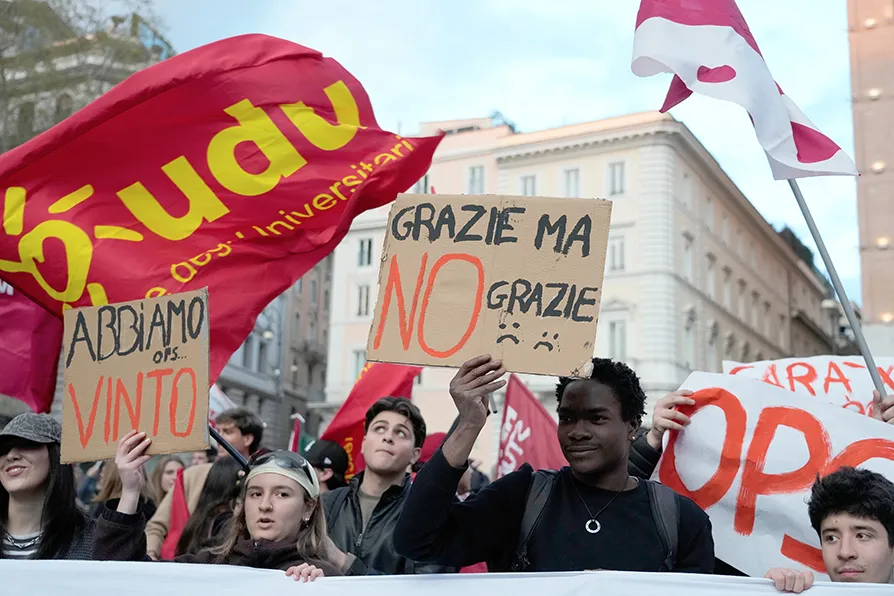
Italians reject controversial judiciary reforms in a referendum that boosts the left, reports NICK WRIGHT

CJ ATKINS commemorates one of the most dramatic moments in working-class history

ASSAF TALGAM talks to an Israeli Communist lawmaker about the need to use every tool of democratic and non-violent struggle; how Israeli society has changed since October 7 2023; and the persecution of the left in the parliamentary arena

Gaza’s collective sumud has proven more powerful than one of the world’s best-equipped militaries, but the change in international attitudes isn’t happening fast enough to save a starving population from Western-backed genocide, argues RAMZY BAROUD