Preferable to Starmer he may be, but there is scant sign of a sharp political break in Burnham’s policies so far — while left challenges aren’t making much of a running either, finds ANDREW MURRAY. How can socialism be put back on the map?


 Latest editorial

A Short Vision: a haunting, six-minute work of art on nuclear Armageddon that everyone should watch
A six minute animation that conveys the horror of atomic war A Short Vision, made in 1956, is more effective than any drama, writes LINDA PENTZ GUNTER
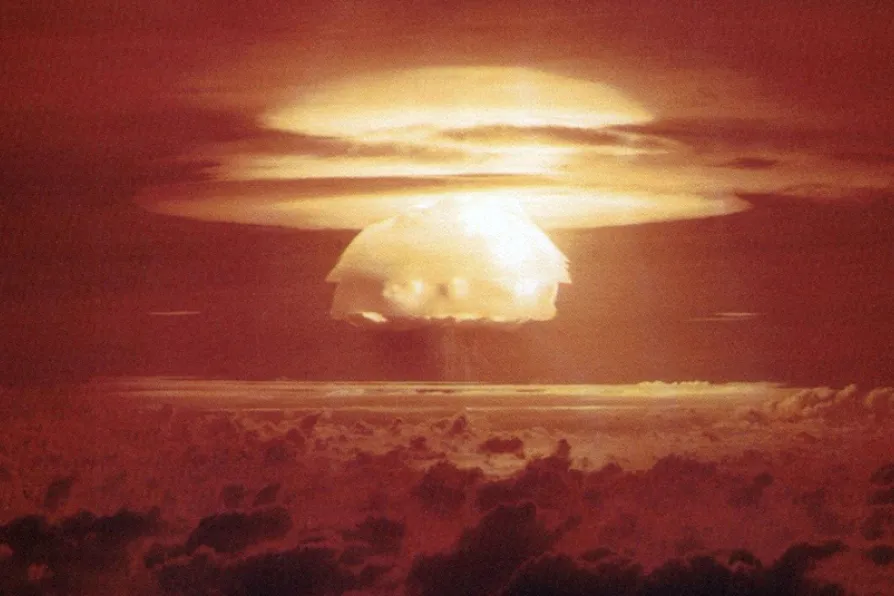 Nuclear weapon test Bravo (yield 15 Mt) on Bikini Atoll. The test was part of the Operation Castle

CHARLEY ALLAN reports from Clacton on Farage’s fears his by-election stunt has backfired
JEREMY CORBYN says we should never forget the horrific reality of nuclear weapons, or cease our efforts to rid the planet of them entirely
The new TUC Cymru general secretary speaks to Morning Star Wales reporter David Nicholson about her trade union background and ambitions for the movement
Internationalism is deeply embedded in socialist theory and practice. Examination illuminates its complexity asserts the Marx Memorial Library and Workers’ School
The Claudia Sheinbaum government is no pushover and is holding firm despite US abuses of the relationship, says DAVID RABY
As we approach the grim anniversaries of Hiroshima and Nagasaki, SIMON BARROW sounds the alarm over the dangerous and murderous direction our government is heading





SOMETIMES the most effective way to communicate the horrors of nuclear war is also the most infinitely simple.
We have read books and reports and analyses about the evils of the United States atomic bombing of the Japanese cities of Hiroshima and Nagasaki, on August 6 and 9 respectively.
And we’ve been chilled by the dramatic films On The Beach (1959), Fail Safe (1964), The War Game (1966), The Day After (1983), Testament (1983) and Threads (1984), which depicted the horrors of a nuclear attack. Even US President Reagan was supposedly awoken to the imperative of nuclear disarmament after seeing The Day After. Sadly, he sabotaged those chances in the end by clinging to the ludicrous and ineffective Missile Defence System, nicknamed “Star Wars.”
There are fewer nuclear weapons today than during the height of the Cold War, but still enough to destroy the world many times over. And instead of disarming, the major nuclear weapons nations are once again rearming as the world becomes ever more destabilised by wars, climate pressure and the fight for control of resources. Nuclear arsenals in the US, Russia and China are growing larger and more lethal.
But the suicide path our leaders are still taking us on was anticipated well before the feature films and television dramas warning us of the omnicidal outcome of nuclear war; and before the scientist Carl Sagan introduced us in 1983 to the concept of nuclear winter, its inevitable aftermath.
Their story, and ours, is to be found in A Short Vision, a film released in 1956. It is six minutes of agonisingly moving and even visually beautiful animation made by a British couple on their kitchen table. The film has all but disappeared from memory and public discourse but is thankfully viewable on YouTube here.
A Short Vision was made by Hungarian-born artist and painter Peter Foldes and his British wife Joan with sponsorship funds from the British Film Institute’s Experimental Film Fund. The eerie and frighteningly evocative score was the work of another Hungarian emigre, Matyas Seiber. The narration is by British actor James McKechnie.
It is that haunting music that sets the mood from the moment the film opens, as we see a sinister object flying across the landscape, a dark, silent, menacing shape, almost a precursor to the more modern stealth bomber or the UFOs of science fiction. It is never named by the narrator. Nor is the word “nuclear” ever spoken in the film.
Then we see a leopard pinning a deer. Both look up. “And the deer darted free from the tearing claws, and they both hid in fear,” relates the narrator. The object, referred to only as “it,” flies on. The scene is repeated with an owl and a rat also looking up before the rat, too, is released to flee.
More beautifully drawn images follow, of families sleeping peacefully as the object flies over the nighttime lights of a city. The ordinary citizens are sleeping, but those who could have prevented what’s to come are not. “But their leaders looked up, and their wise men looked up. But it was too late.”
By now we are more than half way through the film, the music has become even more spine-chilling, but we are still waiting in dread and anticipation of what is to come.
And then it happens.
The giant explosion and conflagration is rendered in hundreds of flickering fragments of reds, oranges and yellows as the object explodes in a massive fireball billowing into a giant mushroom cloud. The faces of the leaders begin to bleed, then peel off and melt away, leaving only skeletons.
Everyone is destroyed — those who saw it, those who didn’t, the leopard, the owl, the rat and the deer.
“When it was all over there was nothing else left but a small flame,” the narrator tells us. We watch the flame flicker, then consume the object itself, now transformed into a small moth. Then it is gone “and the flame died.” The film closes with a black screen and the simple words “THE END.” Which, indeed, it is.
After being shown at the National Film Theatre in January 1956, A Short Vision was reviewed by The Times, which described the film as “a work of sombre imagination.” The headline called the film a “cartoon,” which is how it was generally described, but visually it is closer to art, a reminder of Peter Foldes’s roots as a painter. Indeed, in the same review, the Times said the film was “a series of powerful, static drawings dissolving to show the death and consumption of all living things at the explosion that brings about the end of the world.”
But it was the film’s journey to the United States that marked the most extraordinary chapter in its brief history.
On May 27, 1956 it was screened by CBS on a popular prime time variety programme hosted by Ed Sullivan, who described his choice to show the film — seen then in black and white — as “a plea for peace.”
“If you have youngsters in the living room, tell them not to be alarmed at this ’cause it’s a fantasy, the whole thing is animated,” Sullivan said, as if somehow the fact of it not being live action made it less traumatic viewing.
Instead, the power of the film’s simplicity is what makes it arguably more effective than the longer dramas that followed.
Indeed, a review in the Post-Standard, a Syracuse, New York daily newspaper, said the film “gains power through its very simplicity. Perhaps no other medium could convey the finality of such conflict.” The reviewer added that “It should be shown all over the world, particularly in Russia. It is the best argument for peace at any price that has been presented in a long time.”
Sadly, that imperative is still true (although perhaps without singling out Russia). After its US adventure and brief theatrical release, A Short Vision disappeared into ignominy. Instead, it should be compulsory viewing today, shown in as many venues as possible. Someone should screen it onto the walls of Number 10.
The airing on Ed Sullivan’s show engendered such a huge and largely positive response that Sullivan showed the film again on June 10. This time, however, he admonished parents “who have youngsters in your living room, it is a harrowing experience for youngsters, so would you please take them out of the room.”
A year after A Short Vision’s debut, the Campaign for Nuclear Disarmament was born and, a year later, in 1958, thousands marched to Aldermaston to protest against the Atomic Weapons Research Establishment there. But the arms race continued, escalating to a frightening pitch by the early 1980s.
On June 12, 1982, one million people rallied in Central Park in New York City to demand the abolition of nuclear weapons and an end to the arms race. CND marched again, bringing hundreds of thousands of protesters to Hyde Park in London in 1982 and 1983 with the same demands.
By then, Peter Foldes was dead, as were Seiber and McKechnie. But Joan Foldes, who remarried and moved to France, is still alive. She is 102. The extraordinary and powerful work she did with her husband sadly remains as resonant and important today as it was in 1956. I wonder what she makes of that?
Linda Pentz Gunter a writer based in Takoma Park, Maryland. She is the Executive Director of Beyond Nuclear and the author of No To Nuclear. Why Nuclear Power Destroys Lives, Derails Climate Progress And Provokes War.

Similar stories

On Hiroshima Day, we print a statement by Coventry Lord Mayor’s Committee of Peace and Reconciliation

JEREMY CORBYN says we should never forget the horrific reality of nuclear weapons, or cease our efforts to rid the planet of them entirely

For 80 years, survivors of the Hiroshima and Nagasaki atomic bombings have pleaded “never again,” for anyone. But are we listening, asks Linda Pentz Gunter