TUC president and POA leader STEVE GILLAN speaks to Ben Chacko on the eve of Congress 2026


 Latest editorial
Does the left have a plan for the Burnham era?
Preferable to Starmer he may be, but there is scant sign of a sharp political break in Burnham’s policies so far — while left challenges aren’t making much of a running either, finds ANDREW MURRAY. How can socialism be put back on the map?
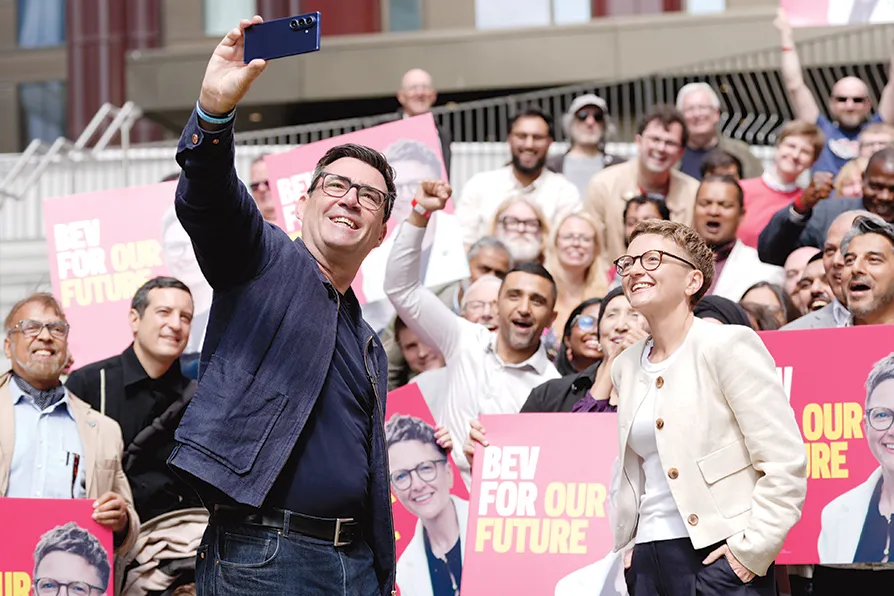 New hope or not so much? Andy Burnham

DOUG NICHOLLS welcomes a turning point at this year’s Congress, where many motions call for a co-ordinated plan to revive British industry, a perspective outlined in his new book
HOPE VIRGO of campaign Dump the Scales warns MPs voting today they should be alert to the threat legalised assisted death poses to people with eating disorders
The Together Alliance is hosting two summits, North and South, to build power and plan action against the scourge of racism peddled by the right. DANIEL KEBEDE urges mass participation
The drift toward militarisation in Europe is not inevitable, left-wing and peace movements can preserve sovereignty and prevent war, says DÁIRE HUGHES MP
Whatever differences exist among international sympathisers of the Bolivarian revolution about its current trajectory, they should unite against the imperialist power that is the source of an enforced retreat, argues ROGER D HARRIS
Trade unions need to step up and force a turn in the policies of the labour movement to effectively confront the far-right threat, argues NICK WRIGHT





ANDY BURNHAM does not herald a new era in British politics, nor is he yet the parent of an -ism.
His accession to Downing Street has met with general approbation, even if only because his predecessor was a leader of unmitigated awfulness. Therefore, Burnham at Number 10 — north and south — constitutes a turning point in the regular push-and-shove of electoral and parliamentary politics.
Will it amount to more? Here the socialist left should get a vote. Previous columns have looked at the state of the right, the capacities of social democracy and Burnham’s own programme in the new context.
The left, however, has appeared marginal to events. For the first time this century, the Labour left did not field a candidate at a time of leadership transition.
It is true that, in 2007, John McDonnell was not able to force an election against Gordon Brown, but he had a decent pop at it. Diane Abbott flew the flag in 2010, Jeremy Corbyn won most famously in 2015 and again in 2016, and Becky Long-Bailey was the genuine left alternative to the fraudulent Starmer in 2020.
So its absence from such contest as there was this summer is a step back. The Socialist Campaign Group (SCG), diminished by design of Starmer and his egregious aide Morgan McSweeney, did issue a worthwhile statement of policy, but it made little impact.
It is true that no challenger advanced by the left could have made it onto the ballot paper — something which would have required the backing of 81 MPs. But, like McDonnell against Brown, a candidate could both have given key issues a sharper focus and raised the undemocratic iniquity of the rules blocking their advance.
That is now water — a rivulet, perhaps — under the bridge. The SCG has been home to different opinions as to backing Burnham. Some of its MPs joined the huge majority of the PLP which nominated the ex-mayor for the leadership, while some kept their powder dry, including Apsana Begum, John McDonnell and Jon Trickett.
Since his election, Burnham has made some unity gestures. Three SCG MPs have been named parliamentary private secretaries, the lowest rung on the government ladder. Some left MPs were hoping for more, but it is nevertheless a positive contrast with the Starmer dispensation.
And Diane Abbott has had the whip restored to her, righting a repeated wrong done to her by the factional, and racist, Starmeroids.
So it is fair to say that the boot of right-wing authoritarianism has been removed from the neck of the Labour left, allowing it to breathe a little.
It is also evident that there is almost as much space leftwards of the Burnham premiership as there was of the Starmer regime.
Take just three issues. The ruling out of a private-sector rent freeze will have disappointed millions, the more so since the idea had been floated by the new premier’s team.
Nor has decisive action been taken over the bankrupt and ramshackle water companies, headed by Thames Water. Perhaps it is coming but, given that the problems and possible solutions have long been common knowledge, every day’s delay looks like procrastination.
Third, ringing commitments to continue the Ukraine war for as long as it takes have been made, yet there is no movement on Palestine to correspond with Burnham’s apology for Starmer’s pro-genocide positioning. Word is that such movement is not to be expected imminently.
So there are issues aplenty for a left critique of the new government, which has far from sealed the deal with the public. The “Burnham bounce” has not achieved much altitude, presently leaving Labour six points adrift from its anaemic 2024 result.
No sure recipe for victory, certainly. Many voters remain exasperated.
The left needs to offer its own popular, programmatic alternative. To do that it must overcome its squeamishness concerning confronting the escalating military spending bill.
Diane Abbott has shown the way here for months. There are modest signs of hope — a good statement from Momentum, indications of a stronger line from Tribune.
If that nettle is not grasped by more of the left, then the Burnham government will be on course for failure.
Committing to no tax rises as per the 2024 manifesto, to Treasury debt rules and to Trump’s Nato spending targets is not breaking with the last 40 years of politics but reaffirming it. Dithering on utility nationalisation and Gaza will only reinforce the point.
Now the left is not, and today less than ever before, the same as the Labour left. At all levels other than the parliamentary, the Corbyn levy of socialists remains dispersed and largely outside the Labour Party.
The window of opportunity for it to coalesce in a viable electoral alternative of the left may be closing.
Your Party appears an effective write-off. It is finally establishing branches around the country, but a combination of cloudy political strategy, factionalism, serial blunders and control-freakery have laid it low.
Two of the more representative members of its executive — ex-MP Laura Smith and Liverpool councillor Sam Gorst — have recently resigned, as has the entire leadership in Scotland. Only two of the four MPs who claim adhesion to Your Party actually identify themselves as such in the Commons — Zarah Sultana and Jeremy Corbyn, and the latter sometimes continues to refer to himself as “independent.”
The majority of the executive last month voted no confidence in the party chair and secretary who have, however, declined to quit. It would be tiresome to adjudicate the rights and wrongs of all this, but it does not say “ready for government” exactly.
Anyway, the enthusiasm of last summer has evaporated. Some of it transferred to Zack Polanski’s newly socialist Greens. The Greens, however, seem to be the main victims of the Burnham bouncette.
Their vote remains far higher than it was pre-Polanski, but the new premier seems to be at least partially consolidating the left electorate around Labour.
Moreover, Polanski’s repeated social media imbroglios speak to a tussle between political sobriety and digital addiction, with the latter oftentimes coming out on top.
Of course, the Greens could yet advance into the vacancy to Burnham’s left, if the latter leaves it open as seems most likely. But it feels fragile.
Burnham’s ascent also raises larger questions. What is the left’s project here? The 40 years the Prime Minister wishes to repeal have done damage both to working-class agency and the socialist objective that cannot be easily undone.
One can reverse from a “wrong turn” for sure, but one cannot return to a place abandoned 40 years earlier and find it unchanged.
The reconstitution of the working class as a historical subject is grounded in struggles for social self-assertion and the fashioning therefrom of a view of the world antithetical to capitalist class rule.
In that process — which Marx and Engels described as “formation of the proletariat into a class” — we are only in the foothills, which does not mean that the ascent cannot suddenly speed up.
If Burnham actually delivers on promised reindustrialisation, and it amounts to more than tweaking nuclear warheads, that would help.
Any “reformation” will also draw on established traditions, organisations and symbols remaining extant. History affords no blank slates.
To stick with the Communist Manifesto, socialists are not mainly needed for social amelioration, for which trade unions, radicals or even liberals are usually adequate, but for the “overthrow of the bourgeois supremacy,” which is not giving a good account of itself, and the conquest of power by the working-class.
That thread may not seem immediately visible in today’s somewhat lurid political tapestry. But we are often told, indeed often assert ourselves, that the status quo, or “centrism,” or the prevailing political establishment, is imbibing in last-chance saloon.
What indeed lies beyond that undesirable watering hole? If Burnham fails, either through irresolution or because he is overborne, what is the next hostelry?
One answer is the Reform-Restore bloc, now scorpions in a mating dance, and which won nearly 30 per cent of first-choice votes in the Manchester mayoral by-election.
Their programme is the bourgeois supremacy with a black hundred knout. Can socialists find a way to unite with the trade unions and the mass movements of struggle against capitalist crisis and imperialist war to generate a viable alternative?
It is certainly more consequential than any number of parliamentary private secretaries.

Similar stories

Can entrenched institutional power be overcome?
The new PM’s opening addresses offered hope, council homes and reform — but little detail on how any of it will be delivered, warns CLAUDIA WEBBE