Cuban trade union federation CTC leader OSNAY MIGUEL COLINA speaks to Ben Chacko about life and work under a crippling US siege


 Latest editorial
Trump’s pushing it — but Claudia Sheinbaum’s no pushover
The Claudia Sheinbaum government is no pushover and is holding firm despite US abuses of the relationship, says DAVID RABY
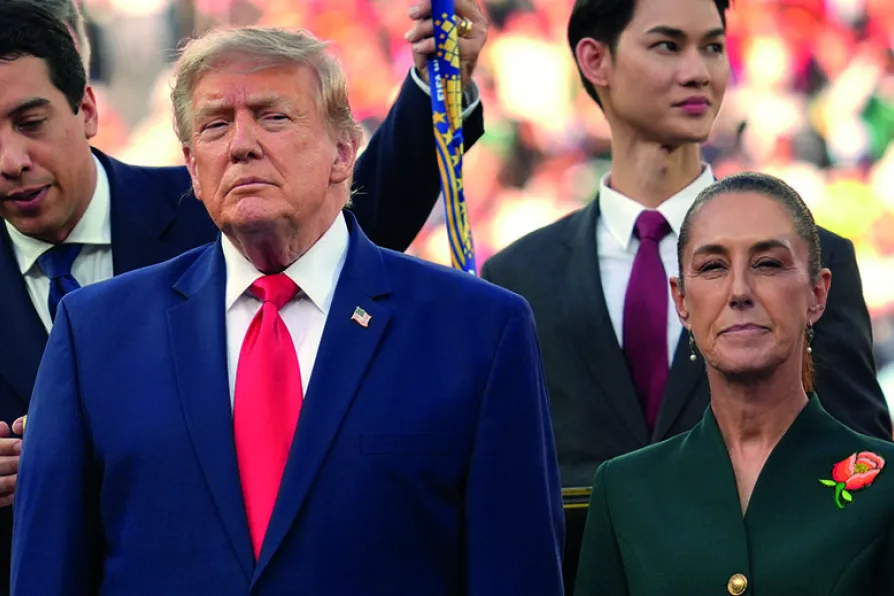 Troubled relationship: Donald Trump and Claudia Sheinbaum
A part of the British empire’s network of slavery, today the Caribbean island of Nevis faces a new form of exploitation in the form of crypto-colonialism, CLAUDIA WEBBE writes
A new book by Victoria Holmes illuminates the many hidden histories of the oppression experienced by Gypsy/Roma/Traveller community, writes ROGER McKENZIE
Even the oligarchs of the artificial intelligence industries are warning that their creations have the capacity for the ultimate destruction of the planet and its population. ANDREW MURRAY suggests that there might just be other solutions
The Labour government must deliver on its commitment to bring back privatised services into the public sector. This not only saves money but also creates accountability and generates wider social benefits, argues ANDY MCDONALD MP
Public ownership of Great British Railways has enormous potential to improve our railway network, but that can’t happen unless jobs, employee rights and union recognition is at the heart of the transition, argues MARYAM ESLAMDOUST
Challenges from the unscrupulous misuse of AI to steal actors’ voice and physical likenesses is being met with a firm union response, writes LYNDA ROOKE





AS EVIDENCE grows of illegal US intervention in Mexico, the government of President Claudia Sheinbaum has become bolder and more direct in its response. This also applies to its response to repression against Mexican migrants north of the border.
This is in addition to the ongoing legal investigations by the Mexican attorney-general’s office (Fiscalia General de la Republica) of illegal authorisation of actions by CIA and other agencies by the right-wing state government of Chihuahua, and questioning of unfounded US Justice Department drug-trafficking charges against several Mexican politicians (“Firm Rebuttal of US Meddling,” May 29 2026).
A very important case which has never been resolved was the mysterious seizure of Sinaloa cartel boss “El Mayo” Zambada, seized and flown to the US where he was then arrested. This was on July 25 2024 when Amlo was still president. Mexico demanded an explanation, but none was forthcoming. There was widespread suspicion that this was a clandestine and illegal operation by US agencies, but there was no hard evidence.
On arrival in the US Zambada was immediately transferred to New York and charged in the District Court of Eastern New York with drug trafficking, money laundering and other crimes. It later emerged that he would probably be granted the status of “collaborative witness.”
The case recently returned to the headlines when it emerged that at a commercial event a US company had displayed an aircraft which it said had been used by the FBI to fly Mayo Zambada across the border. President Sheinbaum denounced this in her morning press conference on July 6.
A further complication arose when the Mexican attorney-general’s office accused former US ambassador Ken Salazar (under the Biden administration) of lying when he said he knew nothing about any participation of US agencies in Zambada’s capture. The issue remains a sore point in relations between the two countries.
Trump’s hostile declarations
US officials from Trump on down continue to make hostile (and baseless) declarations about Mexico “being run by the drug cartels,” but at the same time they continue to negotiate on practical issues. Sheinbaum always adopts a firm but diplomatic position which generally produces positive results.
Thus a longstanding dispute concerned the spread of screwworm, a disease affecting cattle which has been common in Central America. It led to Washington halting imports of live cattle from Mexico. But stringent measures taken by Mexico led to praise from US Agriculture Secretary Brooke Rollins and agreement to resume the cattle trade in late August.
More important is the ongoing revision of the US-Mexico-Canada (USMCA) trade agreement: although the agreement as such continues till at least 2036, the US is insisting on annual revisions as part of Trump’s protectionist agenda.
In mid-July US Trade Representative Jamieson Greer made a declaration accusing Mexico of allowing too many third-country imports, but on July 23 Greer led a delegation to negotiate in Mexico City with Sheinbaum and her economy and finance secretaries which ended on a positive note.
Where Mexico has had less success is in efforts to protect its citizens north of the border from abuse by the notorious Ice agency. Four Mexican-Americans have been killed in recent days by Ice brutality, and a total of 17 have died in its detention centres.
Diplomatic protest notes by the Mexican foreign secretary and an instruction to Mexican consulates to promote legal action on such cases have been rejected outright by the State Department.
On the judicial front the US continues to make gratuitous accusations against Mexican politicians and public officials of complicity in drug smuggling and organised crime, but the Mexican attorney-general’s office insists that while it will investigate all cases, no punishment or deportation will occur without adequate evidence, which has not been forthcoming.
On the other hand, Sheinbaum has pointed out that while since 2018 Mexico has handed over more than 90 convicted criminals to the US, not a single offender has been deported from the US to Mexico despite 269 requests in the same period, including some very serious cases.
But on July 27 it was reported that acting US Attorney General Todd Blanche had recognised in an interview that extradition requests by Mexico ought to be examined by US authorities. He also recognised that under President Sheinbaum and Mexican Security Secretary Omar Garcia Harfuch there had been significant progress in combatting organised crime.
In the Latin American context the reality is that despite constant threats and bluster, the only direct armed assault by the Trump administration on a Latin American country was the brutal raid on Venezuela on January 3 this year.
In all other cases it has relied on bribery, corruption and intimidation with the assistance of local collaborators to pervert elections and judicial processes.
Further overt armed intervention cannot be ruled out, particularly in relation to Cuba, but in a country of Mexico’s size and importance it is unlikely. What is much more likely, indeed almost inevitable, is an attempt to manipulate the Mexican mid-term elections (of several state governors and the lower House of Congress) in June 2027; indeed Sheinbaum herself has warned about this.
Mexico’s advantages
Fortunately Mexico has several advantages in this respect. The first is the enormous popularity of the president, the government, the Morena party and the Fourth Transformation process.
The second is last year’s constitutional reform of the judiciary which greatly reduced corruption.
The third is the exceptional success of the Fourth Transformation’s communications strategy which has almost completely discredited establishment media and right-wing propaganda.
Another advantage, now grudgingly admitted even by international financial media, is Mexico’s remarkable economic record.
With steady growth, low inflation, a stable currency which has appreciated against the dollar, growing domestic and foreign investment attracted by public investment in infrastructure and technology, the country is a success by any standards.
It is the biggest exporter to the US and its biggest client, and has just achieved a record trade surplus.
While maintaining close integration with the US and Canada it is also diversifying, with new or improved trade agreements with Japan, South Korea and (most important) the European Union. It is becoming a technological powerhouse, producing its own electric cars and buses, railway locomotives and carriages, and its own AI complex which is the biggest in Latin America.
The latest news is that on July 29 KIA of South Korea announced that it is investing $649 million to install a new production line at its Mexican plant to produce its most advanced electric vehicle, the first such facility outside Korea, starting now (August 4): a major vote of confidence.
Armed with such a powerful base, Sheinbaum felt bold enough to declare at the same press conference that Mexico will send two more naval vessels with aid to Venezuela and one to Cuba.
David Raby is a retired professor of Latin American history, a freelance journalist and co-ordinator of the UK Mexico Solidarity Forum. His book, Mexico In Transformation: From Amlo to Claudia, was published in 2025 by Praxis Press. He can be contacted at david.raby@mexicosolidarity.org.uk and on X @DLRaby.

Similar stories
FRANCISCO DOMINGUEZ introduces the background to a conference on defending Latin America’s sovereignty
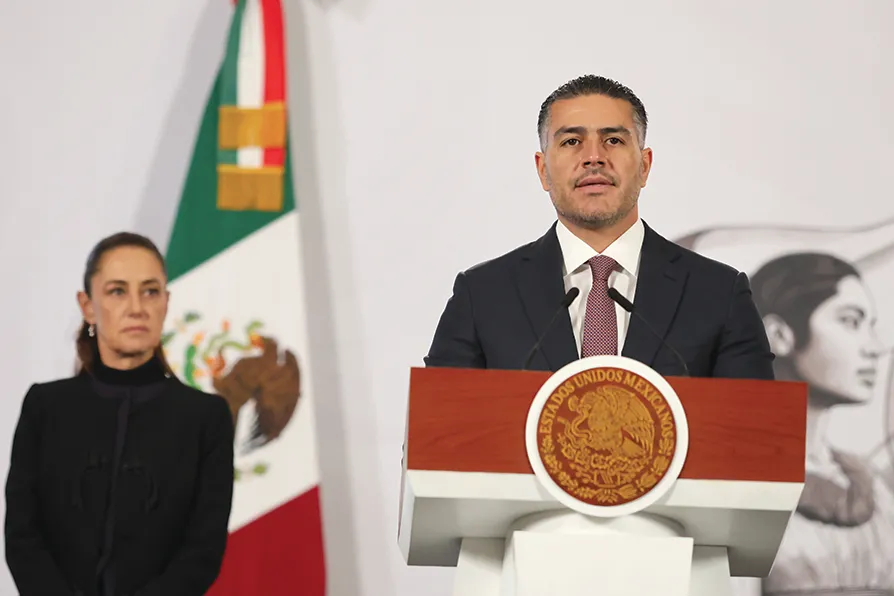
DAVID RABY explains the background of the recent upheavals in Mexico
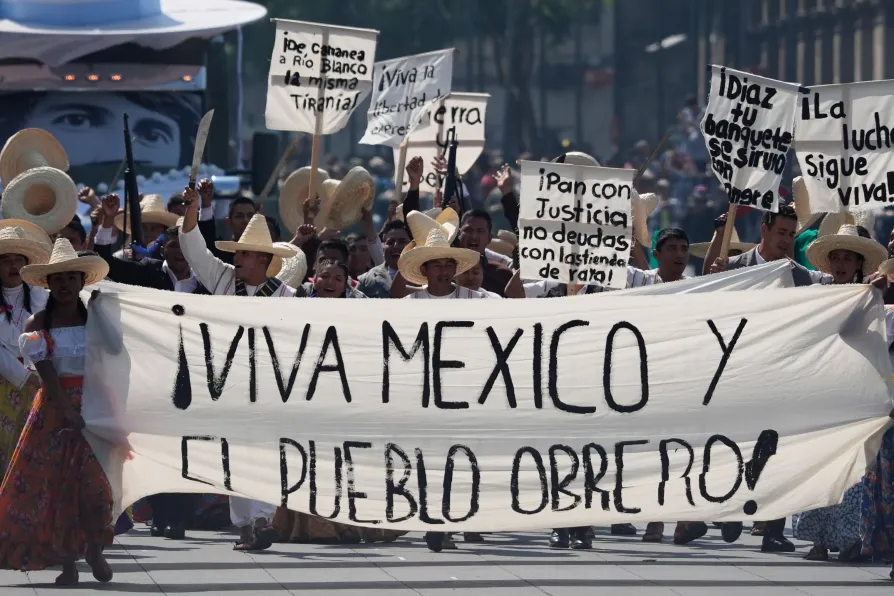
A November 15 protest in Mexico – driven by a right-wing social-media operation – has been miscast as a mass uprising against President Sheinbaum. In reality, the march was small, elite-backed and part of a wider attempt to sow unrest, argues DAVID RABY