
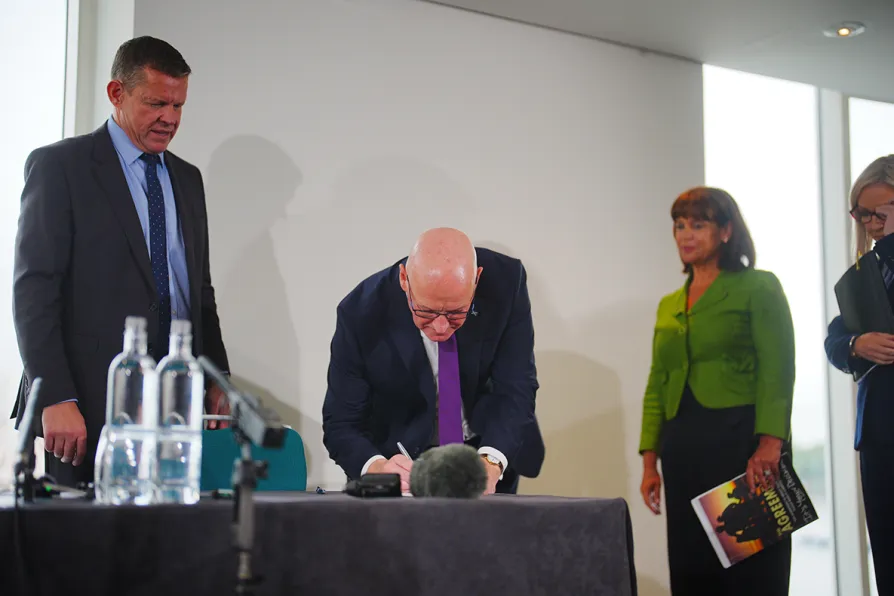
The UK Prime Minister may have the regal touch in northern England, but he’s been wrong-footed on the constitutional challenges posed by the Celtic Alliance of first ministers from Scotland, Wales and Northern Ireland, argues KENNY MacASKILL

Turning nuclear remembrance into positive resistance
As we approach the grim anniversaries of Hiroshima and Nagasaki, SIMON BARROW sounds the alarm over the dangerous and murderous direction our government is heading
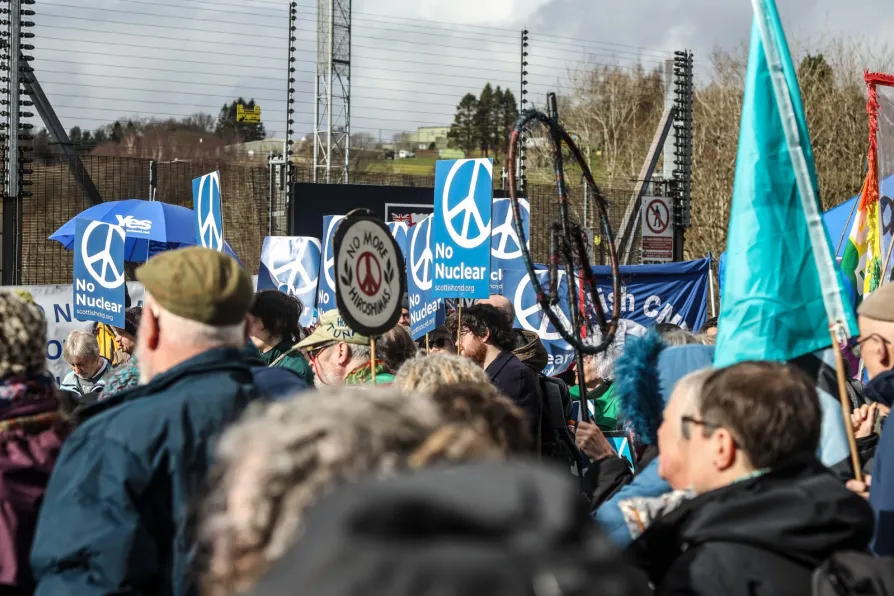
 A Scottish CND demo
NEIRLAY ANDRADE, a member of the Communist Party of Venezuela’s political committee, outlines her party’s position on the crisis facing the country
A look at Taylor Wimpey’s accounts shows why Labour’s market-led housing strategy won’t deliver more, cheaper homes, as promised, says SOLOMON HUGHES
DAVID HORSLEY remembers the remarkable life and death of US black revolutionary George Jackson, whose politically passionate prison letters were published as Soledad Brother
Cuban trade union federation CTC leader OSNAY MIGUEL COLINA speaks to Ben Chacko about life and work under a crippling US siege
A part of the British empire’s network of slavery, today the Caribbean island of Nevis faces a new form of exploitation in the form of crypto-colonialism, CLAUDIA WEBBE writes
Challenges from the unscrupulous misuse of AI to steal actors’ voice and physical likenesses is being met with a firm union response, writes LYNDA ROOKE





EVERY August, the world looks back at the flattened, radioactive landscapes of Hiroshima and Nagasaki in 1945. The realities remain staggering: over 200,000 human beings incinerated in seconds or left to perish from horrific thermal radiation. Genetic deformities for years to come. Environmental devastation, with later surface-level nuclear testing producing even worse long-term fallout impact.
But for organised labour and the trade union movement, these solemn anniversaries can never be passive history. They are an urgent, annual alarm bell as governments across the world are being urged to turn themselves into the largest, most dangerous warfare states in history.
On March 5 Janan Ganesh, author of George Osborne: The Austerity Chancellor, spelled out the goal with brutal directness in the Financial Times. “Europe must trim its welfare state to build a warfare state,” his article’s headline declared. “There is no way of defending the continent without cuts to social spending.”
That is what Labour Chancellor John Healey wants us to believe, too. It is a dangerous lie. A lie leading to growing inequality, deepening poverty, and an arms race which — like all arms races in history — can lead only to war involving levels of devastation which will make Hiroshima and Nagasaki look primitive in their death-dealing consequences.
This is why we must turn sorrowful remembrance into active resistance and the building of positive alternatives. That is, ones which resist the predatory capitalism of the arms lobby, and recognise that true human and national security is built on foundations of social security, solidarity and democratic accountability.
Right now, public services are being starved of resources. Infrastructure is crumbling, real wages have stagnated, and hospitals, schools, and energy networks operate on the brink of exhaustion. Yet, amid endless assertions from Westminster that “there is no money left,” the taps are opened wide for an accelerating nuclear arms race.
The UK government has committed to lifting the national nuclear warhead cap by 40 per cent and spending well over £200 billion replacing the Vanguard fleet with four new Dreadnought-class nuclear submarines. Combined with broader pushes to ratchet up military budgets toward 2.5 per cent — or even 5 per cent — of GDP, Britain is cementing its position among the world’s top spenders on weapons of mass destruction. This massive expansion of military spending is a direct theft from the working class.
For decades, fears for the future of skilled manufacturing and shipbuilding jobs tied to arms contracts have inhibited many workers in the defence sector from opposing nuclear weapons. That is a false choice engineered by successive governments that have refused to plan an industrial economy.
Holding working-class livelihoods hostage to weapons of planetary destruction is morally and economically bankrupt. Modern nuclear warhead production and submarine construction are remarkably capital-intensive but job-poor compared to almost any other sector. Pound for pound, state investment in renewable energy infrastructure, rail electrification, public health, and civil engineering generates far more high-skilled, unionised jobs than specialised military hardware.
The reality of Britain’s nuclear arsenal — homeported at HM Naval Base Clyde at Faslane in Scotland — is that it offers zero protection against the actual existential crises facing working people today: climate collapse, economic inequality, cyber-attacks, and public health emergencies.
Instead, Trident renewal actively exacerbates these dangers. Every pound sunk into warheads, nuclear reactors, and submarine hulls is a pound denied to green technology, school repair, and social care. Moreover, the presence of operational nuclear warheads just miles from Scotland’s largest population centre exposes local communities to catastrophic risk while binding Britain to a Nato doctrine of fatal first-use ambiguity.
By expanding its own arsenal, the UK dismantles its moral standing under the Nuclear Non-Proliferation Treaty (NPT), encouraging global escalation in a volatile multipolar world.
Yet the specialised skills of workforces at Faslane, and Rosyth are precisely the technical competencies required to lead a rapid green energy transition — building tidal turbines, offshore wind platforms, and modern transit. Workers should never have to choose between a liveable pay-cheque and the survival of their grandchildren.
That is why Scottish CND is embarking on a significant research project, aiming to report in April next year, that will show how workers themselves can secure their economic future by playing a major role in designing the alternatives we need. This can be enabled by a Scottish Diversification Agency tackling the decommissioning of nuclear weapons alongside the transition from fossil fuels and major industrial adaptation in the face of AI and robotic technologies.
When the first atomic weapons detonated over Japan in 1945, trade unionists were among the first to warn that humanity had created a technology capable of erasing its own future. Eight decades later, as political leaders hustle us toward a new era of militarisation and nuclear brinkmanship, it is once again the labour movement that must call a halt.
Simon Barrow is a researcher and consultant with Scottish CND.

Similar stories

DOUG NICHOLLS welcomes a turning point at this year’s Congress, where many motions call for a co-ordinated plan to revive British industry, a perspective outlined in his new book

The new PM may offer more of the same, but early signs on his housing policies look promising, says GLYNN ROBBINS

Scotland’s Labour members deserve a real choice — and if continuity Sawar is all they get, the end is nigh for the party, says VINCE MILLS
Burnham must finish what Starmer promised to start when it comes to employment rights, write TONY BURKE, co-chair of the Campaign for Trade Union Freedom; Professor KEITH EWING, president of the Campaign for Trade Union Freedom; and Lord JOHN HENDY KC, vice-president of Campaign for Trade Union Freedom