

 Latest editorial

Expanded teams bring historic diversity, yet high prices and US entry barriers threaten to make it the most exclusionary tournament yet, writes JAMES NALTON
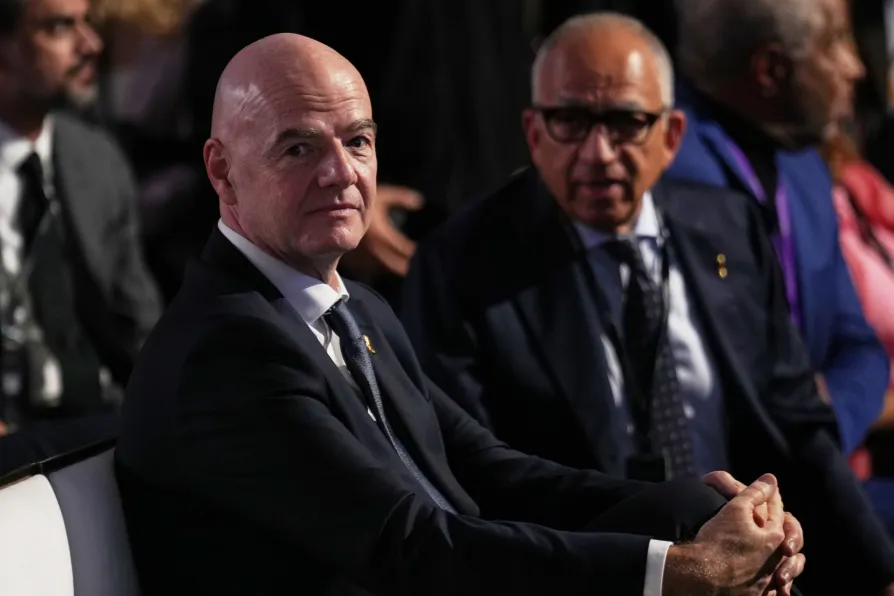 FIFA President Gianni Infantino attends the Future Investment Initiative Institute's summit, where President Donald Trump is set to speak, March 27, 2026, in Miami Beach, Fla.





FIFA president Gianni Infantino has continued to insist that the 2026 World Cup will be “the most inclusive in history.” But from extortionate ticket prices making the tournament inaccessible to the majority of fans, to the US government increasing travel bans, visa requirements, and general hostility towards visitors, it could end up being the most exclusionary World Cup in history.
The one area where Infantino may be correct in his statement is the competing teams themselves. Each of football’s regional confederations is represented at this tournament and there are several debutants, with Africa especially seeing the largest ever percentage of CAF member representation at a World Cup.
It’s also the first time Oceania has been guaranteed a spot at a World Cup without having to go through an intercontinental play-off, with the place being won by New Zealand.
The next team in line from that region, New Caledonia (Fifa rank 151), only narrowly lost to Jamaica (Fifa rank 71) in the intercontinental play-off semi-final, with Jamaica only losing on penalties to DR Congo in the final for a place at the World Cup.
It shows how small the margins can be in international knockout football at a certain level, and that a team placed higher in the Fifa rankings is not always guaranteed a big win against a much lower-ranked one.
Much of this increased inclusion is due to the expansion of the tournament to 48 teams for the first time.
As well as Oceania getting its guaranteed spot, every other confederation saw its number of guaranteed spots increase. Africa saw the biggest increase as CAF received an additional four spots, while Uefa, the AFC, and Concacaf all gained an additional three. Conmebol were given two more, meaning it had six guaranteed spots for its 10 members (had Bolivia won its intercontinental play-off against Iraq, the South American confederation would have seen 70 per cent of its members qualify, which, it could be argued, is too many).
Rather than being welcomed across the board, this increased inclusion has been the subject of debate. It ultimately boils down to whether you believe the World Cup should be made up of the supposed “best teams” in the world, predominantly from Europe and South America, with just a scattering of teams from elsewhere, or whether you believe the World Cup should be global and inclusive, even if it means some higher-ranked teams from Uefa miss out.
But even if you favour the first option, how do you decide which teams are the best in the world unless they play against other teams from other confederations?
Uefa teams face each other regularly in the Euros, Nations League and World Cup qualifying, and other regions have their own intra-confederation versions of these tournaments.
What is the point of a World Cup if it is just more of the same? If the nations from Europe and South America are indeed so much better than everyone else, then the World Cup is a chance to prove it against teams from other regions, not against teams from their own. If they are truly the best, they will naturally meet in the latter stages of the tournament.
The failure of Italy especially and others such as Hungary, Denmark and Poland to qualify for the World Cup seems to be what sparked this. There has also been a haughty attitude towards some of the teams that did qualify from other regions, as if these teams that we’re not used to seeing at World Cups, such as debutants Jordan, Uzbekistan, Curacao and Cape Verde, somehow don’t deserve their place.
The Independent reported last week that Uefa is apparently not happy with “only” having 16 spots at the 48-team World Cup, and this seems to be a view reflected elsewhere. There is a sense of Western and European arrogance and entitlement to it all.
The World Cup should, as the name suggests, be for the world. If you are a European team that is not good enough to take one of 16 available spots, which is more than any other confederation gets, then you are not good enough to represent your region versus other regions.
Sixteen qualification spots are enough, some might say, as with South American allocation, more than enough, for a confederation to represent itself at a World Cup and to send those teams to test themselves against others from around the world, which, again, is surely the point.
If you added more teams from Uefa, then some of the group stages at the World Cup final tournament would become little more than an extended round of European qualification.
Regional qualification exists for a reason. It means nearly every nation in the world play at some stage of the World Cup. Qualification is part of the wider tournament, with the finals supposed to be a celebration of global football, where those teams who believe they are the best get the chance to show it against those from other regions looking to challenge them.
And if not via a regional qualification tournament, how else would you decide which teams qualify for a World Cup? The Fifa rankings are themselves not a faultless measure of team quality and though they serve a purpose for organisational and seeding purposes, using them to decide who qualifies for a World Cup would move international football towards Super League territory, making it more of an invitational tournament rather than one you qualify for on merit.
The regional qualification process itself is not always perfect, but this is down to the regional confederations themselves, and even a slightly flawed regional qualification tournament is better than wherever the alternative would be.
The whole point of international football test matches and tournaments has always been for teams to challenge themselves against teams they don’t normally play, to prove a point and/or show off their own players and brand of football.
There is no point in a World Cup that does not welcome the world and in 2026, Fifa will host one of its most inclusive tournaments in terms of the nations involved. It’s just a shame that, due to it being predominantly hosted in the United States, it will be one of the most exclusionary in every other regard.
