WILL STONE samples the 20th anniversary atmosphere of this eclectic end-of-season indie festival


 Latest editorial
Why the working class should oppose assisted death
JOHN MCINALLY recommends that this rational, reasonable and devastating case against the End Of Life Bill be read by every serious socialist activist
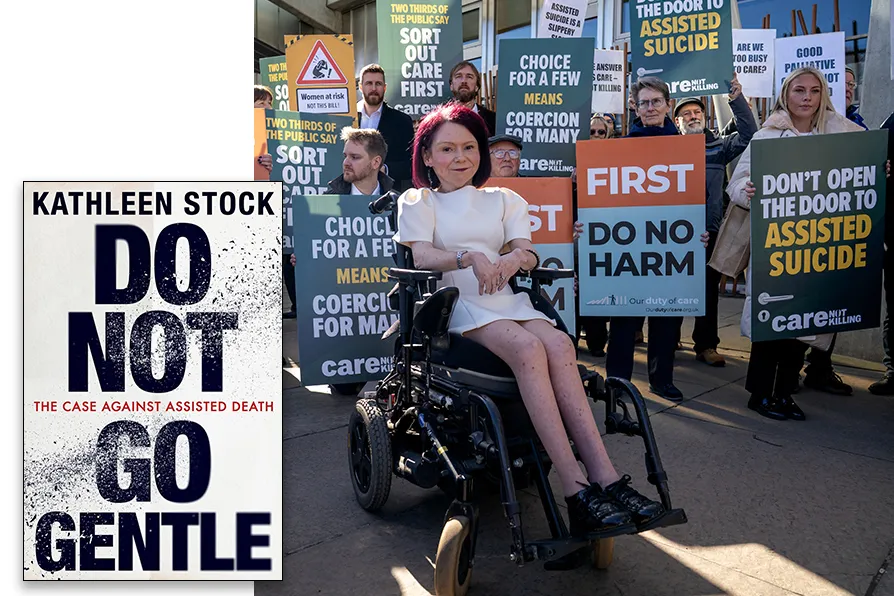 LEADING EXAMPLE: Pam Duncan-Glancy MSP joined protesters take part in a rally organised by Care Not Killing, to oppose the Assisted Dying Bill outside the Scottish Parliament in Edinburgh. March 17, 2026

Comics are not just superheroes and spandex – it can be public art, telling public stories, suggests HARRIET EARLE
The bard serenades the Diggers of Wigan and their festive followers
ALEXEI SAYLE speaks to Angus Reid about a lifetime of protest, how to hone political art – and what to do now
ANDY HEDGECOCK, JAMES WALSH, LEO BOIX and MARIA DUARTE review Just An Illusion, Everybody Digs Bill Evans, Blue Film, Oasis: Don’t Look Back in Anger, and Runner
MARIA DUARTE recommends a nerve-wracking reconstruction of the 72 hours before the Normandy landings





Do Not Go Gentle: The Case Against Assisted Death
Kathleen Stock, The Bridge Street Press, £22
KATHLEEN STOCK’s Do Not Go Gentle systematically dissects and debunks the assumptions, myths and lies constructed by Western liberal elites in their drive to impose state organised and institutionalised assisted death sold as freedom of choice, bodily autonomy and an inalienable “human right” based on compassion and humanity.
Her analysis focuses on moral, ethical and cultural questions, but the most telling conclusion to be drawn is political; state-sponsored assisted death is reactionary rather than “progressive.” Its emergence is inextricably interconnected with both neoliberal dismantling of public services and its relentless ideological offensive to elevate individual “human rights” over collective need, regardless of societal consequences.
Two archetypical figures, the “Freedom Lover” and the “Merciful Helper,” characterise pro-assisted death advocates, exposing the logical, moral and ethical inconsistencies and downright contradictions in their position. Rational, reasonable and restrained in tone and form, it is a polemic that never misses its targets.
There is no “in principle” or “religious” objection to assisted death, and most people can envisage circumstances that justify ending a life as a humane and rational choice.
Sponsor of the Terminally Ill (End of Life Bill) Kim Leadbeater and supporters find terms like assisted suicide “highly offensive.” Little wonder when substituting euphemism for accurate language is an integral element of the “compassion” sales pitch intended to manufacture consent and to avoid informed debate on the issue.
A private members’ Bill was a scandalously undemocratic mechanism with which to drive through legislation on an issue with potentially major societal consequences, as was Leadbeater when she ensured that the oversight committee had a majority of MPs who agreed with her, scuppering critical amendments: a ruthless manoeuvre designed to evade scrutiny.
Challenging manufactured wisdom achieves sharp clarity; “Many traditional arguments for assisted death services rely on the idea that great pain at the end of life is likely or even inevitable, and that death at the hands of doctors is the only solution. But there is good news – this is simply not true.” A factual statement powerfully reinforced in considering palliative care.
Note that “specialist palliative care is quite new” and that “in places where assisted death is being offered as an alternative, palliative care is improving much more slowly than the norm” due to “competition for a limited resource.” As Stock points out: “It is about whether the governments, law-makers, and the medical profession are right to provide this alternative in large cohorts, systematically.”
The differences between extreme, untreatable physical pain and psychological suffering, both cavalierly conjoined by assisted death advocates, is brilliantly argued. For example, anyone who has suffered catastrophe bereavement will almost certainly experience suicide ideation, but the idea the state is on hand to offer oblivion in the face of what is understandable human suffering that will ameliorate naturally, or with assistance, including therapy, is an abomination.
The “slippery slope” of extending criteria for assisted death is for the liberal authoritarian zealot extolling a bodily “autonomy” that exists independently of the social relations that define our humanity, and has a strategic, specific terminus – “the right to die.”
This helps create an unmissable opportunity for a “solution” coveted by social Darwinists like Matthew Parris who openly express the real view of our ruling class – why tolerate the existence of people who contribute nothing to profitability while draining resources; in their eyes this is “waste,” they are better off dead.
Without detracting from its achievement, it must be noted that while implicit in virtually every line, there is no clear explanation of the defining issue in all this: class.
Seneca and Aquinas are quoted but it doesn’t make clear their attitudes to suicide express an elite ideology justifying the class systems they had an interest in maintaining. Slaves were “speaking tools” and peasants were the “property” of the local robber baron.
Under capitalism workers are merely disposable units and subject, in Engels’s formulation, unless they organise to secure their own class demands, to “social murder.”
This book raises a fundamental question for the labour and trade union movement. Why has it been left to Stock, a left-leaning philosopher witch-hunted by so-called “left activists” for her defence of the materialist reality of sex, to make such a devastating and unanswerable case against assisted death, something wholly inimical to working-class interests?
With honourable exceptions — disability campaigners, Marxists and MPs like Diane Abbott — the movement has been largely silent in the face of the assisted death reactionary assault.
In part the answer lies in the movement’s capitulation to the very hyper-individualist identity politics Stock fears may be “unstoppable.”
This book must be read by every serious socialist activist. In setting out the dangers of assisted death for our class it can be read, albeit unintended, as a rebuke for the movement’s inaction. But a more important conclusion must be that in order to defeat the threat of rampant neoliberal hyper-individualism, a return to class politics and collective class action and human solidarity are long overdue.
John McInally is a former vice-president of the PCS union and author of A State of Struggle (Manifesto Books, 2025)
