


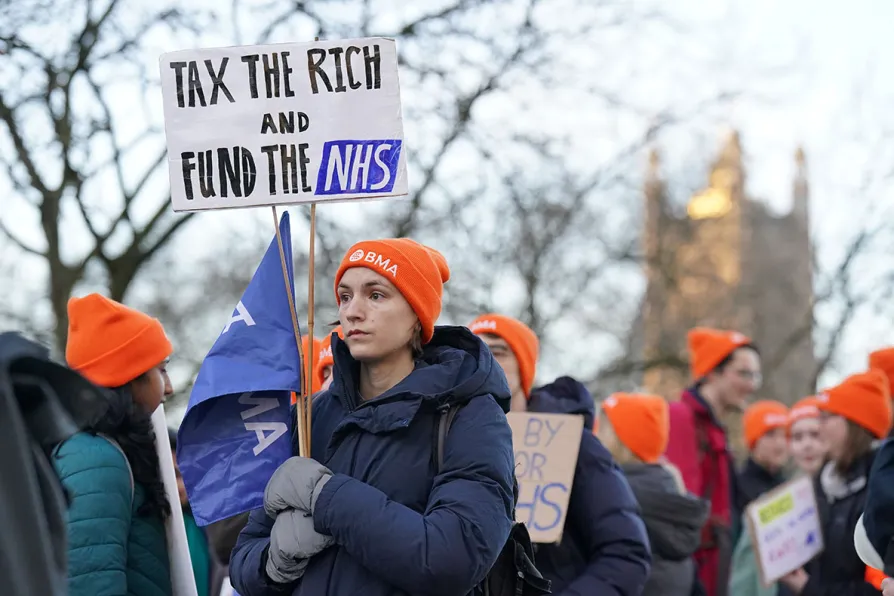
 Junior doctors and members of the British Medical Association (BMA) outside St Thomas' Hospital, London, January 3, 2024






THE six-day strike by resident doctors in England, due to start after the Easter bank holiday weekend, raises issues that concern the whole labour movement.
Doctors’ disputes are sometimes viewed at arm’s length by other trade unionists. The British Medical Association (BMA) remains outside the TUC.
Doctors, unlike most NHS workers, are not part of Agenda for Change bargaining structures, which can reduce solidarity across the healthcare workforce, and their wages are relatively higher.
Nor does every strike slogan — the threats to move to New Zealand for higher pay that featured on some junior doctors’ picket line placards last year, for instance — encourage sympathy from workers on lower pay with no such options.
But their basic grievance is that their pay remains a fifth lower in real terms than when the bankers’ crash hit in 2008.
Real-terms wages are significantly lower for most workers than they were in 2008. As other unions have stressed, reversing the impact of Tory austerity means winning restorative pay awards, which at least aim at returning to real-terms 2008 incomes over time.
The government tries to present an offer of 3.5 per cent as generous because it is slightly higher than consumer price index (CPI) inflation in the 12 months to February.
Three problems. One, CPI is a less appropriate measure of inflation than the higher RPI (retail price index), because the latter includes housing costs, a huge slice of any typical household budget.
Two, pay awards that merely keep pace with current inflation cannot rebuild workers’ wages to pre-crash levels.
And three, the US-Israeli war on Iran is sending energy prices spiralling and choking off trade routes. We are on the cusp of another huge inflationary crisis. Workers have not recovered from the last one. Without real-terms raises we are looking at misery for millions.
The BMA’s talks with government collapsed after ministers accepted the pay review body’s recommendation. Another factor relevant to other unions.
Other healthcare unions — Unison, Unite, the Royal College of Nursing — have long called for the abolition of the allegedly independent pay review body for the NHS.
Pay review bodies are not independent — their composition and remit are decided by ministers.
They let ministers duck ultimate responsibility for public-sector pay. They create the illusion that what workers are worth can be determined by external experts.
In this they undermine workers’ agency — the collective power exercised through direct negotiation between representatives of the workers and employers.
Review bodies must be replaced as a means of determining pay by collective bargaining. Defeating one in this dispute will have an impact elsewhere.
The questions are intertwined. The loss of real-terms income is tied to the retreat of collective bargaining, which covered more than 80 per cent of workers in the 1970s and now covers just 26 per cent. In the same period wages as a share of British GDP have shrunk from 60 to 50 per cent. The share taken in rents and profits has grown correspondingly.
What we’ve lost, the bosses have won. Ministers will point to tight budgets and fiscal rules to say doctors — and nurses, and teachers, and firefighters and prison officers and others — cannot have real pay rises.
But not everyone has got worse off since 2008. CEO salaries have rocketed — the average FTSE 100 CEO now earns 113 times the median wage, compared to 84 times in 2008. The profits posted by Big Oil and the big banks break records year on year.
That is what “austerity” is — the transfer of wealth from workers to the wealthy. It will accelerate as the aftershocks of Trump’s war begin to hit.
Unless we can stop it. We need a wave of industrial action on the scale of 2023 and greater.
The reasons the doctors are striking apply to most workers in Britain today. We must support them.
