
RITA DI SANTO contemplates two films about journalism that opened this year’s festival


Walter Benjamin’s search for lost time
KEN COCKBURN is intrigued by the publication of the Marxist theorist’s reminiscence of a bourgeois childhood
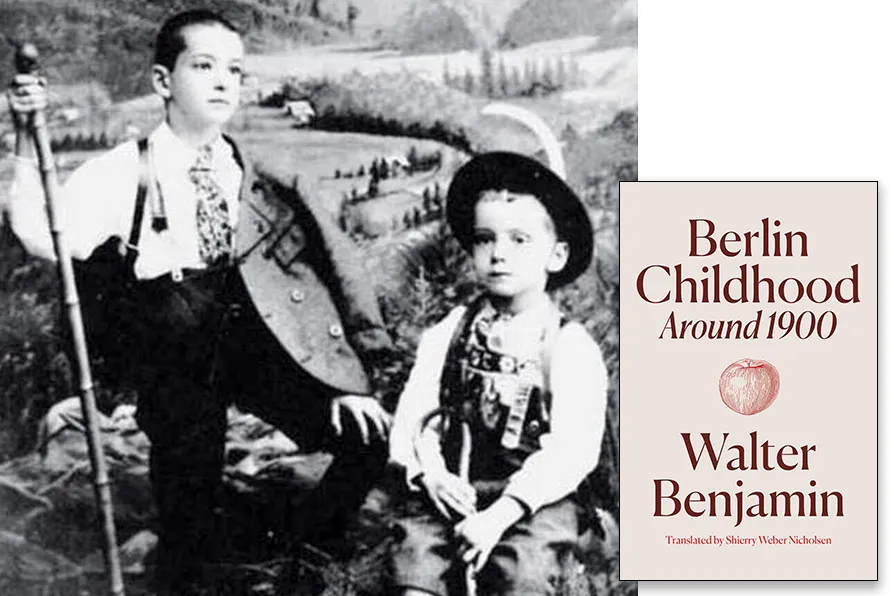
 LABOUR OF MEMORY: Marxist theorist Walter Benjamin (left) and his brother Georg, circa 1900, posing in an Alpine landscape at the photographer’s studio in Vienna [Pic: Nachlass Günther Anders/CC]
GEOFF BOTTOMS applauds a world-class production King Lear that pits late feudalism against a rising bourgeoisie
MARY CONWAY keeps up with the sheer pace of a drama about the terrible gap between sanitised reporting and real-life turmoil of race and gender
New releases from Brian Fallon, Antony Szmierek and Hollow Hand
APURBA CHATTERJEE explains how British artists in India used the “picturesque” to reshape colonial landscapes and celebrate imperial power
PAUL DONOVAN welcomes a revival of Reginald Rose’s classic play that reminds us of the fundamental need for trials with juries





Berlin Childhood Around 1900
Walter Benjamin, translated by Sherry Weber Nicholsen, Verso, £14.97
A REVIEW of John Schad’s novel Walter Benjamin’s Ark by Gordon Parsons recently appeared in these pages. Of Benjamin (1892-1940), Parsons wrote: “Through his short life, which ended at the age of 48 when he committed suicide attempting to escape from the Nazis, the unconventional Marxist Walter Benjamin created works which reshaped modern awareness of culture and language.”
Working independently after he failed to secure university tenure, his key works include the essay The Work Of Art In The Age Of Mechanical Reproduction (1935), in which he presents a theory of art that is “useful for the formulation of revolutionary demands in the politics of art.”
Berlin Childhood Around 1900 is a very different work. Begun in 1932, Benjamin abandoned it when the Nazis took power and he went into exile in Paris, returning to it only in 1938. It comprises 30 short pieces (between one and six pages long in this edition), many of which were published in periodicals in Benjamin’s lifetime. An edition which collected these pieces appeared in 1950, but it was only in 1982 that Benjamin’s complete manuscript was rediscovered and published in the form he envisaged.
In his own short foreword, Benjamin describes writing this book as “immunisation” against exile – at first anticipated, then experienced – and also as an “insight into the inevitable social irretrievability of the past.” It is not a work of autobiography – he writes he has instead “tried to get hold of the images in which the metropolis is precipitated in a child of the bourgeois class.”
This work offers no critique of that class milieu. The images he evokes are often sensory – the sound of carpets being beaten in the yard, the taste of “bitter medicine,” the sight through a window of rain falling – and the strangeness of visits to elderly aunts and grandparents, who seem to belong to a deathless, self-contained realm, where the child experiences both security and terror.
These memories are reviewed and amplified by the adult mind, while maintaining the child’s sense of perspective, both wonderful and grandiose. On a trip to Peacock Island it’s suggested he seek a peacock feather. “Finds are to children what victories are to grown-ups… With a single feather I would have taken possession of them – not only the island, the afternoon as well, the crossing from Sacrow on the ferry – only with my feather would all that have fallen wholly and indisputably to me.”
One of the most striking pieces is Winter Morning, which tracks the wonder of childhood to the disappointments of age. It opens with mention of wishes granted, and goes on to describe the pre-dawn fairy-tale-like scene of the maid bringing a lamp into his bedroom, lighting the fire and putting “an apple in the oven compartment to roast.” When the child checks if it is ready, he sees the apple as “familiar and yet changed, like a close friend who has been away on a journey.” He is reluctant to bite into it as he worries that “the fleeting lore it brought in its fragrance could all too easily escape me on the path across my tongue.”
The piece ends with the adult writer’s explicit expression of regret that so much has escaped him: “The hope I had cherished for a position and a secure living had, in every instance, been in vain.”
Benjamin’s text comes with a Translator’s Preface, an Introduction by the scholar Antonia Hofstatter and an Afterword by Theodor Adorno, written for the 1950 edition. It’s understandable that Adorno, writing only five years after its defeat, writes that “the shadow of Hitler’s Reich falls across [the images],” but that now seems overstated. Hofstatter is nearer the mark when she writes that Benjamin “attends to the debris that history leaves behind” by way of a “diligent and detailed labour of memory.”
