RITA DI SANTO assesses the winners of the most politically charged festival to date


 Latest editorial
US imperialism: continuity, not rupture
RON JACOBS points out, via a transcription of Kissinger’s secret recordings, that Trump could never have existed without Nixon and Kissinger
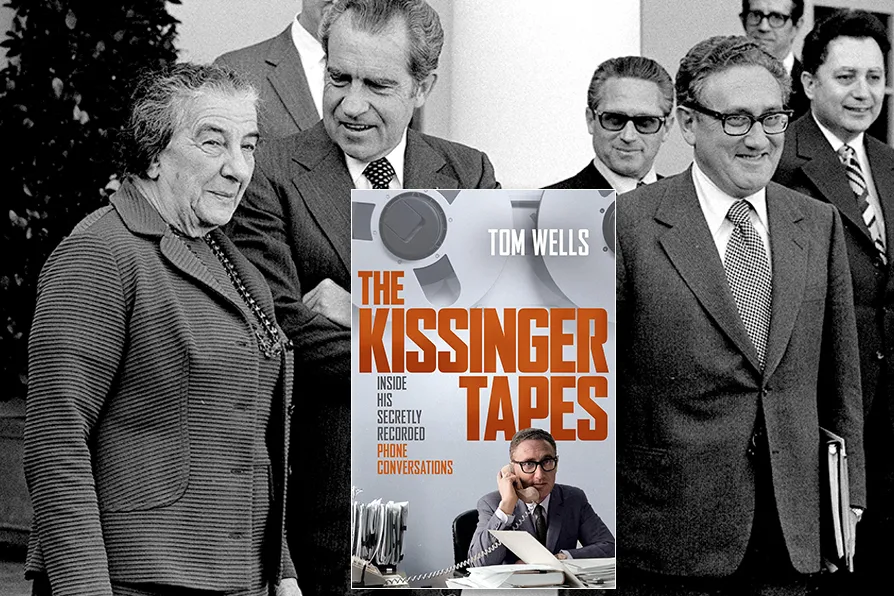 ISRAEL LOBBY: Israeli Prime Minister Golda Meir standing with Richard Nixon and Henry Kissinger, November 1973 [Pic: Marion S. Trikosko/CC]
KATARZYNA KOSMALA introduces a retrospective by one of the most significant figures in contemporary US photography
MAYER WAKEFIELD is entertained but let down by an audacious production that, sadly, doesn't ring true
MARY CONWAY is disappointed by drama that, despite accomplished performances, cannot overcome an unfocused script
New releases from Sam Carter, Spell Songs and Les Thomas





The Kissinger Tapes: Inside His Secretly Recorded Phone Conversations
Tom Wells, OUP USA, £26.99
Richard Nixon’s White House was a rampart of pettiness, paranoia, racism, and cruelty. Populated by sycophants and soldiers of the US right-wing, it was also the domain of one of history’s most calculatingly heartless rulers.
I’m not talking about Richard Nixon — who certainly would not win any awards for compassion — but about his adviser and eventual secretary of state, Henry Kissinger. This new book only confirms my opinion of the man.
Edited by Tom Wells, this text includes close to 600 pages of transcribed recordings selected from more than 20,000 pages of Kissinger’s secret recordings.
The tapes reveal an Oval Office where lying was ubiquitous and most human lives were irrelevant except in terms of how many dead bodies it might take to get an adversarial government to submit to Washington’s desires. The dispassionate manner in which human death is discussed not only reflects a sociopathy all too often present in rulers of nations; it is also a commentary on not just the banality of evil but also the willingness of those in power to commit evil deeds for the purposes of power itself.
An early example of this mentality in the Nixon administration appeared when the North Korean military shot down a US spy plane, killing all 31 people on board. Wells reveals in his commentary that Kissinger considered using tactical nuclear weapons, telling Nixon that “All hell will break loose for two months, but at end of the road there will be peace in Asia.”
This cavalier attitude towards nuclear weapons use appears throughout the book, most often expressed by Kissinger. For those who know Kissinger’s history, it’s no surprise he considered the use of nuclear weapons as often as he did. In fact, the use of tactical nukes was the subject of his 1957 book Nuclear Weapons and Foreign Policy.
A similar callousness toward human life is revealed in conversation after conversation where the US war in Vietnam was the topic. If anything, these recordings reveal an obsession with victory that was ultimately denied and an increasingly greater willingness to use carpet bombing as the path to that victory.
Even after the so-called peace agreement was signed in January 1973 after weeks of some of the heaviest US bombing in the war, known as the Christmas bombings, Kissinger and Nixon continued to advocate and order more bombing while, on the ground, much of the South Vietnamese military did its best to avoid combat.
Meanwhile, the illegal US bombing of Cambodia and Laos took place for years without the US public’s knowledge. These transcripts reveal the deception required to keep most of the US government unaware.
Then there was Chile, a government beholden to the United States during Nixon’s first term. That is, until the election of the socialist Salvador Allende to the presidency in 1971; a left victory despite the efforts of the Chilean right wing, certain US corporations, and the Nixon-Kissinger duet.
If anything, these recordings make it quite clear that Kissinger was not going to allow Allende’s government to succeed. His interest in getting rid of the socialist in Chile rivaled his determination to bomb Vietnam as much as he could before finally assenting to a peace agreement that could have been achieved in 1969; the final text of the agreement included virtually every one of the Vietnamese National Liberation Front’s 1969 demands.
Richard Nixon’s end was a number of things, but mostly it was both tragic and deserved. His lying and deception should have been enough to keep him from a second term in the White House; instead, it was ignored by the voting public who put Nixon back in office by a significant majority.
However, the doggedness of a couple reporters, together with a slighted FBI agent tacitly supported by a segment of the ruling elites, took the man down.
The relevant recordings transcribed in this text show the final years of Henry Kissinger serving at Nixon’s side as years of Kissinger distancing himself from the scandal that undid the Nixon regime. Like his years before Watergate, Kissinger lied and otherwise manipulated the press, the records and whatever else he could in order to maintain the image he had of himself.
Briefly stated, Kissinger was not only a manipulative bully; he was also egotistical and vain, a trait that comes through in his comments about women and in his approach to the rest of the world. When combined with an imperial view that placed the hegemonic desire of the US government as the basis for all international policy, that ego put the entire world in danger.
As I write this review a war begun by the United States and Israel threatens the world; a war undertaken at the command of a White House administration with an even greater arrogance than the one that featured Nixon and Kissinger. It’s a reminder that the latter could never have existed without the former. As The Kissinger Tapes makes abundantly clear, when it comes to US foreign policy, the more things change the more they stay the same.
