
Washington’s inability to subjugate Iran is an example of how it is trying to preserve a regional order that no longer exists, argues RAMZY BAROUD


Trump’s Iran gamble ends in strategic humiliation
A war sold as a quick victory has instead exposed the limits of US power, says KEVIN OVENDEN
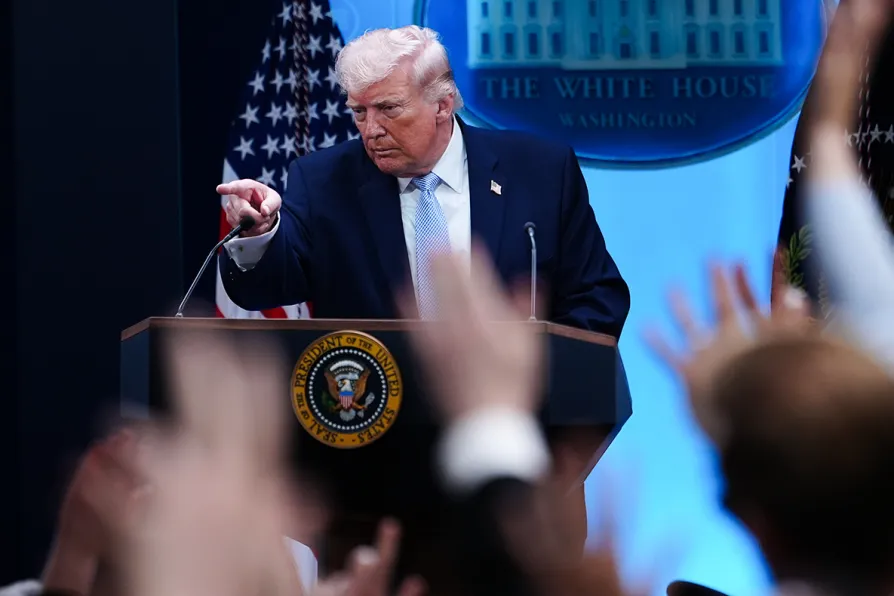
 US President Donald Trump speaks with reporters in the James Brady Press Briefing Room at the White House, April 6, 2026
US financial instability is exposing the limits of a dollar-dominated global economy — and giving the Global South a historic chance to build an alternative, says MURAD QURESHI
DOUG NICHOLLS says the parasitic finance markets must be challenged or another British government could be toppled
The late country singer’s Imagination Library has put hundreds of millions of books into children’s hands. We should build on that legacy by defending the libraries at the heart of our communities, says BRENDA AITCHISON
Deprivation is a fundamental factor in criminal behaviour that must be addressed but, KENNY MacASKILL argues, there needs to a major rethink in sentencing to tackle overcrowding
MML director MEIRIAN JUMP outlines the recently refreshed library’s busy autumn schedule that ranges from book sales, archival exploration, community work with online education and the ever popular site tours
TONY BURKE surveys the shifting political landscape and the challenges Labour needs to address if it is to prevail in the 2028 federal elections





“WORSE than a crime — it’s a blunder.”
That Napoleonic-era quip comes to mind with Donald Trump’s disastrous failure in the war on Iran.
There is huge uncertainty this weekend as Iranian and US delegations were to meet in Pakistan for negotiations. Trump said Israel would be more “low-key” over bombing Lebanon. Benjamin Netanyahu denied it and promptly blew up 300 people.
The US-Iran ceasefire is in doubt in the immediacy, let alone in coming weeks. A divided US administration first accepted an Iranian framework for talks and then denied doing so. Vice-President JD Vance is to lead the negotiations. Informed reports a month ago confirmed that he was against the war and its “facile” and “bullshit” plan.
Israel presented it to Trump as a quick win, with regime change, destruction of Iran’s missiles and a Mossad-guided uprising destroying the Islamic Republic in under a month. Seven weeks later and none of that has happened.
Has Vance been set up to fail, or is his presence a sign of serious negotiations as opposed to the antics of Trump’s son-in-law Jared Kushner, who adores Netanyahu and makes family business deals a part of US diplomacy?
We cannot be sure. We do know that whatever unfolds in the coming weeks, the US is staring at a historic, strategic defeat that will reverberate for years to come. Comparing it with Britain’s debacle over Suez in 1956 is inaccurate. The failed Israel-Britain-France war on Nasser’s Egypt was to undo his nationalisation of the Suez Canal.
The US-Israel war on Iran has put the previously open Strait of Hormuz under the control of Iran. It would never have been able to achieve that without the condition of defending itself in a war of this kind and winning global sympathy.
Trump’s manic and contradictory gyrations aimed at calming the markets have in fact underscored an epoch of rising instability that accompanies declining US hegemony. He swung from not anticipating the closure to demanding opening, to saying he was not bothered, to insisting on the states dependent on it acting themselves.
That has sent shockwaves through those governments — whether friends or foes of the US. Little remarked upon in Britain is just how quickly and severely this oil shock has already hit from India to Indonesia and Australia.
When Britain was the world power it deployed the Royal Navy to force the six sheikhdoms of what is now the UAE into a protectorate of “Trucial states” on the pretext of ensuring freedom of navigation and stopping piracy. Open trade was to 19th-century Britain’s advantage as the only global power.
Post-1945, the US took on that mantle — extended in the 1990s. It could advance not only by military and economic domination, but through what the Italian Marxist Antonio Gramsci called “hegemony.” That is through the voluntary submission of others to your leadership as a general force for stability.
US hegemony was already in decline. It is now gone. The global power cannot ensure the global flow of vital goods. What’s more, it openly boasts that it will make money from others via higher oil prices and some of its officials stoop as low as criminal insider trading.
US policy and its succession of wars in the Middle East has gone through various evolutions since the 1970s. It has not been so much about securing the oil for itself especially, as rather ensuring no-one else does. Thus others are made dependent on US power.
That has seen an increasing entwinement of the US and Israel — whoever has been in the White House. With it went a closer alignment with Gulf states in response to the Iranian revolution of 1979 and then with the opportunity provided by the war on Iraq in 1991 and again in 2003.
The Arabs invested their money (in dollars) in the US, bought US arms, gave Washington bases, moved towards Israel, partnered with US corporations and placed their faith in the US security architecture.
That arrangement has now exploded. Faced with counter-strikes by Iran, the US abandoned not only its bases in the Gulf but also its allies.
Israel took priority for missile interception, not Dubai, Qatar or Kuwait, which actually pay the US rather than rely on huge subventions. South Korea and Japan suddenly found that 70 years of “security guarantees” turned out to mean denuding their air defences overnight and sending them to the Middle East. That buries the ambition under George Bush for the US to be able to fight two major wars simultaneously.
The realisation that their energy and military interests are not guaranteed is cascading through US allies in Asia. The leader of the opposition in Taiwan visited Beijing this week talking emolliently about mutual relations.
A significant aspect of the US-led organisation of the Middle East has been directed at China. It has been part of pushing back China’s rise and locking it out of the Middle East, and elsewhere, to leave it dependent on flows of oil from a region where the US holds the spigot.
Now, the closure of Hormuz and the US’s inability to open it has strengthened China’s position, not led to it going cap-in-hand to Trump.
Already in 2020 former Indian foreign minister Subrahmanyam Jaishankar observed: “For the last 20 years, the US has been fighting but not winning in the Middle East, and China has been winning but not fighting in the Middle East.”
In 2023 China brokered a normalisation deal between Saudi Arabia and Iran, to Israel’s consternation. Netanyahu’s strategy is to fuel antagonism between the Arab states and Iran. But far from creating an Arab united front, this war has deepened division within the Gulf Co-operation Council and even within some governments. Not everyone in Saudi Arabia is happy with de facto leader Mohammed bin Salman’s pro-war position, especially when “allies” prove unable to protect you.
China vetoed a one-sided UN security council resolution this week aimed at pressuring Iran.
That may be a sign that Beijing is prepared to offer Iran diplomatic and other assistance that would make it difficult for the US to restart the war. Military analysts say there are limitations on the US using these talks as a cover, for the third time, to attack Iran. Vast amounts of sophisticated missiles have been burned up. They are replaced in months and years, not weeks. One report claims the number of missile interceptors in Israel is “down to single figures.” Another that more Iranian missiles got through in the last two weeks than in the first two.
Whatever the true military picture, it is a fact that the US navy and its vaunted aircraft carrier battle groups were not able to enter the Persian Gulf. Sending in carriers and the marines has been central to US power projection since 1945. Nowhere does this now have greater implications than in the Pacific.
Trump’s blunder may end up with China more involved in the Middle East and a part of what will have to be the security thinking of the Arab states and relations with Iran. The mere fact that the Iranian talks framework includes the closure of all US bases in the region must panic Arab capitals. That this could even be up for discussion rather than laughed out of court is devastating for them.
Trump has already managed to press together not just Iran and Pakistan but the two of them with China. The US denying that the ceasefire deal included Israel when not just Iran but the Pakistani government insist it does furthers Trump’s diplomatic isolation.
He has already proven volatile and unreliable. Amid his ravings over Nato “not being there” for him he returned to his demands to take control of Greenland.
Those commentators projecting wishful thinking that this can lead to more integrated European security arrangements should stop and pause. The biggest threat Trump wields against Nato is to pull out. Far from unifying non-US Nato, the war has opened divisions.
No-one favours it. But while Spain and Italy closed their air space (and France on a case-by-case basis) Germany kept the US bases open and is desperate to curry Trump’s favour. Meanwhile, Europe’s oil imports from Russia are rising. Economic reality has punctured Anglo-European bombast about the war with Russia in Ukraine, where it has threatened Moscow on Washington’s dime.
Britain, of course, is lumbered with a weak and vacillating Prime Minister who is treated like a punchbag by Trump. Keir Starmer is caught between popular opposition to this war and desperately trying to pretend Britain has a special relationship with the US.
It is uncertain whether the war is not over even in the near term. Iran aside, Israel is determined to annex much of southern Lebanon and to further the ethnic cleansing of Palestine in Gaza and in the West Bank, where a record 34 new settlements were approved this week. Netanyahu will want to cajole Trump back to attacking Iran.
What has happened is a demonstration of the limits of US power and a reversal for Trump, who this time last year saw his tariff war also boomerang.
The underlying drive to war and militarism remains, however. Instead of seizing peace, in both the US and Europe the cry goes up for more arms, steps to conscription, new weapons, more war in Ukraine and for the militarisation of state and society. Whether against China, Russia or another “enemy.”
All as a tsunami of economic consequences has yet to hit fully. In this frightening epoch — where the use of nuclear weapons could be mooted this week — we must do what we can to build the social movements and struggles for peace, against the immiseration of people at home and abroad and for an insurgent politics of hope.
We have to challenge our warmonger states effectively.
The monster who threatened to annihilate a 4,000-year-old civilisation on Tuesday is still in the White House today. So is the coward in Downing Street who said nothing.
