
Andy Burnham’s leadership will be judged on whether he charts a genuinely different course, argues BECK ROBERTSON


Tetragon time: introducing the wonders of New Zealand Spinach
MAT COWARD recommends a crop that keeps growing well under drought conditions
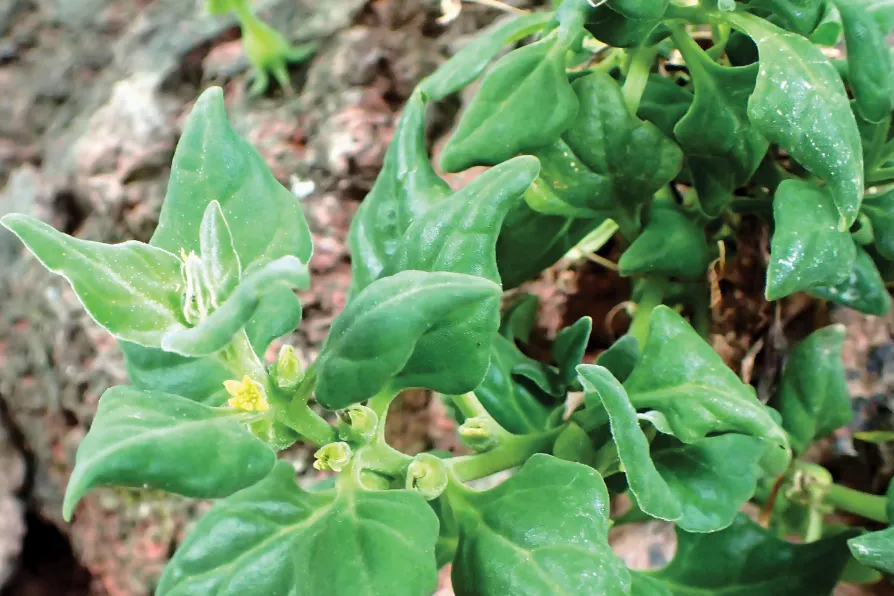
 Tetragonia tetragonioides in Anaga, Tenerife, Canary Islands. Photo: Krzysztof Ziarnek, Kenraiz/CC

While Italy’s communist tradition remains fragmented and politically marginal, France’s party is attempting to re-establish itself as an independent force rooted in working-class organisation, says NICK WRIGHT
Critics of UBI underestimate both its political significance and its economic potential, writes BERT SCHOUWENBURG
As Ontario burns, campaigners are demanding action – not more pipelines, says DAVE McKEE
Innovation in biotechnology is changing how we conceive of meat, say ROX MIDDLETON, LIAM SHAW and MIRIAM GAUNTLETT of SCIENCE AND SOCIETY





TETRAGONIA tetragonioides is usually listed in UK seed catalogues as New Zealand Spinach, though it also has lots of other names. In its native Australasia, the Maori apparently call it kokihi while many Aussies know it as Warrigal Greens. Occasionally you’ll see the seeds sold as Tetragon, which sounds to me like either a first generation computer game or a Doctor Who companion.
I’ll refer to it here as NZS, just to save my typing fingers, while noting straightaway that it isn’t actually a spinach - it’s a spinach substitute. Its most valuable feature is that, unlike ordinary spinach and most other leafy vegetables, it continues to grow well during drought conditions.
There are few other garden vegetables, if any, which will produce as much food during a hot, dry summer. It’s also productive in cool, wet ones. It’s rarely bothered in this country by pests or diseases.
The leaves are soft and fleshy, thicker than spinach, and they don’t wilt away into almost nothing as spinach often will. They are used and taste much the same as regular spinach.
NZS is very easy to grow, and stocked by most of the seed catalogues. It’s worth soaking the seeds overnight before sowing to encourage quick germination.
The plant isn’t hardy, so for sowing directly into the soil wait until you’re confident you’ve had your last frost. Otherwise it can be started in small pots under cover for planting out later.
Select a position in full sun if possible — if not, it will grow in partial shade but not as bountifully. Again, NZS doesn’t demand a rich, moist soil, but it will certainly do best in one. Adding a couple of bucketfuls of garden compost to the ground beforehand will help.
Whether sowing directly or planting out, aim for a final spacing between plants of about 20 inches (51cm), because each one can easily spread over a square yard or metre. You’re unlikely to need more than one or two NZS plants, unless you’re secretly feeding a guerilla army hidden in the hills.
However, this vigorous vegetable is sometimes grown as an edible ground cover. If you’re trying to conquer a weed-infested new allotment, for instance, NZS can act as a kind of living mulch, blocking light from the weeds and protecting the soil from drying out.
It’s a creeping, low-growing plant, its shoots rambling in all directions, their tips being where you’ll find the tastiest leaves. As you cut off the last 4 inches (10cm) of a branch, you are of course simultaneously pruning the whole plant which will help make it bushy and keep it in bounds. Without denuding it of foliage you should be able to harvest it once a week.
There’s no other maintenance to be done with this co-operative crop. You can water it in dry spells to increase the yield, but you don’t have to. The first hard frost of winter will kill NZS, by which time, frankly, you’ll probably have had your fill.
