ROB WARZYNIAK wades knee deep through a pile of ‘dead canaries’ of Trumpist policies which exacerbated the horrors of US capitalism domestically


 Latest editorial

Stop paying lip service to Scottish higher education
Cuts are sweeping campuses as cash-strapped universities slash staff and politicians fail to act on a growing funding emergency. VINCE MILLS reports
 Pupils in a classroom

Without evidence or Nato consultations Berlin’s answer to the Leipzig incident is a rupture of relations. SEVIM DAGDELEN examines why
FRANCISCO DOMINGUEZ introduces the background to a conference on defending Latin America’s sovereignty
The glacier collapse in Nepal is yet another warning that a warming planet is making Himalayan disasters more frequent and destructive – but the countries facing the greatest risks are often those least responsible, says LI YANG
Nick Blair is set to benefit from a hugely lucrative contract to ‘virtually’ train the British army for its next war. Like father, like son, writes SOLOMON HUGHES
Even when tragedy strikes, Western media cannot resist the opportunity to turn it into a sordid propaganda opportunity, as the Nepal-China border tragedy shows, writes CARLOS MARTINEZ
Trade unions should be at the heart of the anti-racist push for reparations for the historic legacy and continuing impact of slavery, writes ROGER McKENZIE





THE AGM of the Unite West of Scotland Branch, which I chair, was a tense affair because the main components of the branch, Glasgow Caledonian University (GCU) and Glasgow School of Arts (GSA) both face funding crises.
The GCU management have announced plans to cut up to 100 posts through a “targeted” voluntary redundancy scheme in response to an estimated deficit of £10 million which is a result, management claim, of reduced numbers of international students, mainly due to a collapse in recruitment at the university’s London campus — a debacle covered by the Financial Times.
Currently GCU is not in deficit and has considerable reserves but management are refusing to use these to mitigate the funding crisis, even on an interim basis. So far, the take up of offers for voluntary redundancy had been very limited and management are refusing to rule out compulsory redundancies.
Both institutions are suffering from a systemic underfunding which is undermining higher education across the UK.
It takes a different shape in Scotland because the Scottish Parliament decided to adopt a policy of no tuition fees, as opposed to the high levels of student fees seen in England — from £3,225 in 2010 to £9,535 in 2024. Student fees have undoubtedly contributed to the debt burden on students in England and limited access to higher education by working-class students.
The argument that the lack of fee income from students in Scotland is the primary source of the crisis is ignoring the reduction in Scottish government support.
Since 2014/15, funding per student in Scotland has fallen by 39 per cent in real terms, while the Scottish Funding Council Research Excellence Grant has fallen by 43 per cent. Meanwhile operational costs, staff salaries, and infrastructure maintenance have continued to rise.
In Scotland, as in England, universities have come to rely on income earned from international students to address financial shortfalls. International students pay between £10,000 and £40,000 annually in contrast to the £1,820 notional fee for Scottish students. However, data from the Higher Education Statistics Agency (HESA) in 2025 reveals a 12 per cent drop in international enrolments — from 83,975 in 2022-23 to 73,915 in 2023-24, with an estimated cost £150 million.
Some of this has been a consequence of Westminster’s attempt to tighten regulations on immigration, for example, the restrictions on bringing in dependants. This has led a sharp decline in the number of international students on taught postgraduate courses. The more serious issue though, is we now have a higher education system that is dependent on a source of funding which is increasingly volatile — from currency fluctuations in some countries to competition from Australia and the US.
The result of all this has been a tsunami of job loss from the higher education sector in Scotland: the universities of Aberdeen, Dundee, Edinburgh, Glasgow, Glasgow Caledonian, Heriot Watt, Stirling, Strathclyde and West of Scotland have all lost staff and risk losing more. According to the Herald newspaper across eight higher education institutions in Scotland, approximately 1,000 jobs have already been lost to severance schemes since 2024 and as many as 2,200 further posts could be at risk.
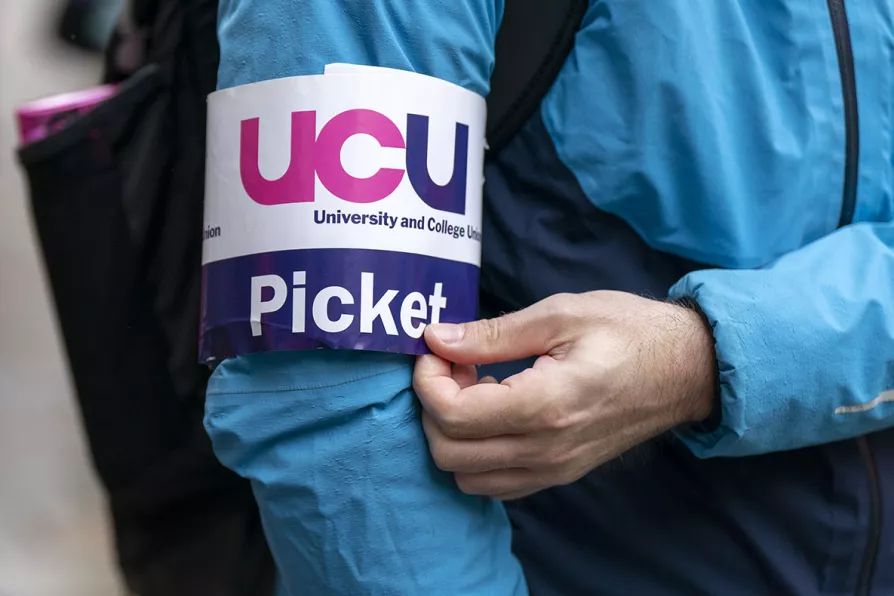
Staff have responded with strikes, and action short of strikes and, with the Scottish election approaching in May, intense lobbying of parties and candidates for the Scottish Parliament. On April 24 there will be a rally in Glasgow as part of a day of action that will include strike action.
So what are the Scottish political parties we might loosely call progressive, saying about this crisis? Their manifestos might offer more hope but there is little in what they are currently saying that would give staff and students reason to believe that change is on the way.
As the party of government, the SNP is very much in the firing line, but it seems impervious to the depth of the crisis higher education faces. In their budget statement, the SNP government announced a combined increase in resource and capital funding for universities of £55m, as a “significant real-terms increase.” The university sector dismissed it as insufficient.
According to the Institute for Fiscal Studies (IFS): “Without substantial increases in devolved revenues, improvements in public-sector efficiency or cuts to other spending, it will be increasingly difficult for future Scottish governments to continue to provide a wider range of free services — such as university tuition and personal care — than their counterparts elsewhere in the UK.”
How Scottish Labour might tackle this dilemma is also a bit of a mystery. Their policy commitment for 2026 is rather cryptic: like the SNP they promise to “maintain free university tuition for Scottish students.”
How they might do this is left entirely unclear: it is to “…work with the higher education sector to find a funding model that ensures the long-term sustainability for the sector.” But we are given no hint as to the nature of the “model.”
For a serious solution you have to look at the manifesto produced by the Scottish Trades Union Congress (STUC) to grasp what workers need from political parties: “Politicians need to be honest that taxes will have to rise … They have the power to do so through property, land, wealth and other taxes, such as a private jet tax, an online sales tax, and a levy on alcohol retailers.”
It is an approach which Ken Drury, currently standing for the executive council for Unite in the education sector, fully endorses. Drury said: “It’s time to stop just paying lip service to the importance of higher education, and to start to fund it properly.”

Similar stories

JACK DAVIDSON explains the motivation behind the UCU strike action at the University of Sheffield