KEN COCKBURN traces the one original language – that of the Yamnaya pastoral nomads – from which all European and Indian languages derive


 Latest editorial
Spilling her guts
JAN WOOLF is bowled over by a major retrospective for the YBA artist
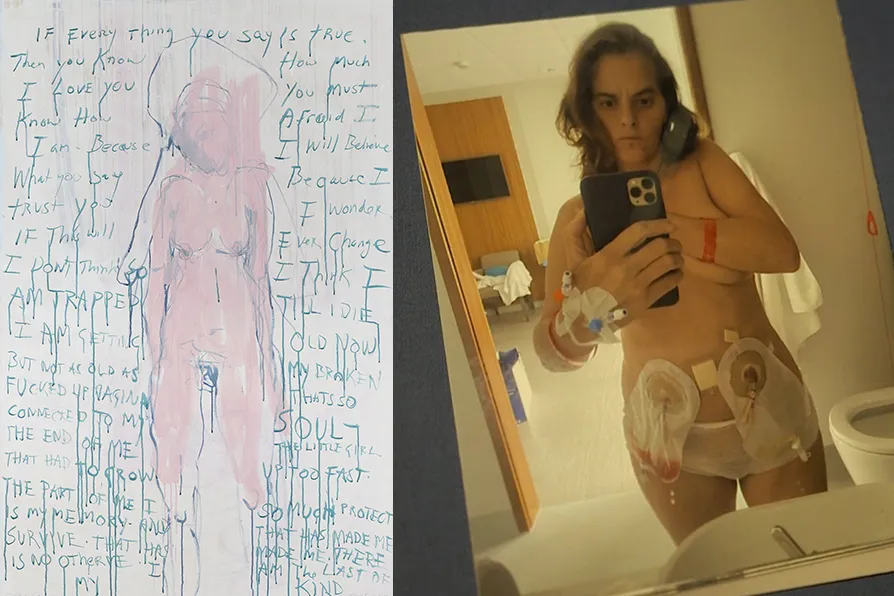 (L) Tracey Emin, I am The Last of my Kind, 2019; (R) from Stoma photographs, 2020 - 2025 [Pic: © Tracey Emin. All rights reserved, DACS 2026]

PAUL DONOVAN is fascinated by the debunking of the iconic British war hero
ALEX HALL recommends a searing panorama of our global predicament
Comics are not just superheroes and spandex – it can be public art, telling public stories, suggests HARRIET EARLE
ALEXEI SAYLE speaks to Angus Reid about a lifetime of protest, how to hone political art – and what to do now
The bard serenades the Diggers of Wigan and their festive followers





Tracey Emin: A Second Life
Tate Modern, London
★★★★★
Tracey Emin’s all the rage at the moment. It was once thought that her de-mons were me-doms, her potty mouth on the run, but this retrospective at Tate Modern reveals her universality in content and glory in form.
Courage too. In short, Tracey Emin is extra ordinary.
Please don’t join those two words up to make the rather ubiquitous one — but take them at face value. Hers has been a life of ordinary sufferings. For working-class women! Rape, abuse, neglect, abortion are ordinary enough. This is the Epstein era after all, Gisele Pelicot has told her story, and who knows what’s happening on our street corners this very minute.
Extra is the fine art that Emin has made from this experience — art that transcends the suffering, and often the passion. Hers isn’t the Renaissance art of upturned gazes and suffering sainted-flesh. Exhibitions like that doesn’t get notices like this at the end: “The artist invites us to feel our own emotions in response to the works, as well as think about their content. If you need a space to reflect on your time in the exhibition, Tate Visitor Engagement Assistants can show you to a quiet place nearby.”
Neither is it “outsider art,” as in the 2018 show at Sotheby’s auction house, where artists outside the system, but often in the mental health one were given a show. This made me uncomfortable, as it was funded by people who create the social conditions that cause anxiety and mental ill health in the first place.
Just had to get that off my chest, like Tracey gets stuff off hers. A Second Life is a before and after show. Spilling her guts either side of the bladder cancer diagnosis in 2020. This is the mark of the true artist; that you don’t just carry on but evolve.
In the first room is a smashing work — My Major Retrospective 1982-1993. This charts Emin’s lifelong commitment to painting, presenting works from her first solo exhibition at White Cube. It’s a series of tiny photographs of her art school paintings from the 1980s which she destroyed following a traumatic period in her life. What a tragedy, but here they are, for the record. It’s inspirational in that it can give you ideas about your own life mementos.
But you need to lean right in to see them, risking setting off an alarm. Now there’s an idea for a mischievous piece of interactive art. So, why have the rope so far back? Why not put it under glass? This is my only criticism of the show – but of the curation, not the art.
Nearby, the video Why I Never Became a Dancer explains how she was raped aged 13, and the subsequent sleeping around. How she entered a dance competition which promised a way out, with local lads hounding her off the dance floor chanting “Slag, slag, slag, slag.” Then her twirling round a studio to Sylvester’s You Make Me Feel (Mighty Real) and grinning joyfully, yelling “Shane, Eddie, Tony, Doug, Richard, this one’s for you.”
And you want to cheer because she is a survivor of extra ordinary vitality. She both transforms and transcends what others would experience as failure. Trauma is turned into success through some alchemical process of will, courage and talent.
Some say she can’t draw. Oh yes, she can; but on her own terms, like everything else she’s done. If she has drancestors (drawing ancestors) they are from the expressionist school; Munch et al – and way before that, cave art.
There are some gut-wrenching drawings in the abortion series, as well as her film explaining what this meant to her. A dimmed galley space linking small intimate photos before and after her guts were rearranged. The stoma photos are so brave. But maybe not to record and show them would have been braver? You get the feeling that not to make art out of this would have compounded her suffering.
There is a lesson in that.
That bright pink plug in her stomach is a part of her small intestine. This is not narcissistic, and we are not voyeurs. She is sharing it. Gifting it.
Then the famous bed that didn’t win the Turner prize. Called a sculpture and surrounded by what the posh art world would call “objects trouvés”. I would call this “emotions trouvés” as the things surrounding the bed are the detritus of emotional pain.
She has recently said, that if she remade My Bed it would be all neat and tidy, sheets tucked in – no mess. Nice to know.
Entering the rooms beyond the bed, you gasp (I did anyway) at the vulnerability and the beauty. Her minimal lines are just right and express what’s needed. Splats, splashes and dribbles of paint that she either controls or sees the aesthetic in – which amounts to the same thing. Images of pudenda and vulva that could not be further away from pornography. These rooms have a cathedral-like quality.
She runs her mouth less these days – a turn that turned her into “mad Tracey from Margate,” the Establishment’s bit of rough. She is now more circumspect, running her free studio-based art school in Margate as Dame Tracey Emin – her own woman, doing charitable work and supporting young artists. OK, she’s been all over the place politically throughout her life, but that isn’t how we judge artists. Unless they’re fascist of course, in which case it shows in the art. She turned down Reform’s request to use her image of a naked body running with a union jack by the way. “My arse is a bit too brown,” for you lot.
I thought the neon text signs a bit boring – maybe because her idea has been taken up by the corporate world. But also that her sculpture has more life than Rodin’s.
She’s quoted in the press release thus: “I feel this show… will be a benchmark for me. A moment in my life when I look back and go forward. A true celebration of living.” I hope she’s happy now, she deserves it; forever and ever, Emin.
Runs until August 31. For more information see: tate.org.uk
