New releases by Interpol, Phoebe Bridgers, Lambchop


 Latest editorial

Sorry, but this isn’t radical
JOHN GREEN is disappointed by a history of the British working class that retreads familiar paths and offers no new insights
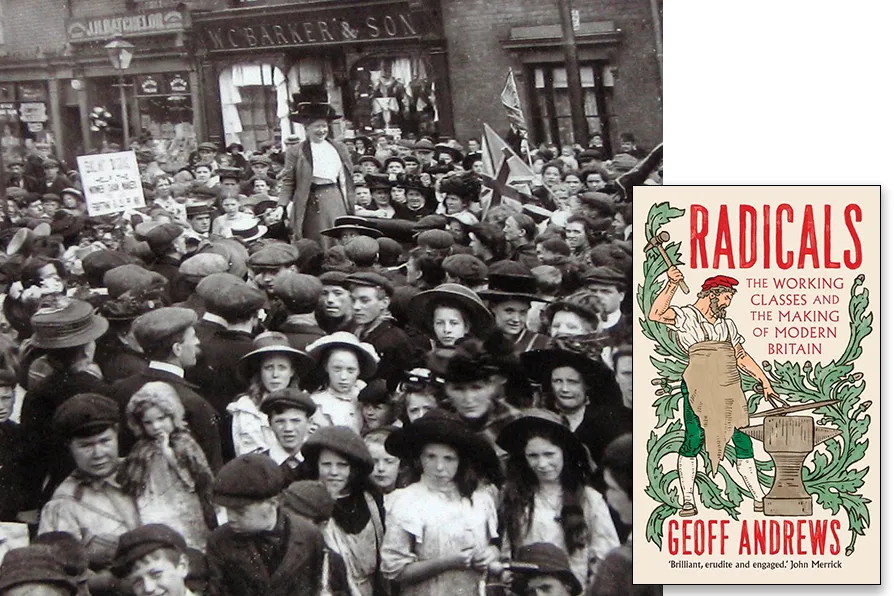 STRIKING OMISSION: True radical Mary MacArthur addresses the crowds during the chainmakers' strike, Cradley Heath 1910 [Pic: Edwin Beech/CC]

ANGUS REID urges us to understand the persecution of Jason Arday from a political and historical perspective, and to see the victim in human terms
Re-releases of the classics Gypsy Rhumba and Buena Vista Social Club, and a stunning album by Palestinian artist Faris Ishaq
Nothing, says ANDY HEDGECOCK, can rescue this undistinguished amalgam of ponderous melodrama and shallow philosophical speculation
JAMIE BRITTON invites readers to visit 3,500 locals as part of a marathon artistic pub crawl
JOHN GREEN welcomes a valuable and incisive analysis of a world become hyperpolitical but without the mass movement institutions to represent it





Radicals – The Working Classes and the Making of Modern Britain
Geoff Andrews, Yale University Press, £25
THE title holds great promise, but its contents hardly live up to it. It is largely an eclectic mish-mash of widely known historical movements from the Chartists to the modern day, offering no new insights.
As Andrews writes in his introduction, the role of the working classes in shaping modern Britain has been largely ignored by mainstream historians. He attempts to put the record straight but adopts an idiosyncratic approach.
His first chapter gives prominence to Thomas Wright, an obscure late 19th century working class writer and activist. While Wright is clearly an interesting and neglected figure, capturing Andrews’ interest, he is hardly significant in terms of the historical development of the working class.
Andrews writes at length about the importance of 19th-century working-class auto-didacts and how this educational movement impacted on the development of a working-class consciousness. Surprisingly, in this context, he doesn’t reference the seminal work by Edith Hall and Henry Stead, A People’s History of Classics, which explores in great detail the influence of the classical past on the lives of working-class people from the late 17th to early 20th century and whose voices have been almost completely excluded from previous histories.
Hall and Stead examine working-class experience of classical culture from the Bill of Rights in 1689 to the outbreak of World War II. Their work reveals a deeper understanding of what these cultural interactions signified to the working poor: from the promise of social advancement to covert and overt class war.
Andrews’s book also has a number of niggling failings. In his rather patronising chapter on that iconic work, The Ragged Trousered Philanthropists, he questions its proletarian authenticity on the basis that its author Robert Noonan was the son of a privileged South African couple. Jack Mitchell, a university lecturer and authority on the work, is also described wrongly and condescendingly as “an archetypal CPGB functionary.”
Writing of the match girls strike of 1888, he says that it was the first strike organised by women “and the next one would be 80 years later at Ford Dagenham,” ignoring the successful 10-week strike in 1910 by women chain-makers in the Black country. The caption on a photo misidentifies Jayaben Desai, leader of the Grunwick strike. While mentioning the role of working-class dramatists in the late ’50s and ’60s, he ignores the key figure of Arnold Wesker. These are perhaps not significant in the whole context but are a sign of sloppy research.
The book takes us on a rather well-worn path through the significance of Chartism to the establishment of the Fabians, the SDF and ILP and the key role played by worker education.
In his conclusion, he rightly focuses on the fact that the working class(es) today bear little resemblance to that of the heyday of Britain’s industrial revolution and even that of the early 20th century.
Today, the working classes play little role in day-to-day politics or in mass movements as an organised force. The working class is fractured and no longer has any sense of class cohesion, loyalty or consciousness; the Labour Party — created by the working classes to obtain a political voice — no longer has working-class roots nor is it seen to represent those interests anymore.
Hobsbawm had already noted in the 1980s that large sections of the working class no longer identified with the labour movement and, post Thatcher, it was no longer able to rely on its traditional strengths. Andrews notes that disillusion with the Labour Party has helped fuel the popularity of nationalist parties, the Greens and Reform, is dismissive of Corbynism and holds out little hope for a resurgence of a new left.
