A new generation of right-wing politicians have shifted from promoting deregulation to championing anti-migrant politics warns SOLOMON HUGHES


 Latest editorial

A society robbed of its compassion
Art matters because stories, herstories, histories, and even flights of fancy matter, posits MATT KERR
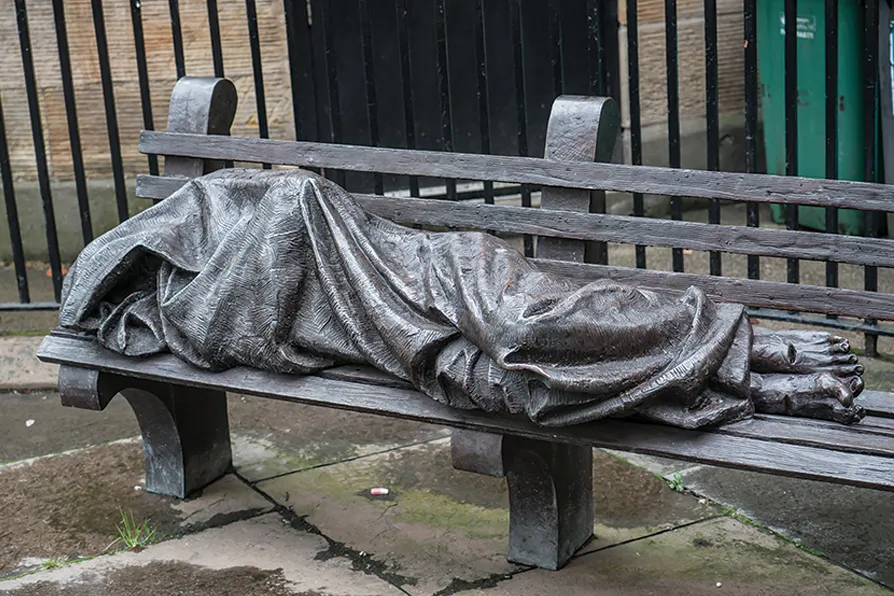 ART TAKES A STAND: The Homeless Jesus bronze statue in Glasgow, located at Nelson Mandela Place near St George's Tron Church, was created by Canadian sculptor Timothy Schmalz and installed in December 2017 [Pic: Brian Deegan/Creative Commons]
by the Greater Manchester Workers’ and Tenants’ Association
The US relationship with Israel has evolved into a strategic liability, argues RAMZY BAROUD
A champion motorcyclist, trade union organiser and communist, Clem Beckett went from Britain’s speedway tracks to the battlefields of Spain, where he gave his life resisting Franco’s forces at Jarama. GEOFF BOTTOMS pays tribute to this remarkable anti-fascist
The greatest threat to democracy may no longer come from political parties but from unelected tech oligarchs like Peter Thiel and his powerful Silicon Valley network, argues JOHN GREEN
Claiming to ease a fertiliser shortage, the Trump administration has suspended tariffs on Moroccan phosphate imports – deepening US support for the Morocco’s control over Sahrawi territory, writes LUKE ROTELLO





YEARS after moving in, I’m still surrounded by boxes of books. The long process of building their dream home will be finished just in time for me to snuff it, but they’ll get another chance.
Little gems hide in those boxes, and every time one is opened I remember how they came to live with me. Second-hand shops, May Day stalls, and of course Unity Books. From the daft to the theoretical, from the sublime to the ridiculous, each one can tell a story or two before a single page is even turned.
Plenty, I’m sure, can now be found in the ether, but reading off a screen doesn’t come as easy to me and besides, if I gave up on them I wouldn’t be able to periodically remind my daughter that “you won’t find that on the internet” as she rolls her eyes.
I’ver spent the last day hunting through the boxes not for gold but for The Stane. A little grey book with a Thor-like figure on the front, filled with poems and songs mocking power and glory while reminding the reader of their own.
This little thing has floated in and out of my life for just about as long as I could pay attention. On my dad’s shelf, disappearing and reappearing before finding its way on to mine. It never seems to be there when I look for it, preferring to be discovered rather than found.
I remember being dropped off at the author’s house, Churchill Drive, Ardrossan. My sister and I had never seen so many books outside a library. The home of Dick and Helen Aitken, two lefty stalwarts who had taken our dad under their wing. I remember thinking I saw Helen on the telly only to put firmly in my place — “that’s Barbara Castle, numpty!”
Dick had been a newspaper man, but by now was well retired and, from what I could see, dedicated his time to putting The Stane together and painting watercolours of rural idylls a million miles from his sharp political satire. He framed them too, and showed us how to cut the glass, even giving us one of the little scorers for the job. I’ve no idea what he thought a six year-old would do with this, but it now lives in the shed.
Paintings were distributed to friends — we ended up with three — every one of them featuring his signature, well-placed, duck’s backside; a little act of rebellion us sproglets could relate to.
Rebellion takes many forms. Unite hospitality workers at the Village Hotel in Govan are still out on strike, months on, holding firm against an employer who appears determined not to allow them a second victory after their historic action — the first strike in a major hotel chain since 1979 — last summer. Rightly, there’s a lot of strike ballots and picket lines around just now, but for me, the strike and Village and the Vue cinema stand out.
Taking strike action, and facing all the risks that still outrageously go with that, isn’t a bundle of laughs in any sector, but in an industry where low pay is endemic, precarity is routine, and abuse is commonplace, it is positively heroic. They will win again.
It takes a particular collective strength of character, smart organising, and yes, a bit of art too. Posters to grab attention and inspire support, music to sustain the picket — and irritate the employer — and poetry to tell the story.
Nearly three years ago, a then Glasgow institution, the 13th Note was shut down by a vindictive owner who would rather see it disappear than give people safe working conditions. Undeterred, Unite Hospitality and the 20 workers who lost their jobs bid to take on the lease and run it themselves. They raised the cash, formed a plan and took it to the council.
Despite these workers having literally run the place for years, in its infinite wisdom, the city’s arms-length property company — City Property — declined the bid. The once buzzing venue still stands empty, an eyesore, rotting away when it could deliver jobs and be cared for in return.
A hundred yards from that spot a few years earlier, shops were handed over to business for the princely rent of a pound. “Better that than see them lie empty” was the logic, a logic robust enough that even the council leader’s partner was one of many who took up the offer.
Within staggering distance of where the 13th Note rots stands Trongate 103. An old warehouse into which the council ploughed £8 million to provide stable, affordable spaces for the arts back in 2009 when £8m was a lot of money.
Its multistorey atrium rattled to the sounds of Edwyn Collins and Teenage Fanclub on a joyful opening night, and since then that space has displayed established artist and first-timer alike, and with a notably higher presence of working-class work than most — a low bar, admittedly.
I’ve been back a few times since. Up to GMAC film to see The Big Lie and frequently to Glasgow Independent Studios (GIS) to build bookshelves for my partner and packing cases for her paintings, the space echoing to my cries of sweary anguish as I did so.
Take that as a declaration of interest, if you like. I think we should all have an interest in the next chapter of this story though. City Property intends to hike charges by 300 per cent, a rise that would cost GIS alone at least another £20,000 a year — enough to force this self-sustaining co-op into moving out, folding, or fighting.
I can well understand why City Property is doing this. Since its inception under Labour and then under the SNP, it has existed to allow off-balance-sheet borrowing; it has mortgages to pay and a virtually bankrupt council expecting it to wash its own face by charging “market” rates.
The trouble is that market rates are nonsense. If the market functioned as its acolytes claim, the £1 rents around the corner wouldn’t have been necessary, and the council wouldn’t have spent all that money building Trongate 103 in the first place.
Areas littered with empty premises should be cheap in a functioning market, should they not? Of course not. They are owned by people who would rather sweat the capital than take the risk of the buildings actually being used for any sort of purpose at all.
When artists cry for support at Trongate 103, or elsewhere, in times like these they will naturally face the “tough decisions” line from public and politicians alike. People will look around them and see things like the crumbling roads, the funding crisis at all levels of education, soaring homelessness and see art as a low priority.
Fair enough, perhaps, but it is the same tyrannical principle that values needs of capital over need itself that has left Scotland with the highest rates of homelessness on record and over 10,000 kids growing up in temporary accommodation.
The homes exist, just as the spaces for artists do, but it remains in the interests of owner to deliver scarcity, rather than a better world.
That this guides the private players should never be a surprise, they exist to make a profit and that’s what they’ll do, but short of it all collapsing tomorrow the least we should expect is some sort of alternative from what’s left of the public realm.
City Property can hike its charges, not see a penny, and sit on yet another empty building, or show some imagination.
Art matters because stories, herstories, histories, and even flights of fancy matter.
A society robbed of spaces for workers to live, breathe, and imagine, is a society robbed of its compassion.
No rebellion is complete without it.
