TUC president and POA leader STEVE GILLAN speaks to Ben Chacko on the eve of Congress 2026


 Latest editorial
The return of the Homunculi
Small Prophets finds Mackenzie Crook conjuring tiny prophetic beings from working-class malaise, writes STEPHEN ARNELL
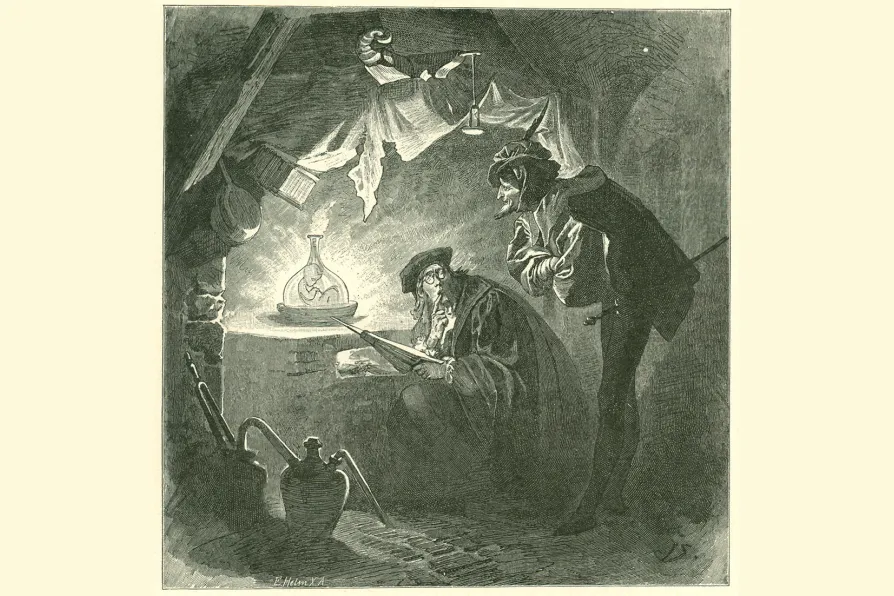 Famulus Wagner and Mephistopheles with a Homunculus in a vial. Illustration for Johann Wolfgang von Goethe, Faust [Pic: Public domain]

DOUG NICHOLLS welcomes a turning point at this year’s Congress, where many motions call for a co-ordinated plan to revive British industry, a perspective outlined in his new book
HOPE VIRGO of campaign Dump the Scales warns MPs voting today they should be alert to the threat legalised assisted death poses to people with eating disorders
The Together Alliance is hosting two summits, North and South, to build power and plan action against the scourge of racism peddled by the right. DANIEL KEBEDE urges mass participation
The drift toward militarisation in Europe is not inevitable, left-wing and peace movements can preserve sovereignty and prevent war, says DÁIRE HUGHES MP
Whatever differences exist among international sympathisers of the Bolivarian revolution about its current trajectory, they should unite against the imperialist power that is the source of an enforced retreat, argues ROGER D HARRIS
Trade unions need to step up and force a turn in the policies of the labour movement to effectively confront the far-right threat, argues NICK WRIGHT





MACKENZIE CROOK’S critically lauded BBC2 comedy Small Prophets has been credited with the creation of an entirely new subgenre; “magical social realism.” This combines aspects of folkloric sorcery with Mike Leigh’s forensically bleak (but often comedic) investigation of blue-collar life in these Isles.
Life in a northern town
The show depicts the mundane life of Michael Small (the excellent Pearce Quigley), trapped in a mournful existence since the mysterious disappearance of girlfriend Clea seven years ago on Christmas Eve, his Manchester house piled up with her boxed possessions, the Christmas tree still up in the living room. The tedious grind of low-wage employment is effectively depicted at the DIY store where Small works, although he manages to cock a snook at management, in the shape of Mckenzie Crook’s Gordon, fated to forever come off worse in the petty upbraidings he regularly administers to his droll underling.
So far, so not entirely groundbreaking, although far wittier than anything Ricky Gervais, Crook’s old boss from The Office, has ever come up with.
All the small things
The gamechanger appears when the equally excellent Michael Palin, as Small’s dad, old people’s home resident (and possible dementia sufferer), suggests a possible solution to the mystery of Clea’s disappearance and a cure for his son’s anhedonia. His suggestion, gleaned from his time spent in Egypt on national service, is the creation of truth-prophesying “Homunculi,” who can tell Small Jnr the fate of his Inamorata. And maybe make him a few quid through sports betting.
These tiny humanoid creatures represent the nexus point of ancient thaumaturgy and science; grown in large glass bottles using (according to lore) blood, horse manure and … semen, the latter believed at the time to contain microscopic human beings.
From then on Small Prophets becomes an entirely different proposition, although still grounded in the reality of Crook’s vision on Britain’s struggling-to-get-by working classes. The impish Homunculi, who take the forms of a King, Queen and Bishop, have to be treated with respect, but as long as the correct rituals are observed, and their jars sealed, will obey their creator/master.
Slightly like the relationship between Roper (Hugh Laurie) and his needy by-blow Teddy Dos Santos (Diego Calva ) in BBC1’s recent second season of The Night Manager. I guess.
We’ve only just begun
The origins of the Homunculi began with Zosimus in the third century AD, and the alchemical writings of Paracelsus (1493-1541), with the beings and their plant-based cousins, the Mandrakes, occupying a singular place in lore, continuing to be accepted as “real” for centuries; and may still be by some, for all I know.
See also the mud-derived Golem of Taldmudic legend; looming, much larger creatures animated by the Hebrew letters of God’s name, written on paper and either inserted into the mouth or glued to the forehead of the being.
Cultural portrayals of Homunculi have hidden in plain sight over the years, in books such as Peter Ackroyd’s House of Doctor Dee (1993) and movies including Pan’s Labyrinth (2006), The League of Gentlemen’s Apocalypse (2005) and The Golden Voyage of Sinbad (1973), where Tom Baker as the evil wizard Koura creates a winged variation.
My own particular favourite movie Homunculi were represented in James Whale’s camp classic The Bride of Frankenstein (1935), where Ernest Thesiger’s oddball Doctor Pretorius shows Henry Frankenstein his Homunculi collection. Everyone has to have a hobby, I suppose.
And on TV, Tom Baker has another encounter with the Homunculi, this time as Doctor Who encounters the nasty Mr Sin (Deep Roy) a carnivorous Homunculus from the future in The Talons of Weng-Chiang.
To conclude on a suitably dystopian note, the modern-day version of the Homunculi are already with us. I speak of course about AI: the predictive, imitative, probable supplanter of humanity, originated by advanced algorithms, massive datasets and massive computational power.
Rather than blood, sperm and horse dung.
