TUC president and POA leader STEVE GILLAN speaks to Ben Chacko on the eve of Congress 2026


 Latest editorial
Opposing imperialist adventures from above and below
KEITH FLETT argues that we need to stand up to those in power every single time they transgress
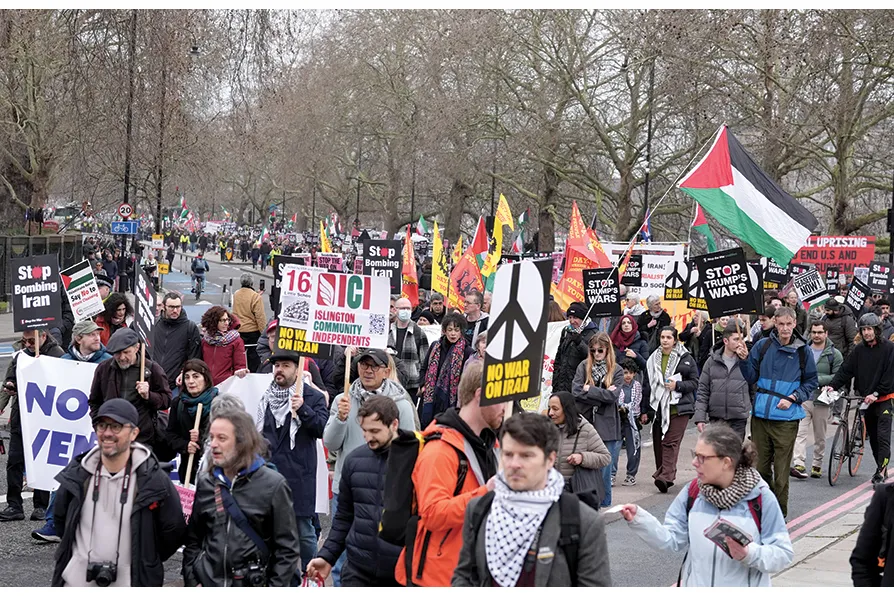 EXPRESSING REVULTION: CND, Stop the War, Palestine Solidarity Campaign, Muslim Association of Britain, Palestinian Forum in Britain and Friends of Al-Aqsa organised national protest march to the US Embassy in London. March 7 2026

DOUG NICHOLLS welcomes a turning point at this year’s Congress, where many motions call for a co-ordinated plan to revive British industry, a perspective outlined in his new book
HOPE VIRGO of campaign Dump the Scales warns MPs voting today they should be alert to the threat legalised assisted death poses to people with eating disorders
The Together Alliance is hosting two summits, North and South, to build power and plan action against the scourge of racism peddled by the right. DANIEL KEBEDE urges mass participation
The drift toward militarisation in Europe is not inevitable, left-wing and peace movements can preserve sovereignty and prevent war, says DÁIRE HUGHES MP
Whatever differences exist among international sympathisers of the Bolivarian revolution about its current trajectory, they should unite against the imperialist power that is the source of an enforced retreat, argues ROGER D HARRIS
Trade unions need to step up and force a turn in the policies of the labour movement to effectively confront the far-right threat, argues NICK WRIGHT





WHAT Keir Starmer’s actual position is on Trump and Netanyahu’s imperial adventures in the Middle East is not entirely clear. We can however be sure that as Marx noted the past weighs like a nightmare on the brain of the living.
On March 17 2003 Starmer wrote in the Guardian in a piece that remains online that the Iraq War was unlawful.
While the mass protests against that war did not stop it, they effectively finished the front-line political careers of those who promoted it, notably Tony Blair.
This dialectic of protest from below and political impact from above can be seen in earlier decades.
In the mid-1960s Harold Wilson backed Lyndon Johnson’s war in Vietnam but was mindful of anti-war protests. Johnson wanted British troops on the ground in Vietnam. Wilson refused. However he did secretly allow US forces to use British bases in the Far East and specialist troops were deployed under the US aegis.
In 1956 when France and Israel attempted to take control of the Suez Canal, Labour leader Hugh Gaitskell refused to back Britain’s role, using the slogan “law not war.” The US did not back the adventure which gave Gaitskell more room for manoeuvre. However street protests and even some anti-war industrial action also influenced his position.
Gaitskell was a right-wing Labour leader remembered for facing down attempts to get the Labour Party to commit to unilateral nuclear disarmament. It was the coming together of pressure from below and politically expedient positions at the top that was important.
Britain is no longer a significant imperial power but from the late 19th century until World War II it certainly was. In the decades before 1900 not a year went by without Britain being at war with someone over issues of imperial ownership.
This placed a heavy duty on the labour movement and the left and the legacy of that period still remains. For example Britain had the mandate to run Palestine after World War I up to the creation of Israel in 1948. That period has rightly not been forgotten in the present day.
It was also centre stage in one of the most well-known disagreements on the left in the 1960s. Perry Anderson [philosopher and historian] and Tom Nairn [Scottish political philosopher] complained that the British left had not developed a distinctive body of Marxist theory as had happened in other countries.
Whether this was true is one thing but it also provoked a response from the historian EP Thompson in his Essay Peculiarities of the English. Again whether his points stand up decades on can be reviewed but a core part of the argument was the anti-imperialist duties that the left had to take on.
Thompson argued that there had been “so bloody much to oppose” that the space for developing theory was limited. Again whether that holds does not obscure the reality that there was an awful to lot oppose in terms of British imperial activities.
There are some very well known instances: the dockers refused to load ships taking supplies for the counter-revolutionaries after the 1917 Russian Revolution and British socialists played a significant role in the International Brigades during the Spanish Civil War against Franco’s fascism.
There are many other examples including the fight for Indian independence, opposition to Britain’s brutal actions in Kenya in the 1950s, opposition to Nato and the impact of the Cold War.
Thompson correctly noted that triumphs for the anti-imperialist left have been rare in Britain, as in other countries. However it is the political presence of those opposed to imperial adventures and wars that continues to make those at the top think twice about what they can get away with and how.
