
The US administration is endangering lives by reversing environmental protection laws, CHAUNCEY K ROBINSON argues

Oppose Trump’s show trial of Venezuela’s President Maduro
The indictment of Nicolas Maduro after a deadly US assault is just the latest phase in a long campaign against the Bolivarian government, warns FRANCISCO DOMINGUEZ
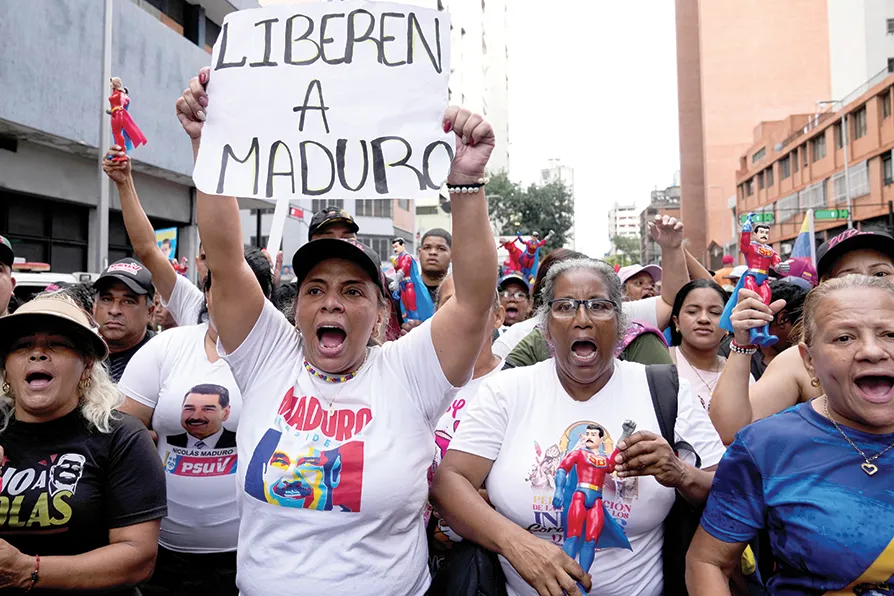
 ‘Free Maduro’ placard at a protest in Caracas, January 2026
It’s time to stop retreating and go on the offensive to promote working-class interests, argues DOUG NICHOLLS
Marco Rubio wants to defeat socialism in Nicaragua, not restore ‘democracy,’ writes JOHN PERRY
Believe it or not, there was a time when the US government built beautiful homes for working‑class Americans to deal with a housing shortage, writes ERAN BEN-JOSEPH
DIANE ABBOTT provides an analysis of the reasons for EU and British voters’ dramatic swing to the right
Train drivers’ union Aslef general secretary DAVE CALFE speaks to Ben Chacko about his hopes that Burnham’s devolution agenda will include the importance of the railway





DONALD TRUMP’S military assault against Venezuela in January 2026 bombed four cities, killed over 100 people and saw the brutal kidnapping of Venezuela’s president and first lady.
President Nicolas Maduro and Celia Flores were taken to the Metropolitan Detention Centre in Brooklyn, New York, where they were criminally indicted by the US Department of Justice (DOJ) and the US District Court for the Southern District of New York.
The case against Maduro will have an important court hearing this Thursday. All those who support international law and oppose the US war on Venezuela must call this what it is: a show trial.
Maduro has been indicted of three criminal charges:
1. Using his position as president “to import tons of cocaine into the United States”;
2. Illegal activity that Maduro has carried out as a member of the National Assembly, foreign minister, vice-president and as president of Venezuela (so from 1998);
3. Since in or about 1999, Maduro, with other Venezuela officials “have, for decades, partnered with some of most violent and prolific drug-traffickers and narco-terrorists in the world, and relied on corrupt officials throughout the region, to distribute tons of cocaine to the United States.”
The DOJ’s indictment against the president is embellished with claims of “association” with organisations designated as foreign terrorist organisations (FTOs) by the US State Department including the Farc, ELN, Sinaloa Cartel, the Zetas Cartel and Tren de Aragua.
However, with the exception of the Farc, the State Department only designated those groups as FTOs in February 2025. Most of the connections to narco-terrorist groups cited in the indictment refer mostly to dates well before that. The dates are 1999, 2003, 2004, 2006, 2008, 2011, 2015, 2019, 2020, 2022, 2024 and 2025.
The widely publicised false claim that Maduro was the head of the Cartel de los Soles was dropped by the US DOJ on January 5 2026.
Furthermore, given the apparent inconsistency in charges of narco-terrorism — with the alleged links predating FTO designation — it would appear that only the charge of drug-trafficking remains.
On this, the indictment asserts that the “defendants, together and with others, engaged in a relentless campaign of cocaine trafficking throughout the time period charged in this Superseding Indictment, resulting in the distribution of thousands of tons of cocaine to the United States.”
Specifically, it is stated that “throughout [this period] Nicolas Maduro Moros, along with members of his family and other corrupt officials, provided law enforcement cover and logistical support for the transport of cocaine through Venezuela, with knowledge that their drug-trafficking partners would move the cocaine north to the United States.”
The long-running war on Venezuela
This is just the latest phase of the US’s long-running war against Venezuela. Since Hugo Chavez came to power in 1999, US agencies have initiated a campaign aimed at maligning the Bolivarian revolution with the usual US propaganda arguments claiming “violation of human rights,” “threats against democracy caused by authoritarian tendencies,” “drug-trafficking” and “narco-terrorism” — with “threat to regional stability” being a US favourite.
This demonisation campaign, systematically broadcast and magnified by the corporate media globally, was aimed at isolating the Bolivarian government including destabilising it by financing and fomenting violent insurrection against it by the US-backed opposition forces.
After the death of Chavez in 2013, the stepping up of the allegations of massive drug-trafficking by the Bolivarian government coincided with the US belief that with the passing of Chavez, the Bolivarian revolution would unravel. So they intensified the media war against Maduro’s presidency.
For example, report after report from the United States Department of Defence’s Southern Command (SouthCom) made all sorts of claims about drug-trafficking from Venezuela and tried to link these to the government.
Lies about drug-trafficking
However, these allegations contradict the United Nations Office on Drugs and Crime (UNODC) annual reports.
In the UNODC Annual World Drug Reports for 2005, 2006, 2007, 2008, 2009, Venezuela either does not have any, or there are very few, illegal cultivations.
Colombia is number one for cultivation, production and exporting by a great margin. In contrast, the reports include assertions of there being no illicit (or very small number of) laboratories in Venezuela to produce cocaine.
For example, the 2008 UNODC World Drug Report includes the assertion: “The US authorities estimate that around 90 per cent of the cocaine, which entered their country in 2006, transited the Mexico-Central America corridor.”
In all these reports, it is asserted that Venezuela is mainly a transit country through which a small proportion of cocaine shipments seek to reach the US and also Europe.
UNODC reports that Venezuela regularly carries out large seizures of cocaine. For example, the 2010 World Drug Report, citing the US National Drug Intelligence Centre, states: “According to US estimates, some 70 per cent of the cocaine leaves Colombia via the Pacific, 20 per cent via the Atlantic and 10 per cent via the Bolivarian Republic of Venezuela and the Caribbean.”
The Drug Enforcement Administration 2024 and 2025 Annual Cocaine Reports confirm that Colombia “remains the primary source country for cocaine (84 per cent) entering the United States,” followed by Peru and Bolivia, and as with UNODC, the DEA also confirms that the favourite route to the US is through the Pacific.
In the 2024 report Venezuela is not mentioned. The 2025 report mentions Venezuela’s Tren de Aragua as a violent criminal organisation but one “that mainly operates within Venezuela migrant communities” in the US and elsewhere.
The show trial of Maduro
The US military attack on January 3 was an unambiguous violation of the UN Charter which specifically prohibits the use of force in international relations, a principle enshrined in Article 2(4).
The attempt by US officials to characterise the kidnapping as “law enforcement” is fallacious. No matter how egregious the accusations against a president might be, the US cannot enforce law in another state’s territory. Such action is incompatible with international law.
US authorities simply do not enjoy jurisdiction to enforce US law on other territories.
What Trump perpetrated against Venezuela is a gross manifestation of extraterritoriality, a clear violation of international law.
Furthermore, the kidnapping of a head of state exercising their duties is a greater violation of international law. The US neither made any effort to obtain a UN security council mandate, nor did it face an imminent or ongoing armed aggression by Venezuela or any actor operating from its territory.
These actions are violations of the political independence and territorial integrity of Venezuela. Trump’s shameless intention to take possession of Venezuela’s oil represents an explicit violation of Venezuela’s absolute sovereignty over its natural resources.
The underlying principle of all of this is the right of all nations to self-determination as enshrined throughout the UN Charter but specifically stipulated in Articles 1(2) and 55.
The US has an extradition treaty with Venezuela. If Trump had credible charges against anyone in Venezuela, it could have used established legal processes to seek extradition. This is what was done with former president Juan Orlando Hernandez with “conspiring to distribute more than 400 tons of cocaine and related offences.”
As the case against Maduro is legally and factually weak, the only way it can hope to achieve the desired political results is by a grotesque and farcical show trial that is likely not to have even the semblance of legality.
If the US can seize a sitting president abroad and put them on trial, the principle of sovereign equality collapses. If international law is to mean anything, the charges must be dropped and President Maduro and Cilia Flores returned to Venezuela where they belong. As the murals painted across Venezuela say: Bring them back!
Join the protest: Stop Trump’s Show Trial of Maduro — Thursday March 26, 5.30pm, outside the US embassy in London.
