
The Defence Universities Alliance is a bit to co-opt higher education into the wider drive to war — we should resist as earlier generations of scientists did, argue say ROX MIDDLETON, LIAM SHAW and MIRIAM GAUNTLETT of SCIENCE AND SOCIETY


Momentum for change in Ireland is exciting and unstoppable
On the 110th anniversary of the Easter Rising, Ireland stands at another historic crossroads, writes DECLAN KEARNEY of Sinn Fein
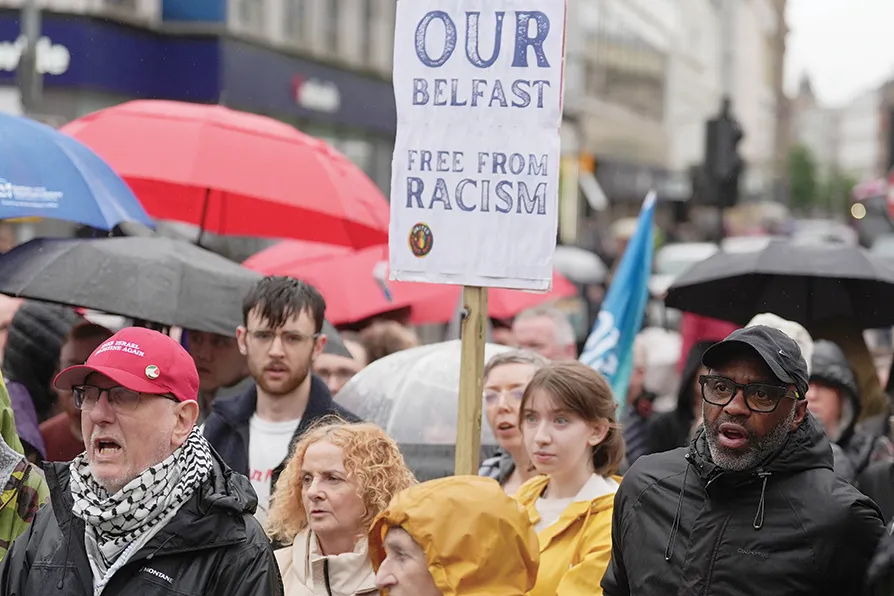
 NEW CONFIDENT VOICES: United Against Racism rally at Belfast City Hall in response to the riots of ‘week of shame’ in June 2025
In the third of a four-part serialisation from her new book No to Nuclear, LINDA PENTZ GUNTER explains how the world had a chance to build an energy system around renewables more than 70 years ago — instead, it chose nuclear
In the fourth and final part of our serialisation from LINDA PENTZ GUNTER’S book No to Nuclear, she asks how anyone can see nuclear as value for money given its constantly ballooning costs
Elon Musk says AI will make work optional. The world of abundance he predicts actually spells the end of the capitalist system, argues FAWZI IBRAHIM
CARLOS MARTINEZ responds to liberal hawk Simon Tisdall’s evidence-free China-bashing and asks whose agenda it really serves
Indian students have fought for the right to education, schooling us all in the process. Comrades from the Students’ Federation of India (SFI) — UK comment on the resistance and its ripples here





APRIL 24 marks the 110th anniversary of the Easter Rising in Ireland, when Irish revolutionaries took on the might of the British empire and declared a national republic.
The Proclamation of the Republic itself was a revolutionary document which asserted the sovereignty of Ireland, and the rights of all its people to freedom, equality and social justice.
Today the Proclamation’s timeless values and principles continue to inspire progressives and democrats in Ireland and beyond.
The Rising occurred at the dawn of the 20th century, during which seismic revolutionary events such as the Russian, Chinese, Cuban and Vietnamese revolutions occurred: and when other equally seminal documents to the Proclamation, such as the United Nations Charter, the Bandung Principles, and South Africa’s Freedom Charter, shaped the politics of national liberation and anti-imperialism.
This weekend, the Sinn Fein Ard Fheis (National Congress) will convene in Belfast. The Ard Fheis comes at a time of huge opportunity for further progressive change in Ireland.
In the aftermath of Britain’s imposed partition of Ireland, two conservative states grew out of the counter-revolution following partition in 1921.
In the north an apartheid, one-party state was established, which institutionalised sectarian inequality and state repression against the nationalist population.
After attempts at democratic reform of the state in the late 1960s were brutally crushed, an armed struggle by the IRA against British occupation began.
The war continued until 1998 when the Good Friday Agreement (GFA) secured a peace settlement.
This peace process has transformed Irish society, but while the GFA is a peace settlement, it is not a political settlement.
Although the Agreement contains within its provisions the right to self-determination, exercise of that right continues to be denied the Irish people by successive British governments, and to be opposed by the DUP and political unionism.
However, the political landscape is changing. Brexit has been a political and economic game changer.
The existence of partition, and denial of national democracy, and failure of the British government to fulfil its obligations under the GFA, continues to destabilise politics in the north.
The state of public finances and ability of the regional executive to deliver sustainable public services has never been more difficult for local ministers.
This British Labour government has not reversed the chronic underfunding of the north by the Tories since 2010. It has persisted with the same austerity policies.
Combined with inflationary pressures, and escalating fuel and energy prices due to the US/Israeli illegal war against Iran and supported by Britain, the cost-of-living crisis has deepened for workers and families.
As a result, schools in the north are crumbling; children with special educational needs, and adults with additional and complex needs are being failed; the health service is in crisis; and, the challenges for the waste water infrastructure system, environment and agriculture are immense.
As British politicians increase funding for weapons of war and mass destruction, working people are paying the price.
The fact is that British governments and politicians have not, and never will act in the interests of citizens of the north.
However the prospect of achieving Irish unity has moved firmly onto the political horizon.
It is this reality which is driving the increased arrogance, negativity and confrontational approach of the DUP, and others in political unionism.
DUP tactics are focused upon causing political demoralisation and slowing down the pace of change. It is hell-bent on pursuing a wreckers’ charter within the assembly and executive, no matter what the consequence.
Nonetheless a change is occurring within the protestant section of the community. Protestant people, including those who have been traditionally unionist, are questioning the benefits of being part of a decaying union, and where their interests will be best served in the future.
They are watching political and economic developments in Britain, including a potential surge of support for independence in Scotland and Wales, and feeling increasingly remote from decisions made in London, by politicians who neither understand or care.
All of this underlines that while the political institutions established by the GFA are important mechanisms to try and make change on behalf of citizens, they are not ends in themselves.
Greater numbers of citizens are looking beyond the limits of partition towards new constitutional and economic models.
An unprecedented, organic discussion is now taking place throughout Ireland about reunification.
A political consensus among all non-unionist parties north and south now exists on the need to plan and prepare for Irish unity.
A ground-breaking Joint All Party Oireachtas Committee (including members of the coalition government in Dublin) report published in July 2024, called on the Irish government to commence such a process immediately.
This is important because while Sinn Fein is now the largest political party in Ireland, and its electoral growth has helped fuel the momentum for constitutional change, our party alone cannot achieve a united Ireland.
Crucially, other parties on the Irish political left are now pro-actively campaigning for unity. So too, are significant sections of Irish civic society.
The campaign to elect President Catherine Connolly put the national democratic issue centre stage. Her election illustrates important progressive, political and attitudinal shifts within Irish society.
Of course, it is too early to say if these are permanent changes, but there is reason to be optimistic.
Irish people, particularly younger generations, instinctively align with anti-colonial struggles and the rights of oppressed peoples.
The genocidal war in Gaza, accelerating annexations of the West Bank, and oppression of the Palestinian people, has mobilised a new young generation of activists. They have been politicised by the rise of neoimperialism, its aggression in Latin America, and by the wars against Lebanon and Iran. They care passionately about the global climate emergency.
Young people are at the centre of an exciting, democratic movement which seeks to decolonise Irish society through a resurgence in the Irish language, music, cultural expression and international solidarity with peoples denied their rights across the world.
Today’s youth are demanding a progressive future in spite of the conservative forces both north and south.
110 years after the Easter Rising, the momentum for change in Ireland is exciting and unstoppable. That will be in evidence during this Sinn Fein Ard Fheis, as our members and supporters strategise and formulate policy on how to complete the reconquest of Ireland, and achieve a truly egalitarian, national republic.
Declan Kearney is national chairman of Sinn Fein and a member of the Legislative Assembly for South Antrim.
