
Tony Benn’s constituents chose him by an overwhelming majority — but because he had inherited a peerage, parliamentary rules declared their choice invalid, writes MAT COWARD


Why is Karl Marx’s Capital important and is it worth reading today?
Karl Marx’s Capital remains one of the most influential works of social science ever written and is much more than merely an historical document, repaying study today, writes the MARX MEMORIAL LIBRARY and Workers’ School.
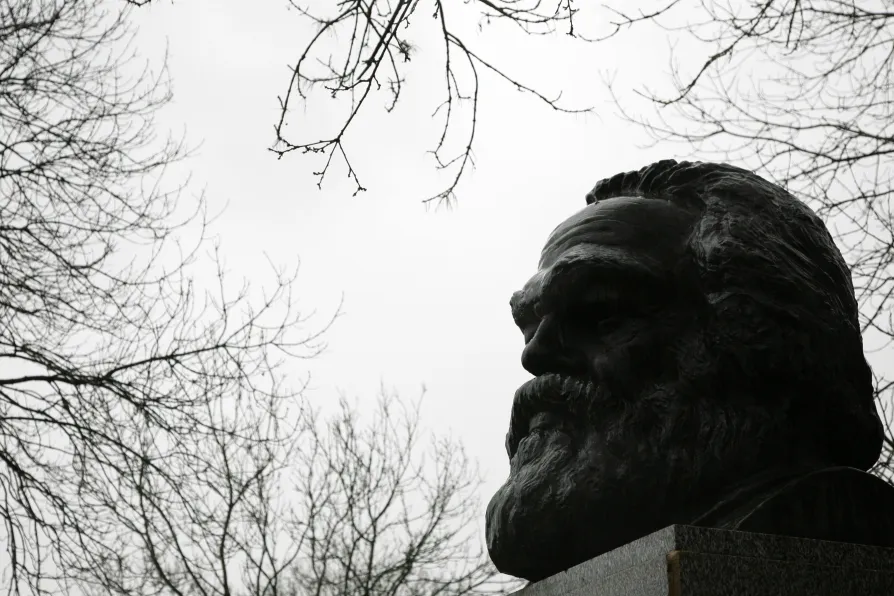
 A view of the grave of Marxist philosopher Karl Marx (1818-1883) in Highgate Cemetery East in Highgate, north London

The real welfare dependency is at the top of our society, says ALAN SIMPSON
Two months of student unrest have forced out India’s education minister and rattled the BJP regime. Could this be the beginning of the end for Modi, asks Communist Party of India (Marxist) general secretary MA BABY
Councillor SAM WHEELER says there’s a tangible shift in mood on the left in the city whose mayor has recently become PM — but there’s no room for complacency
Communist Party leaders Alex Gordon and Lorraine Douglas deliver vital medicines in trip to besieged socialist island
TUC Cymru is playing a leading role in tackling far-right ideas in the workplace, says LAURA DOEL





KARL MARX’S monumental work Capital, subtitled A Critique of Political Economy, is perhaps his best known work next to The Communist Manifesto (which he co-wrote with Friedrich Engels).
It is also one of the less read. Yet it remains not just an historical “classic” but also a rewarding critique of the political economy of capitalism, of huge relevance to the world today and to the struggle for something better.
Context
By the mid-19th century, capitalism dominated Western Europe. Massive industrial expansion created new wealth but also stark inequality and appalling working conditions. The wave of revolutions in 1848 had failed; Marx was an exiled revolutionary living in London, supported by Engels. He devoted himself to a structured and systematic analysis of capitalism, in order to understand its structure and strengths but also its susceptibility to crisis and why it persisted despite social unrest.
Marx’s work draws on the insights of earlier classical political economists (such as Smith and Ricardo); philosophers (from Epicurus and Lucretius to Hegel and Feuerbach) and utopian socialists (including Saint-Simon, Fourier and Owen). His original plan, outlined in the Grundrisse (“foundations,” 1857–61) was to produce a comprehensive account of capitalist political economy in six volumes or “books.” However as the project evolved and expanded, Marx focused his efforts primarily on the first volume with notes and drafts of the contents of three more, and of a fourth theoretical-historical volume.
Ultimately, only the first volume of Capital was published (in 1867) during Marx’s lifetime. Two further volumes were edited and published posthumously by Friedrich Engels, compiled from Marx’s extensive but often fragmented manuscripts.
The central argument of Capital is that the underlying feature of capitalism is the exploitation of labour, and that unpaid work is the motor of its development. Beginning with an analysis of the commodity, Marx argues that the capitalist mode of production is a historically specific system where social relations are mediated by commodity exchange. His labour theory of value asserts that the economic value of a commodity is determined by the socially necessary labour time required for its production.
Worker’s capacity to work (their labour power) is “sold” as a commodity, but its use-value — the ability to create new value — is greater than its exchange-value (the wage), allowing the capitalist to extract extra (“surplus”) value which is realised in money terms as profit. Part at least of that profit is invested again into new “means of production” — a process of capital accumulation.
Competition between capitalists drives technological change, creating a reserve army of labour, and a long-term tendency of the rate of profit to fall, leading to economic crises and intensifying class conflict.
That analysis is developed in detail over the three volumes of Capital. In his preface to the first (1867) edition of Volume I, Marx outlines his plans: “The second volume of this book will treat of the process of the circulation of capital (Book II.), and of the varied forms assumed by capital in the course of its development (Book III.), the third and last volume (Book IV.), the history of the theory.”
As published in English the subtitles of each volume reflect its content.
Volume I: The Process of Production of Capital is Marx’s most extensive and historically detailed work. Focusing on the immediate process of production of commodities, their use value and exchange value, it lays out the foundational categories of his critique of political economy and traces the ways in which surplus value is generated and capital accumulated through the exploitation of labour.
Volume II: The Process of Circulation of Capital edited and published by Engels in 1885, shifts the focus from the immediate production process to the conditions and contradictions involved in realising the value and surplus-value produced. The analysis here is in places abstract and technical, assuming commodities exchange at their values to isolate the specific problems of circulation. He examines the role of technological change, the causes of recurring economic cycles and the potential for crisis.
Volume III: The Process of Capitalist Production as a Whole edited and published in 1894, also by Engels, examines competition between different forms of capital and the distribution of surplus-value into profit, interest, and rent. It integrates the analyses of production and circulation (examined in Volumes I and II) to explain the “concrete forms which grow out of the process of capital’s movement considered as a whole” and further develops Marx’s thesis on the internal contradictions of capitalism including the tendency of the rate of profit to decline.
A fourth “Volume” of Capital, edited from Marx’s manuscripts by Karl Kautsky in 1905 and usually published as Theories of Surplus Value critically examines how earlier economists — Smith, Ricardo, Malthus and others — developed a labour theory of value but were limited by their failure to see exploitation as the extraction of unpaid work.
Reception then
When Volume I was published in Germany in 1867, it sold slowly. The book was long, dense, and technically demanding, which restricted its audience. Socialist activists however, saw it as a structured foundation for socialism, especially its analysis of exploitation and surplus value. The Russian translation (1872) sold well and influenced radical intellectuals debating whether capitalism was inevitable in Russia. It established Marx as a major theorist of political economy.
The publication of Volumes II and III in 1885 and 1895 saw progressively greater interest. By the early 20th century, Capital was widely regarded — by supporters and critics alike — as one of the most important critiques of capitalism ever written. Lenin declared in 1913 that Marxism is “the legitimate successor to the best that humanity produced in the nineteenth century, as represented by German philosophy, English political economy and French socialism.”
After the Russian Revolution, Capital — among other works of Marx and Engels — became a central reference point in Marxist analysis of the dynamics of capitalism.
…and relevance today
More than a century later, Capital remains one of the most influential works of social science in history. Its analysis has been foundational to the international labour movement, socialist and communist political parties, and to a wide range of academic disciplines, including sociology, political science, and philosophy. It remains central to Marxist economic theory and has been highly influential not merely in the capitalist imperial “core” but within socialist and anti-colonial and liberation movements in the “global South.”
A free taster session on Wednesday May 6 will explore Volume I of Marx’s Capital. Those interested can progress to a 20 session online reading group starting a fortnight later. Details and registration on https://tinyurl.com/CapitalTaster2026/. Marx’s Capital can be read and downloaded from the Marx-Engels Archive www.marxists.org/archive/marx/works/download/. A recommended reader is Ben Fine, Ben and Alfredo Saad-Filho (eds.) Marx’s Capital Pluto Press downloadable from https://tinyurl.com/Capital-V1-4-pdf/.
Meantime International Workers’ Day is on Monday May 4. A rally will gather at midday on London’s Clerkenwell Green outside the Marx Memorial Library and Workers’ School, which will be open free to visitors from 11am. At 12:30 there will be speakers from the Library’s steps before the May Day March sets off for Trafalgar Square.
