


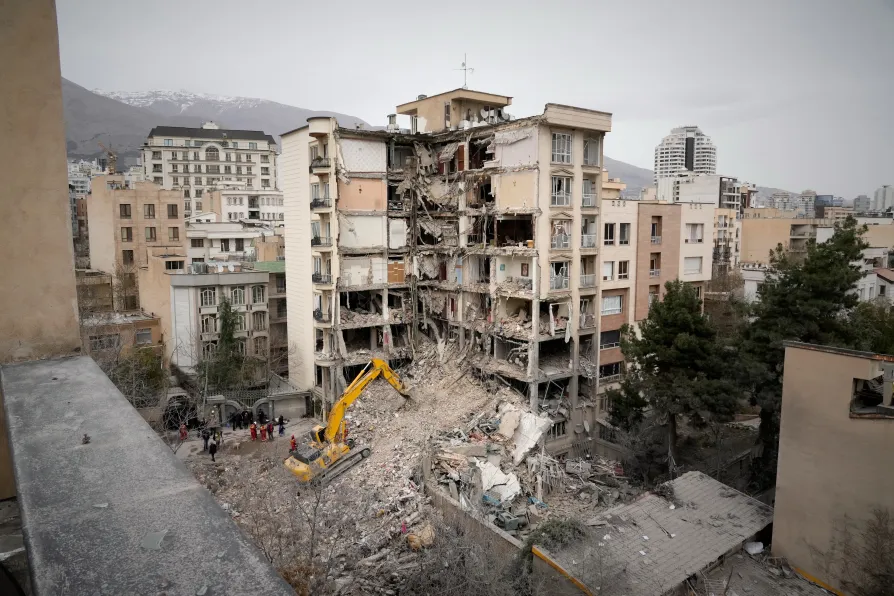
 Iranian Red Crescent emergency workers use a bulldozer to clear rubble from a residential building that was hit in an earlier U.S.-Israeli strike in Tehran, Iran, March 23, 2026






MINISTERS’ “wait and see” approach to the inflationary crisis caused by the US-Israeli war on Iran is totally inadequate on two counts.
It seriously underestimates the scale of the problem — the disruption to oil and gas flows resulting from the closure of the Strait of Hormuz and significant damage to Gulf energy infrastructure will be long-lasting.
Since energy inputs are needed for everything, prices are going to soar across the board. Rachel Reeves’s “support for those who need it most” will not cut it — most of the population will feel the pain.
And it works on the assumption that time-limited emergency interventions can shield us from the worst until things are back to normal. British politics needs to get real — crisis and scarcity are the new normal.
If we do not respond, our current reality of falling living standards, failing services and degradation of our environment and social spaces will just be a taster of what’s to come.
Qatar’s declaration of force majeure — a get-out clause invoking circumstances beyond a party’s control — for long-term natural gas contracts follows similar declarations by Kuwait and Bahrain.
Damage to its Ras Laffan liquefied natural gas terminal, which supplies a fifth of the global total, will take years to repair.
This leaves energy importers who have cut themselves off from Russian supplies — or allowed Washington to cut them off, as with its destruction of the Nord Stream pipelines — in retaliation for the Ukraine war increasingly dependent on a single supplier, the United States, which has demonstrated its readiness to use trade to blackmail even formal allies to impose its will.
Political choices also lie behind our unnecessarily antagonistic relationship with the world leader in renewable technology and supply — China — and alignment behind a climate-denialist United States which is acting both to perpetuate dependence on fossil fuels and to maximise its control over them.
Britain is particularly vulnerable to rising prices because a privatised energy sector has gutted its own storage capacity.
The Tory government allowed the closure of the Rough gas storage facility, which had provided 70 per cent of the country’s storage, in 2017. It was reopened in 2022 but at a fraction of former capacity.
We are dependent on “just-in-time” supply vulnerable to rapid price fluctuation and actual interruption in a crisis, with storage of 1.2-2 per cent of annual demand. Germany, by contrast, stores about 25 per cent of its annual usage. Labour is no more inclined to change that than the Tories — when Centrica boss Chris O’Shea warned last year Rough might have to close again ministers repeated that its future was a commercial decision.
Households are more exposed than during the last inflationary crisis. A million households are already behind on energy bills with no repayment plan in place. Suppliers are owed more than £4 billion in outstanding bills, triple the level of winter 2020.
The government is abdicating on our security and future by leaving them to commercial decisions in which the public interest is not a factor.
We need a high-profile, labour movement-led campaign to nationalise the energy sector. We need price controls, not price caps set by a corporate-captured regulator concerned to keep profits high.
We need serious investment in building renewable energy capacity and state support, via subsidies and use of direct procurement for schools, hospitals, prisons and more, for sustainable local agriculture as rising fertiliser prices hit the global food market. We need an accelerated, publicly funded home insulation drive to reduce energy usage.
In short we need a comprehensive political alternative to the status quo. One that opposes the militarism and warmongering driving global instability. One that adapts our whole economy to a world where shortages will be more frequent and worse. And one that prioritises sustainability and resilience over corporate profits.
