New releases by Interpol, Phoebe Bridgers, Lambchop


 Latest editorial

The memoir of a London Recruit
JOHN GREEN relishes the record of a life well lived in the service of the fight for justice and socialism
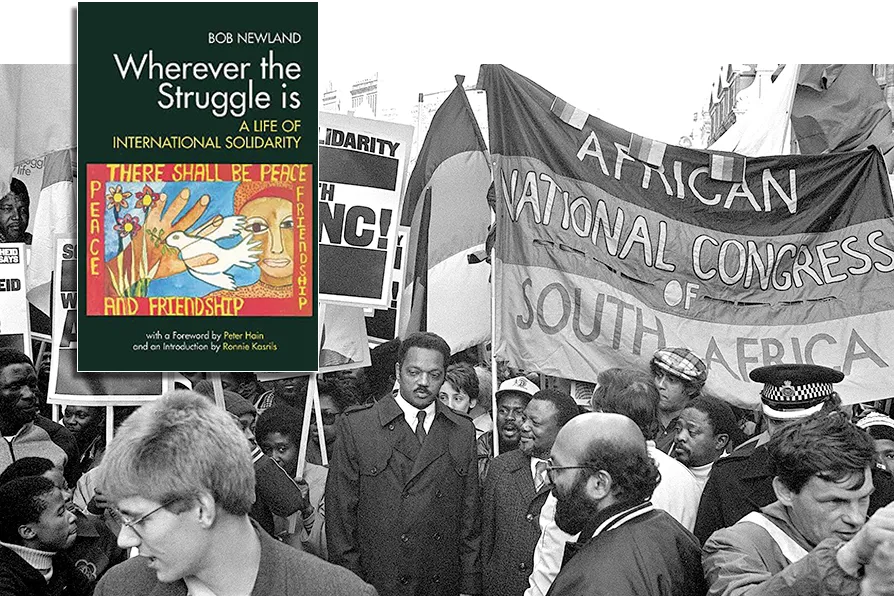 BRINGING APARTHEID TO ITS KNEES: US Democrat and civil rights campaigner Jesse Jackson who joined one of the marches through London to Trafalgar Square for the anti-Apartheid rally

ANGUS REID urges us to understand the persecution of Jason Arday from a political and historical perspective, and to see the victim in human terms
Re-releases of the classics Gypsy Rhumba and Buena Vista Social Club, and a stunning album by Palestinian artist Faris Ishaq
Nothing, says ANDY HEDGECOCK, can rescue this undistinguished amalgam of ponderous melodrama and shallow philosophical speculation
JAMIE BRITTON invites readers to visit 3,500 locals as part of a marathon artistic pub crawl
JOHN GREEN welcomes a valuable and incisive analysis of a world become hyperpolitical but without the mass movement institutions to represent it





Wherever the Struggle is — a Life of International Solidarity
Bob Newland,
Merlin Press, £16.99
BOB NEWLAND’s autobiography is one of those rare examples of a memoir written by one of the foot soldiers of the progressive movement. Despite making often heroic contributions, as in Bob’s case, they are usually omitted from mainstream histories.
He was born in 1950, into an apolitical working-class family in the then genteel south-coast resort of Bognor Regis. His political education began, incongruously, after his friend, the chair of the local Young Conservatives, introduced him to CND. Soon afterwards, as a grammar schoolboy, he met Kevin Kewell, chair of the local Communist Party, who persuaded him that communism offered the only real solution to the woes of the world.
This led him to join the Young Communist League and dedicate his life to political activism. He felt that the school curriculum lacked challenge or meaning, so left as soon as he could, moving to live and work in London. There, he joined the Communist Party after meeting a number of inspiring comrades who broadened his horizons and gave him a new perspective on life.
In short, graphic portraits Newland gives due credit to a number of inspiring grass-roots communists who helped steer him on the path he eventually took.
He was soon fully immersed in the political life of the capital, involved in Unity Theatre and helping as a volunteer at the offices of the Movement for Colonial Freedom, the forerunner of today’s Liberation. The narrative takes us on his political rites of passage, through the campaign against the US war on Vietnam, tenants’ campaigns against rent rises and slum housing, battling the fascist National Front, support for Irish Republicanism to involvement in the 1969 student revolt at the LSE and joining the Anti-Apartheid movement.
His always fascinating, often gripping, narrative takes us at a fast pace though these turbulent times, as we cling to his coat tails, but at the same time he gives the context and wider historical significance of these unfolding events.
His record of activism, reliability and organisational skills made him a key figure to be recruited by Ronnie Kasrils from the ANC’s military wing Umkhonto we Sizwe (MK), based in London. In the late 1960s and early ’70s, Newland became one of that small, courageous band of “London Recruits” who agreed to travel clandestinely to South Africa to undertake the distribution of propaganda leaflets using simple explosive devices, hidden in plastic buckets, and also helping to smuggle fighters and weapons into the country.
After working in a series of short-term jobs, he agrees to take on the political job of West Middlesex district secretary of the Communist Party and later business manager of the Morning Star.
Being a left-wing political activist and then a full-time party official was never an easy option. It demanded full commitment, a precarious material existence and often risked blacklisting.
Unsurprisingly, after the high point of the solidarity actions on behalf of the South African freedom struggle, the narrative flags a little when he becomes a local government employee in south London but, that aside, his memoirs represent a valuable record of a life well lived in the service of his fellow citizens and in supporting the fight for justice and socialism internationally.
