PAUL DONOVAN applauds an intriguing multi-layered depiction, dominated by a stunning impersonation of Marilyn herself


 Latest editorial

Jekyll and Atwood
JONATHAN TAYLOR ponders the difference between autobiography and memoir - between life and story - in Margaret Atwood’s account of herself
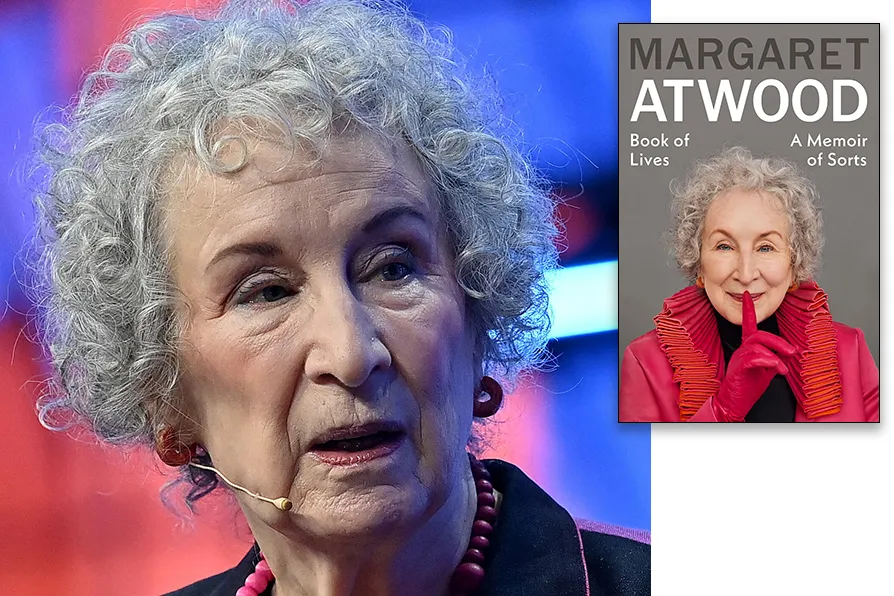 Margaret Atwood, 2022 [Pic: Collision Conf/CC]
LEO BOIX applauds an audacious, self-questioning film about grief, friendship and film-making
MARY CONWAY admires a brave and topical study of Armageddon that is, unfortunately, unable to come to a conclusion
ANDY HEDGECOCK, JAMES WALSH and JAMIE BRITTON review Hanging by a Wire, I Want Your Sex, The Pout-Pout Fish, and Rise of the Foot Soldier: Retribution
Chris Searle speaks to US pianist RAN BLAKE
The Bard hands out medals for his Edinburgh campaign and urges us to support The Men They Couldn’t Hang





Book of Lives: A Memoir of Sorts
Margaret Atwood, Vintage, £30
Nobody really knows what a “memoir” is. But that hasn’t stopped many writers and critics trying to define the form, to distinguish it from traditional autobiography. Judith Barrington, an Anglo-American memoirist who has written extensively on the subject, suggests that:
“The modern memoir… is a different genre from autobiography. A quick key to understanding the difference between the two lies in the choice of a preposition: autobiography is a story of a life; memoir is a story from a life. The latter makes no pretence of capturing the whole span from birth to time of writing; in fact, one of the… skills of memoir writing is the selection of the theme that will bind the work together and set boundaries around it.”
On that definition, Margaret Atwood’s beautifully written Book of Lives is not really a “literary memoir” — which is what was requested by her publisher — but an autobiography. Atwood herself implies as much in the book’s subtitle: A Memoir of Sorts. This isn’t (quite) a memoir: rather, it’s “the story of a life… capturing the whole span from birth to time of writing” — which, for Atwood, is now 86 years of age. On the surface, the book is a linear chronological survey of her life, the people and events in it, across well over 500 pages.
In Barrington’s terms, the book is also an autobiography in another sense. Instead of selecting a “theme that will … set boundaries around” her subject matter, Atwood talks about everything: “romances, adventures … family life, wonderful baby, wonderful parents, great sibs, weeding the garden, knitting, birthday-party-staging, pie-making, bird conservation, arts support, human rights advocacy, fundraising and general busybodiness.”
This is not a “selection” from a life, but the whole kit and caboodle, documenting a kind of Borgesian total recall. One of her editors comments that she “is incredibly good on detail” and anyone reading this book — this “blizzard of images” to use her own words – would find it hard disagree.
The implication is that this eye for detail originates in her father’s entomology. His “lifelong interest in insects” book-ends the Book of Lives, and seems to mirror (or pre-figure) his daughter’s microscopic recall. The “precise close-up detail” in her writing is also linked with her short-sightedness as a child, whereby she could see “ants very well… but vistas not so much.”
Eighty-odd years later, the build-up of such ant-like detail in an autobiography inevitably results in a very long book. Towards the end, Atwood herself wonders how she managed to “turn out so many words, and so quickly.” Although, ostensibly, she’s talking about her earlier writings, the question might just as well apply to Book of Lives.
That so many of these words are fascinating, compelling — both despite and because of the encyclopaedic attention to detail — is a testament to her writerly skill and insight. As her editor suggests: “Her mind… moves on a different level of sensitivity,” such that “every gesture, every word, every expression… has some interior meaning.”
This is just as much the case with her non-fiction as it is with her novels. In Book of Lives, Atwood manages to sustain the reader’s interest in the minutiae of day-to-day living by her insight into the significance, the “interior meaning” of everything she describes — whether by relating it to what she calls wider “life lessons,” or politics, or, most importantly, aspects of her other writings.
This is a book that continually gestures outside itself, often to make connections with her earlier fiction and poetry: her experience of bullying at school, for example, is connected with the storyline of Cat’s Eye; a failed engagement is satirised in The Edible Woman; and her time at Harvard informs various images in The Handmaid’s Tale.
If all this makes the book, in part, a “literary autobiography,” it also does come close to the form of “literary memoir,” as Barrington and others understand it. In effect, Book of Lives is two books in one: the main thrust of it, which is birth-to-now autobiography, along with a subnarrative, which continually traces profound connections between Atwood’s life story and writings (“life and art”).
This subnarrative is a memoir (of sorts): it is thematised, selective, a story “from” rather than “of” a life, tracing causes and effects across time — jumping, for example, from childhood to literary middle-age and back again. This non-linear and non-chronological subnarrative weaves in and out of the main, linear story, haunting it like a transhistorical ghost.
No doubt these two parallel narratives in Book of Lives — one autobiography, one closer to memoir — reflect what Atwood calls her two selves: “the one who lives, and the one who writes… Like Jekyll and Hyde, the two share a memory and even a wardrobe… [but] they are not the same.”
Jonathan Taylor’s most recent book is A Physical Education: On Bullying, Discipline & Other Lessons (Goldsmiths, 2024). He directs the MA in creative writing at the University of Leicester.
