MARIA DUARTE recommends a remarkable study of the friendship between a Palestinian and a Pakistani, broken by a hostile state


 Latest editorial

‘I am a daughter of immigrants. I carry many a different legacy in my mind and imagination’
Chris Searle speaks to Syrian/French flautist NAISSAM JALAL
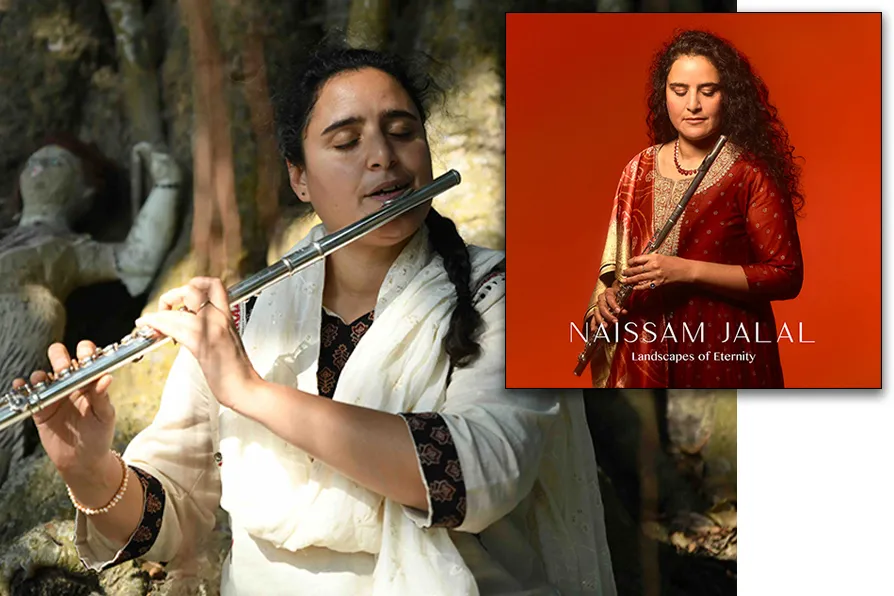 Jazz flautist Naisam Jalal [Pic: Anick Bhattacharya]
MATTHEW HAWKINS rakes through un-fancy words and flair-free summaries to find who and what might be flamboyant
PETER MASON is exhilarated by an exciting, well-considered and historically minded tribute to the great Trinidadian instrument
Reducing historical lives to ‘male’ and ‘female’ roles, we lose the nuance of those lives and a clearer understanding of past societies, suggests CLAIRE ISABELLA GILMOUR
CHRIS SEARLE relishes the genius of pianist Alexander Hawkins, his many ensembles, and his new album





NAISSAM JALAL is a Paris-based flautist of Syrian heritage born in 1984, deeply committed to the musical cosmopolitanism that guides her every note. Her last album, Souffles, waxed in 2025, is a sequence of duets with musicians from France, Cuba and the US, culminating in a track with the veteran revolutionary Floridian saxophonist Archie Shepp.
In her new album, Landscapes of Eternity, Naissam embraces Hindustani music, the sounds of northern India, which she asserts “maintains a deep conscious link with spirituality and nature.”
She travelled for many months in the lands of this music: “During these travels I was overcome by a profound sense of peace. It wasn’t that I felt I had come home, but rather like I had always been there. Even the different, the surprising and the surreal things I encountered felt natural and normal to me.”
In her album she plays with musicians from three continents. Samrat Pandit of Kolkata is a sixth-generation singer; Nabankur Bhattacharya is a tabla drumming master and Sougata Roy Chowdhury plays the lute-like sarod, a fretless stringed instrument of Persian origins, alongside Flo Comment, virtuoso of the tanpura — long-necked and stringed — which creates a sustained harmonic drone.
Two Brazilians complete the ensemble: pianist Leonardo Montana of Sao Paulo and the Rio de Janeiro drummer, Zaza Desiderio. Thus, the jazz of this album is the prime music of syncretism: the amalgam of multifarious traditions.
I ask Naissam about her life in music.
“My parents left Syria in the 1970s after Hafez al-Assad’s coup d’etat, and came to study in Paris at the Beaux Arts. They were painters. They listened to Arabic music, but as a child I didn’t like it. I guess French racism was so deeply inside me that I had a problem loving anything which related to my Arab heritage. When I was a teenager I listened to a lot of hip-hop, soul, RnB, folk and funk — mostly African-American music.”
She spent periods studying Arabic music in both Beirut and Cairo, but asserts that “the foundation of my jazz is not Arabic music but the political and spiritual quest for freedom. But of course, improvisation is common practice in both jazz and Arabic classical music. I am a daughter of immigrants. I carry many a different legacy in my mind and imagination. For me, identity is multiple and in constant movement. The more we are different, the more we have to learn and share with each other.”
How does she see jazz?
“It was born out of the creativity of African-Americans. These displaced people had different biological and cultural identities and faced a violent environment. That’s how jazz was born, as the fruit of creativity and resilience of a people who had a layered identity.”
I ask about the internationalism of her bandmates.
“Leonardo and me have been playing together since 2014. I love his musical sensitivity and his silences. Zaza and I have played together for a few years too. Samrat, Sougata and Nabankur are three brilliant Hindustani musicians able to fit into a project which is not north Indian classical music. Sougata has a very deep sound on sarod and the amazing Flo agreed only to play the acoustic tanpura (which is getting replaced more and more frequently by electronic tanpura). For me, tanpura is the main character of our sound and story in this album.”
And what about her duet with the marvellous Archie Shepp, the great musical militant of the 1970s and 1980s? To me, it sounds like a prayer for world peace.
“Indeed, it sounds like a prayer because it is a prayer for our humanity. I resist in my music. I try to spread love, beauty and care. They are my only weapons against fascism. And since fascism and racism are built on hate, I believe that spreading love is the best way to reconnect to our humanity.
“I am a musician who is both French and Arabic. I have been demonstrating in solidarity with Palestinians since I was six years old. I feel tired, to be honest, it has been happening for too many years. Our world is super-violent and my work for the past 15 years is the expression of my refusal of this violence in either very explicit statements against dictatorship, colonialism, racism and capitalism, or by creating music that is a space of care, a shelter to heal us from this violence.
“I only hope we have the strength to continue the struggle and create freely.”
Landscapes of Eternity is released by Les Couleurs du Son.
