ROB WARZYNIAK recalls the emblematic 1906 book, The Jungle, in its analysis of the crisis presently engulfing the US Food and Drug Administration


 Latest editorial

In Iran – as in any modern war – women and girls bear the brunt
The mass killing of Iranian schoolgirls should have dominated global headlines. Instead it became another example of how civilians — especially women and children — are targeted in war, writes CLAUDIA WEBBE
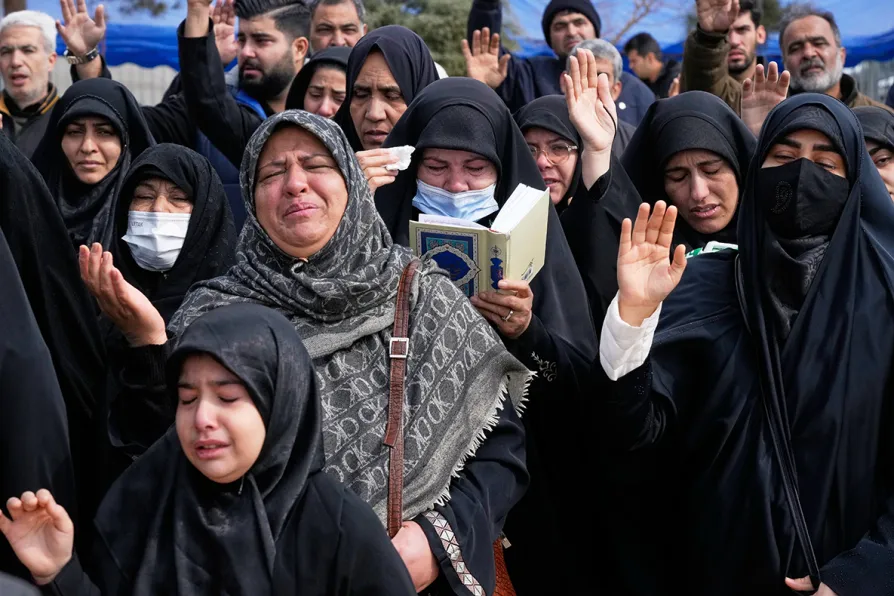 Mourners pray during the funeral of Mehdi Hosseini, a man killed by a US-Israeli strike, at Behesht-e Zahra cemetery in Tehran, Iran, March 9, 2026

Welsh wanderings showcase fiery destruction, alternative water ways and revive memories of a local mining legend, writes MARK SEDDON
As thousands die in the eastern DRC, a global health emergency is being starved of funds, says S KRISHNASWAMY
MAT COWARD explains how in the 17th century a row over whether to kneel at communion became a battle over religion, class and royal power
Renewed illusions in social democratic reformism are sprouting as a result of Andy Burnham’s rhetoric, but material conditions are already intruding into the debate, argues NICK WRIGHT
Andy Burnham could learn a few lessons from a previous Labour government in the pre-privatisation era on how to tackle water shortages, writes KEITH FLETT





ON FEBRUARY 28, just over a week before International Women’s Day, the US and Israel launched an unlawful and illegal war on Iran.
On the very first morning of the war, while children sat at their desks at the Shajareh Tayyebeh girls’ elementary school in Minab, three missiles struck the building. It was a “triple-tap” — a second strike designed to kill those who survived the first, and a third to ensure no rescue.
At least 175 people were killed. Most of them were girls between the ages of seven and 12 — 165 out of a pupil population of just 170. A mass funeral filled the streets of Minab. Sixty-nine children were so completely destroyed that their remains required DNA identification. The deliberate targeting of a girls’ school led to comments from critics, including Iranian academic Professor Foad Izadi, that the “Epstein class” had moved from raping girls in the west to murdering them in Iran.
Meanwhile, the pro-Israel propaganda network got to work, spreading entirely false claims that Iranian forces had hit the school in an echo of the early days of Israel’s genocide in Gaza. The first Israeli bombings of schools and hospitals there were blamed on “misfiring” Hamas rockets while Israel denied any responsibility. Within a few months, every school and hospital in Gaza had been bombed, often repeatedly, and the invaders no longer bothered denying it.
Hundreds of thousands flooded the streets for the girls’ funeral, creating scenes that should have been on the front page of every British newspaper. Not one carried it.
In all three ways, the Minab school attack therefore typified the horror of modern warfare. Women and girls are treated as targets, responsibility is denied and fingers are pointed, then the media move on. By the time the truth is confirmed, it’s been left behind by the narrative.
The same narrative tactics seen in Gaza were accompanied by the same brutality toward civilians. Women and children were especially singled out — not only through direct violence but through acts intended to humiliate and degrade them as women. Accounts describe women and children being forced to strip and paraded before husbands, fathers and strangers. In some cases, Israeli soldiers filmed themselves posing and celebrating in the underwear of those they had humiliated. Such scenes were not confined to Gaza. Similar practices soon appeared in the occupation’s treatment of women in the West Bank and even in the treatment of Palestinians who hold Israeli citizenship.
These abuses are serious war crimes. They are also part of a broader pattern of violence directed at Palestinian women. According to the United Nations, rape, sexual torture and other forms of gender-based abuse have been reported both in Gaza and, especially, in Israeli detention camps where many women are held for months or years without trial or charge. These horrific abuses intensified from the earliest days of the genocide and continue now, with harrowing accounts from women eventually released or from the legal representatives of those still held. And even where they avoid direct abuse, Palestinian women suffer many of the worst impacts of war. Maintaining dignity where sanitary products and privacy are non-existent, the struggle to feed their children, the impact of malnutrition on pregnancy and breastfeeding — all these become so close to impossible that a new report by Israeli human rights group B’Tselem describes Palestinian women in Gaza as “clinging to what’s left of life.”
Nor are these patterns confined to Gaza or to Palestinians alone, or to the women and children of Iran under US-Israeli carpet-bombing. Equally horrific scenes of rape, violence, murder and starvation have emerged from Sudan, where the Rapid Support Forces (RSF) have been accused of genocidal atrocities in Darfur and the United Arab Emirates has been accused of providing support to the militia. Some analysts have also argued that the RSF has adopted rhetorical strategies similar to those used by Israel to justify attacks on civilians. The consequences of regional violence are also being felt in Lebanon, where escalating hostilities and Israeli air strikes have displaced civilians and damaged critical infrastructure.
A 2025 United Nations report observed that these conditions have created significant barriers for women in Lebanon seeking healthcare and safe childbirth while increasing their exposure to gender-based violence and exploitation. The United Nations has described these impacts as deeply gendered.
Yet while the United Nations has condemned many of these crimes, it is reduced to doing little more than wringing its hands in response, and thus remains structurally incapable of enforcing the principles it proclaims. The genocide of Gaza by Israel has exposed the profound limits of international law when confronted by powerful states and their allies. What was once presented as a universal legal order now appears increasingly contingent on power: applied to adversaries, ignored for friends. Western leaders have begun to say this openly.
Germany’s Chancellor Friedrich Merz recently suggested that appeals to international law have little relevance when dealing with Iran. In Britain, Keir Starmer faced widespread criticism after telling LBC that Israel “does have that right” when asked about cutting off power and water to Gaza — remarks he later attempted to clarify as referring only to Israel’s right to defend itself.
Such statements reveal a deeper reality: that the rules said to govern the international system are enforced selectively, and increasingly discarded when they constrain the strategic interests of Western states.
Others are more subtle but no less invidious. Last week David Lammy, Britain’s justice secretary, was challenged about the Minab school attack. Lammy claimed he was “not aware” of any assessment of the bombing. When pressed to agree that an attack on a school is a crime under international law, he first tried to attribute the attack to Iran being a “febrile war zone.”
Then, when his interviewer pointed out that this wouldn’t excuse bombing a school, he switched to insisting that it was “for the Americans to comment.” Such cowardice in the face of war crimes and genocide by supposed allies has been a hallmark of the Starmer government, alongside an evident willingness to equip and enable the criminals while trying to obscure that complicity.
Today, the schoolgirls of Minab will never grow into women. They were liberated only from life — by bombs that many are claiming were refuelled on British soil.
Britain’s arguments for US operations from its bases “blur the line between lawful self-defence and unlawful war,” as the Chatham House analysis published on March 5 made clear. International law, as one defence analyst told Al Jazeera, draws no distinction between a nation that initiates an act of war and one that supports it — both are equally complicit. War enabled from British soil is still Britain’s war.
Keir Starmer — a man who once pledged that no British military action would proceed without a vote in the House of Commons — did not give Parliament a vote. He gave Parliament a speech.
The facts are plain: RAF Fairford in Gloucestershire — an air base used for every imperial bombing campaign since Kosovo — was handed to the Pentagon for what Keir Starmer called “specific and limited defensive purposes.”
What his speech concealed was this: twelve F-22 Raptors flew from RAF Lakenheath to the Middle East. At least 28 US military flights used British air bases and the base in Cyprus in one of the largest military build-ups in the region for decades. B-2 stealth bombers — the same aircraft designed to penetrate deep into sovereign air space and deliver bunker-busting munitions — were positioned on British soil before being sent to kill.
The mothers of Minab call it murder. History will side with the mothers.
From Iran to Palestine, from Sudan to Congo, the pattern is consistent: the nations richest in resources are the nations most scarred by intervention. The communities with the non-white skin bear the heaviest bombs. The women and children who are furthest from the negotiating table are closest to the blast radius.
What, then, do we as right-thinking human beings and socialists do in the face of such determined ignorance and collusion on the part of “our” governments and the powerlessness of the international bodies that are supposed to hold them to account? It would be easy to throw up our hands in despair, but when governments will not do the right thing, it is up to the people to make them, and it is not enough to just lament the horror of the situation.
Jeremy Corbyn — standing where principle has always stood, outside the approved consensus — tabled the Military Action (Parliamentary Approval) Bill to require a vote before British bases are handed to foreign powers for war. We must support this move and the withdrawal of permission for any “foreign military” to use British bases for offensive or so-called “defensive” operations without explicit parliamentary approval — enshrined in law, not left to prime ministerial discretion.
With the British government evidently far more afraid of offending the US or Israel than of losing the next general election, we must escalate our collective action. Not just in mass protest, though of course that must continue, but in direct action. The recent general strikes in India and Italy, along with industrial and civil actions against interests most closely tied to the crimes or most benefiting from them, have been ignored by British mainstream media precisely because they are effective weapons against the inaction or collusion of governments. Those are tactics we need to copy, and where necessary adapt, in Britain.
Women and girls always bear the brunt of the crimes of imperialism, but as international law collapses all ordinary people suffer and if it is worse in other places than here it is only a matter of time and opportunity, as Tony Benn used to point out. We owe it to women, girls, boys and men to take every action available to us to resist and end the impunity of rogue states and the collaboration of our government. Not just that, we owe it to ourselves and to our own children.
Thomas Sankara was clear that “there is no true social revolution without the liberation of women,” and as every liberation movement has recognised — peace without justice is merely the silence between explosions.
Claudia Webbe was the member of Parliament for Leicester East (2019-24). You can follow her at www.facebook.com/claudiaforLE and x.com/claudiawebbe.
