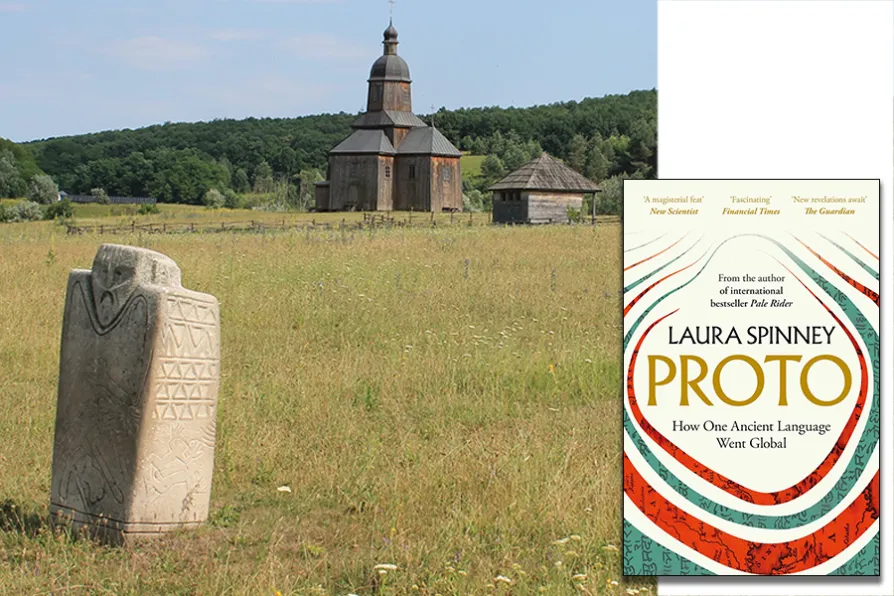
KEN COCKBURN traces the one original language – that of the Yamnaya pastoral nomads – from which all European and Indian languages derive


 Latest editorial
The human cost of the Ukraine war
MARY CONWAY applauds an exploration, through five short plays, that demonstrates the vital role of drama in furthering collective understanding
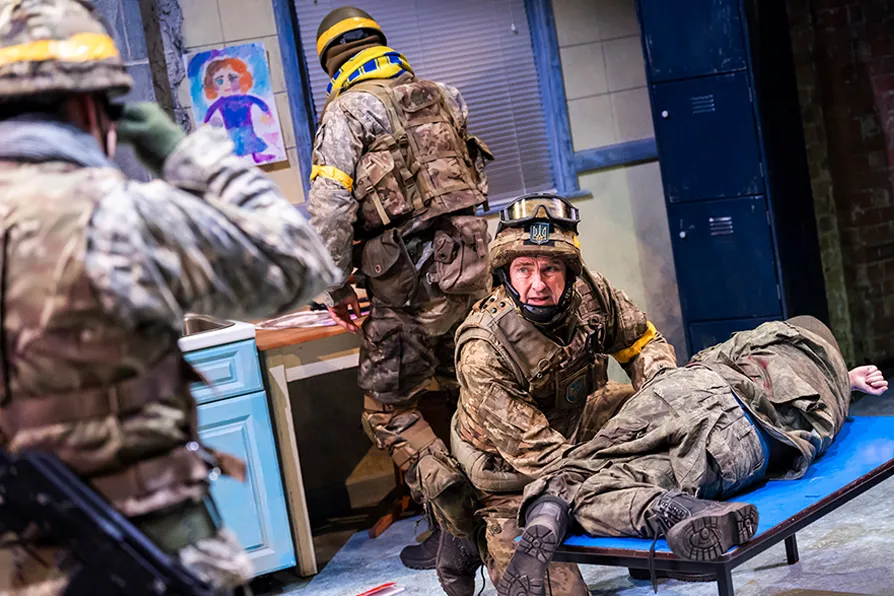 EXPOSING THE CONTRADICTIONS: David Michaels in Ukraine Unbroken [Pic: Tristram Kenton]
PAUL DONOVAN is fascinated by the debunking of the iconic British war hero
ALEX HALL recommends a searing panorama of our global predicament
Comics are not just superheroes and spandex – it can be public art, telling public stories, suggests HARRIET EARLE
ALEXEI SAYLE speaks to Angus Reid about a lifetime of protest, how to hone political art – and what to do now
The bard serenades the Diggers of Wigan and their festive followers





Ukraine Unbroken
Arcola
⭑⭑⭑⭑☆
NICHOLAS KENT holds a unique place in the story of British theatre, his resignation from the Tricycle where he was artistic director for almost 40 years still leaving a massive hole. His specialism throughout has been the use of drama to explore significant political events of our time, ranging from the Stephen Lawrence murder to Grenfell, and from Guantanamo to Afghanistan.
Now at the Arcola in Ukraine Unbroken, he brings us a serious, assiduously researched journey into the human reality that is Ukraine, four years after the Russian invasion. It’s compassionate, timely and — given the world news as it is today — an essential engagement with what Wilfred Owen called “The pity of war; the pity war distilled.”
The evening is composed of five short plays each by a different established playwright. The two plays in the first half focus on the fallout from political machinations at the highest level; the three plays in the second half on the kind of authentic human detail so often missing from news reports or history books: the actual minute-by-minute experience of ordinary people caught up in relentless war. Together, the plays lay out before us the state of Ukraine: the complexity of its politics, the vagaries of its past, its long-term tangled relationship with Russia, and the struggle of its people to retain moral purpose and salvage hope.
All five works are introduced and linked by live Ukrainian music, performed by the virtuoso Mariia Petrovska who both sings and plays the 65-string bandura, a Ukrainian national instrument that was banned under the tsars. The haunting melodies that emerge tie the plays together, and immerse us in Ukrainian cultural heritage and in its collective soul.
The plays themselves vary in power, some ending rather abruptly, though in the interests of the whole. Jonathan Myerson’s Always kicks off with snipers targeting demonstrators from the hotel room of a British MP and his wife in Kyiv in 2014. David Edgar brings his customary clever humour and incisiveness to Five Day War, which demonstrates the folly (or wilful pretence) on the part of the Kremlin in thinking that the Russian assault on Ukraine in 2022 would be a five-day wonder.
Three Mates — written in original Ukrainian by Natalka Vorozhbit and translated by Sasha Dugdale — takes us to the heart of a traumatised young conscription dodger, engaging us emotionally rather than polemically for the first real time in the evening. David Greig’s Wretched Things shows us active soldiers caught up in moral dilemma even as they dice with death. Meanwhile, the finale, Cat Goscovitch’s Taken, exposes the living horror of Ukrainian children abducted into a Russia that swallows and rebrands them beyond recall.
Nick Kent is overall director with only Three Mates falling to Victoria Gartner, and all roles are shared between a fine cast of six.
The achievement in this work is to show us the vital role of drama in furthering collective understanding of deeply serious themes. And it holds the Russia/Ukraine combat firmly in our consciousness.
What the work is not, despite its somewhat misleading title, is a vehicle for flag-waving nationalism. Yes, the invasion is seen as an all-pervasive national crisis; yes, political leaders generally get a bad press; and yes, it is the Ukrainian rather than Russian perspective that is under the microscope here.
But the plays fearlessly explore deeper truths and contradictions in the Ukrainian position. That many Ukrainians have Russian relatives or speak Russian in daily life is raised; that questions over whether the Donbas region should be handed over to Russia are asked; that Nato is regarded, not as a peace-keeper, but as a threat to Russia is openly understood; and the fact that millions of Russians died saving Ukraine from Nazism is referenced as an unassailable truth in their combined history.
So, while the title Ukraine Unbroken trips off the tongue and sounds like a defiant call to Putin — and the musician’s bandura-playing hints of simplistic nationalism — the content of the work dispenses with posturing of this kind and brings us authentic experience, raising as many questions as it answers.
Perhaps, simply, The War in Ukraine would be a better title. See it, and decide for yourself.
Runs until March 28. Box Office: 020 7503 1646, arcolatheatre.com
