RITA DI SANTO assesses the winners of the most politically charged festival to date


 Latest editorial
How 300 companies run half the global economy
STEVE ANDREW recommends a Marxist analysis of the long chains of production that global corporations exploit
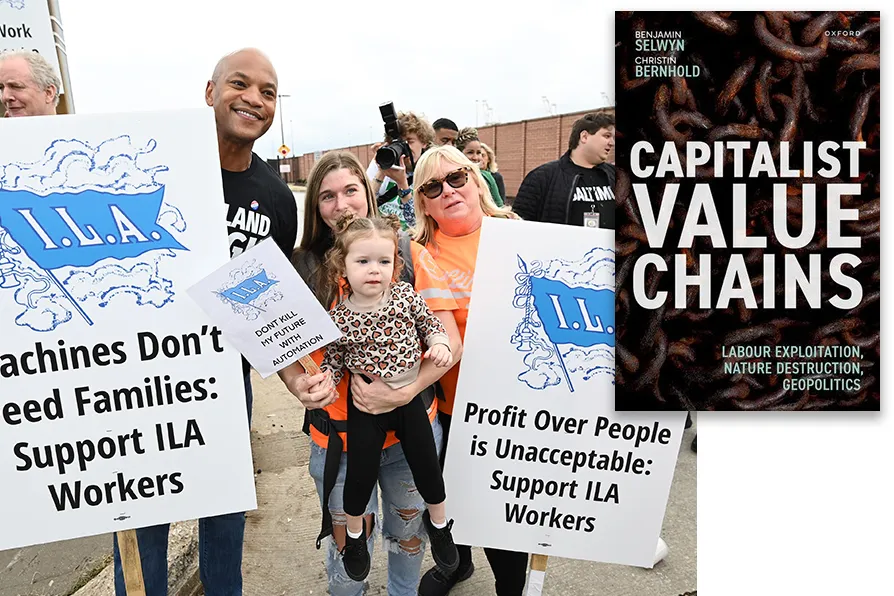 TAKING ACTION AT A CHOKEPOINT: US dockworkers strike. 2024. Governor Moore Meets with members of International Longshoremen's Association [Pic: Maryland GovPics/CC]

KATARZYNA KOSMALA introduces a retrospective by one of the most significant figures in contemporary US photography
MAYER WAKEFIELD is entertained but let down by an audacious production that, sadly, doesn't ring true
MARY CONWAY is disappointed by drama that, despite accomplished performances, cannot overcome an unfocused script
New releases from Sam Carter, Spell Songs and Les Thomas





Capitalist Value Chains: Labour Exploitation, Nature Destruction, Geopolitics
Benjamin Selwyn and Christin Bernhold, OUP, £99
IN contemporary capitalism, substantial portions of commodities are produced in stages across many countries and integrated through what are generally referred to as “global value chains.” In this recent and pioneering text the authors deliberately use the term “capitalist value chains” (CVCs) as to deepen and emphasise their analysis of such chains on an explicitly class relational basis.
Apple iPhones are, for example, made by millions of workers in over 50 countries and, while such developed chains may not be a dominant force, they have certainly become a leading player in the global economy.
The writers make abundantly clear that we need to remind ourselves as to the size of these concerns. Walmart, Amazon and Apple had larger revenues in 2023 than the gross domestic products of Argentina, Austria and South Africa, respectively. In a similar vein, the combined revenue of the largest 300 companies totalled $52 trillion, and was half of the global GDP for that year.
The book also more than effectively demolishes more mainstream arguments in favour of capitalist value chains. World Trade Organisation reports ignore, misconstrue or effectively explain shortcomings by claiming that these are problems caused by lack of adherence to the model rather than the consequences of its brutal introduction.
The central conclusion that Selwyn and Bernhold come to is that CVCs have heightened rates of labour exploitation, reinforced capital concentration, deepened pre-existing forms of uneven development, unleashed incredibly dangerous and warmongering geopolitical rivalries and led to ecological destruction on an apocalyptic and life-threatening scale.
As Marx noted: “Capital comes into the world dripping from head to foot, from every pore, with blood and dirt.”
It is interesting how the defenders of capitalist value chains draw upon economic theories and models that are not only unoriginal, but which have extremely limited value in the sense that they assume “‘free’ markets to be timeless and ones which always act in perfect equilibrium.”
Included within this would be Adam Smith’s theories around the division of labour but transplanted into the international arena; David Ricardo’s understanding of the importance of comparative advantage; and Walter Rostow’s work on the stages of economic growth that seamlessly propel nations to industrialisation and modernity.
Karl Polanyi’s observation that capitalist states play a key and instrumental role in maintaining the so-called free market undermines the myth that the latter is in any way self-regulating.
A central and more than welcome element in this absorbing text is that, in addition to analysing the impact of capitalist value chains on human society, there’s a heavy emphasis on how it remorselessly destroys the natural world. Quoting Antonio Guterres — that we are all one the “highway to climate hell” — Selwyn and Bernhold rightfully stress that capitalism is the engine and CVCs are the accelerator.
Drawing extensively upon Marxist John Foster’s concept of the metabolic rift, Bernhold convincingly demonstrates the extent to which CVCs not only directly cause environmental degradation but inflict unimaginable suffering on hundreds of millions of sentient beings as a result.
Until recently this was a totally neglected area of thought and practice but it’s an emergent trend that some Marxists are increasingly taking notice of, which has historical antecedents on the left and today includes influential advocates such as the legendary activist Angela Davis.
Bernhold is to be congratulated for this inclusion and one would hope that further contributions are in the pipeline.
An additional area of interest, and a positive one at that, is that while value chains generally work in the interest of multinational capital, they can also, on occasion, open up opportunities for labour to take decisive and more than winnable strikes in defence of its interests. Identifying “chokepoints” in the production process as a way of facilitating this saw, for example, a tremendously successful strike by US dockworkers in 2024.
While CVcs are very much a feature of contemporary imperialism, however, greater documentation of the chronology, nature and extent of these monumental changes in terms of the chains themselves, rather than capital in general, would have been welcome.
How the book characterises the nature of the Chinese economy is problematic as well.
There are, of course, many debates on the left as to the extent to which China remains on a socialist path, as there was during the period in which the Soviet Union existed, and I wouldn’t expect every book to argue that the Chinese model should be applied universally.
Additionally, it’s hard not to share some of the concerns of the authors around arguments that equate socialism with one-dimensional productivistic narratives.
My central objection, however, is that the authors adopt a consistently negative approach to the extent of denying that China has made any concrete gains at all. The world historical achievements of lifting hundreds of millions out of poverty are rubbished, active resistance to imperialism is seen as having happened almost by chance rather than by design, and industrialisation is explained as having taken place without development contingent — as it apparently is — on the vast scale of the country, on integration into the global economy on capitalist terms, on a harsh internal labour migration scheme, and the super exploitation of a tightly controlled workforce.
On a similar note, no recognition whatsoever is made of the Chinese state’s continuing social ownership of large sectors of the economy, of its ongoing commitment to central planning, and of profits being reinvested in wider society in a fashion that more Keynesian economists could only ever dream of.
Overall, however, the two authors adopt an approach rooted in Marxian political economy and it’s a well-researched, up-to-date and passionately argued book that fully takes on both big capital and its neoliberal apologists.
Recommended.
