Cuban trade union federation CTC leader OSNAY MIGUEL COLINA speaks to Ben Chacko about life and work under a crippling US siege


 Latest editorial
Hands Off Haiti – foreign intervention is heavily implicated in its current crisis
RUBEN BRETT of Liberation explains why the narratives we hear about the poverty-stricken Caribbean nation are deeply misleading
A part of the British empire’s network of slavery, today the Caribbean island of Nevis faces a new form of exploitation in the form of crypto-colonialism, CLAUDIA WEBBE writes
A new book by Victoria Holmes illuminates the many hidden histories of the oppression experienced by Gypsy/Roma/Traveller community, writes ROGER McKENZIE
Even the oligarchs of the artificial intelligence industries are warning that their creations have the capacity for the ultimate destruction of the planet and its population. ANDREW MURRAY suggests that there might just be other solutions
The Labour government must deliver on its commitment to bring back privatised services into the public sector. This not only saves money but also creates accountability and generates wider social benefits, argues ANDY MCDONALD MP
Public ownership of Great British Railways has enormous potential to improve our railway network, but that can’t happen unless jobs, employee rights and union recognition is at the heart of the transition, argues MARYAM ESLAMDOUST
Challenges from the unscrupulous misuse of AI to steal actors’ voice and physical likenesses is being met with a firm union response, writes LYNDA ROOKE





THERE is a civil war in Haiti. The conflict can be dated to the assassination of president Jovenel Moise on July 7 2021, and has claimed more than 16,000 lives since that time including at least 4,384 killed from January to September of 2025.
The vast majority of killings are attributed by United Nations reports to state security forces (63 per cent in the six months to September 2025) although these reports largely accept the state’s labelling as criminals of those it has killed. Killings by state forces include summary executions of journalists and others accused of subversion.
Official narratives have conflated most opposition to the transitional government, to multinational occupation, and to unelected “interim prime minister” Ariel Henry before his March 2024 resignation, into the category of “gangs.” The transitional government increasingly relies on the designation of its political opponents, armed or unarmed, as gangsters or terrorists to justify its indiscriminate use of exploding drones in civilian areas. Violent gangs remain a real and serious problem, including those like Gran Grif in Artibonite who commit the majority of kidnappings, as well as various criminal paramilitaries who collaborate with police to break strikes and control toll roads particularly in the north of the country.
Then there is Viv Ansanm, the rebel coalition headed by former police officer Jimmy Cherizier. “We have chosen to take our destiny in our own hands,” said Cherizier on February 29 2024, announcing the formation of the coalition controversially bringing gangs together with neighbourhood self-defence groups in “a battle that will change the whole system.” This follows years of efforts by Cherizier and his G9 Revolutionary Forces to establish a lasting ceasefire in the capital and end gang violence against civilians.
In the first three months of 2024, kidnappings nationally fell by 37 per cent and none were reported in Port-au-Prince; September-November 2024 saw 447 kidnappings across the country compared to 835 in the same months of 2023.
In the areas it controls, now estimated at 90 per cent of the capital, Viv Ansanm has instituted social welfare programmes. Since January 2025 the rebel coalition includes a political wing whose platform prominently pledges to restore the 1987 constitution in order to restrict US-educated elites’ political influence by disallowing dual citizenship.
Cherizier has been accused of human rights abuses, including a massacre in 2018 when he was a police officer, and in 2022 became the only Haitian subjected to sanctions by the UN security council which called him a threat to “the peace, security, and stability of Haiti.”
The massacre allegation emanates from a Canadian-funded NGO, the National Human Rights Defence Network (RNDDH) which became notorious for fabricating cases against supporters of progressive former president Jean-Bertrand Aristide after he was overthrown (for a second time) in 2004 by US-trained paramilitaries with the apparent collusion of France, Canada and the European Commission. RNDDH was identified by Haitian human rights lawyer Mario Joseph, in a 2007 interview with HaitiAction.net, as contributing to the false imprisonment of “over 200… locked up for their political affiliation” including leading members of Aristide’s party held for up to three years without trial.
Haiti’s prisons hold more than 7,200 men, women and children in conditions described by the UN as “inhuman and degrading,” with less than half a square metre of cell space per person.
Fewer than 20 per cent have been convicted of any crime. Many spend years in pre-trial detention. In total 139 people died in prison between January and September of 2025, largely from disease and starvation.
Prior to a Viv Ansanm military operation in early March 2024 which liberated Haiti’s two largest prisons, more than 11,500 people were incarcerated across the country with only around 2,000 having been convicted. Torture and forced labour, strictly prohibited by Haitian law, are widely reported.
Despite its constitution forbidding the presence of any foreign military force on Haitian soil, Haiti has spent 20 of the last 31 years under occupation.
The first period of UN occupation (1994-1996) oversaw the managed transition under which Aristide was allowed back into office in 1994, following his September 1991 overthrow by a military junta which went on to kill around 5,000 Haitians while enjoying CIA support.
The second occupation began in 2004 with the second overthrow of Aristide; the UN Stabilisation Mission in Haiti was scheduled to withdraw in February 2006 but remained until October 2017, with a smaller force in place until October 2019.
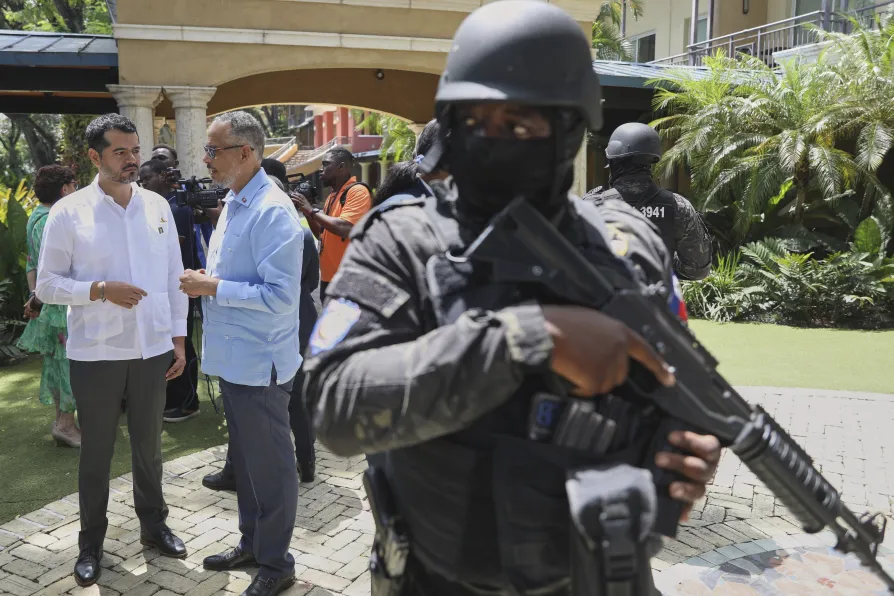
The third occupation began in October 2023 with the deployment of the Multinational Security Support Mission led by Kenya at the request of Ariel Henry, on the pretext of countering gang violence, and continues with an enlarged Gang Suppression Force introduced from October 2025.
Occupation forces have themselves been accused of numerous massacres and other human rights violations, but have generally enjoyed immunity from Haitian law along with the collaboration of Haiti’s elite strata.
Following the devastating 2010 earthquake, US officials turned away planes carrying medical aid; occupation troops were prioritised for resource allocation over disaster-struck civilians.
UN troops were later found to have reintroduced cholera to the country, causing an additional 9,794 deaths after the earthquake.
One key task of occupation forces has been to protect fuel distribution, while successive Haitian governments have been pressured to remove subsidies on fuel prices.
Journalist Kim Ives of Haiti Liberte pointed out to the UN security council in December 2022 that it would have been “more cost effective” for the international community to provide “fuel subsidies for $400 million annually” than to maintain a military force costing $538.5 million per year as was the case 2004-2017.
Ives described the subsidies as “one of the few measures that helped to ease the burden of crushing poverty on Haiti’s masses” enabling domestic transportation and small-scale commerce.
Ariel Henry’s attempt to remove fuel subsidies in 2021, a change US officials had “wanted to see in Haiti for quite some time,” sparked predictable increases in civil unrest and violence which forced Henry to reverse the change until the following year. When subsidies were removed in 2022, the resulting unrest became a justification for renewed deployment of foreign troops.
According to UN reports, 1.4 million Haitians are now internally displaced and 5.7 million (almost half of the population) face famine-like conditions.
Violence against women and girls is extremely elevated, with displaced women among the most vulnerable; more than 7,400 incidents were reported between January and September of 2025, with at least 1,361 people suffering rape.
Successive multinational occupation missions have manifestly failed to improve the security and human rights situation of Haiti, and their legal standing with regard to the UN Charter is shaky at best, yet they have continued to be favoured by the security council.
Sovereignty for the Haitian people in their own country remains off the table. Amid talk of security, development and human rights, there is rarely any mention of reparations for colonial and neocolonial plunder. Nor is there any suggestion of repaying the tens of billions of dollars extorted by France post-independence, money which Haiti is unquestionably owed.
Progressives, democrats and humanitarians must reject the assumption that more and better military intervention is the answer to Haiti’s problems.
We must uphold the Haitian people’s right to sovereignty. We must reject imperialist meddling in Haitian affairs, while demanding reparations for the damage such meddling has already done.
We must give the Haitian people our solidarity and support in rebuilding their own national political life and in pursuing their own development, on the path they choose. We must continue to say: Hands off Haiti!
Ruben Brett is a central council member of Liberation, formerly the Movement for Colonial Freedom.
