
APURBA CHATTERJEE explains how British artists in India used the “picturesque” to reshape colonial landscapes and celebrate imperial power


The forest within
JENNY MITCHELL surveys the work of Hurvin Anderson, now a centrepiece of Britain’s white-dominated art establishment, and explores some of the complexities it opens up about British Caribbean identity
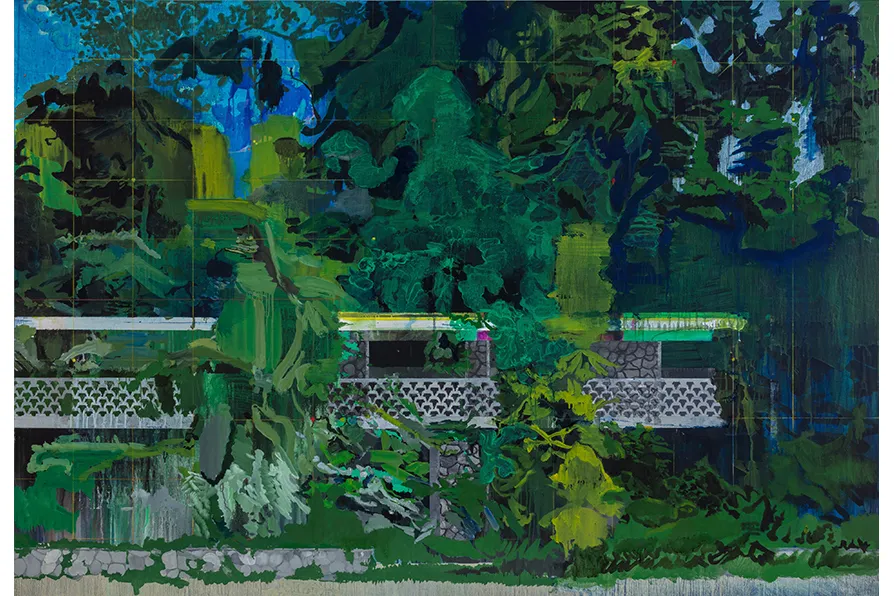
 Limestone Wall. 2020 [Pic: © Hurvin Anderson. Courtesy the artist and Thomas Dane Gallery/Richard Ivey]
PAUL DONOVAN welcomes a revival of Reginald Rose’s classic play that reminds us of the fundamental need for trials with juries
SIMON PARSONS applauds an exceptional performance of Wesker’s little-known play, by the same actor for whom it was written 45 years ago
ANDY HEDGECOCK and MARIA DUARTE review Late Fame, The Death of Robin Hood, Leviticus, and Gail Daughtry and the Celebrity Sex Pass
ANGUS REID recommends a uniquely accomplished documentary collage that contemplates our relation to the natural world
GORDON PARSONS enjoys Kant’s ‘mind-boggling’ theory of human reality: that we create the reality we experience





Hurvin Anderson
Tate Britain, London
⭑⭑⭑⭑☆
WHEN an artist is given a major retrospective at Tate Britain they are being acknowledged as one of the greats. When comparisons with Turner and Constable are made, the viewer is prepared to be impressed. They won’t be disappointed by the major retrospective of Hurvin Anderson’s work, including almost 80 of his luscious paintings and drawings.
It’s clear they speak to the relationship between Britain and the Caribbean, painted by a British-born artist whose parents came from Jamaica in the 1960s. However, at times there might be something “lite” or unchallenging about the work, which helps explain why it has found a home in a white-dominated art establishment.
The first room in the exhibition, called Arrival, is relatively small and contains paintings that explore the artist’s childhood and relationship to his family. However, the viewer will first be met by a large painting that depicts a vibrant forest scene; or perhaps it’s a deliberate explosion of paint, mostly made up of varying shades of green. If it is a forest there are shadows as well as hints of gold suspended from a mighty tree. This painting seems closely related to those that follow in the exhibition, unlike the rest of the work in the first room which is smaller and more personal.
To the right of the forest scene, catching the viewer’s eye with its apparent simplicity and emotional depth, is the painting Hollywood Boulevard. We are told it’s one of the artist’s rare autobiographical works, depicting himself as a child with his father.
The young Anderson appears vulnerable in a pair of shorts, standing almost to attention. The father is stern, looking slightly away from the viewer. In between them is a black cowboy who appears to have wrangled a small animal. This, we are told, references the artist’s belief in the importance of showing black heroes.
Image
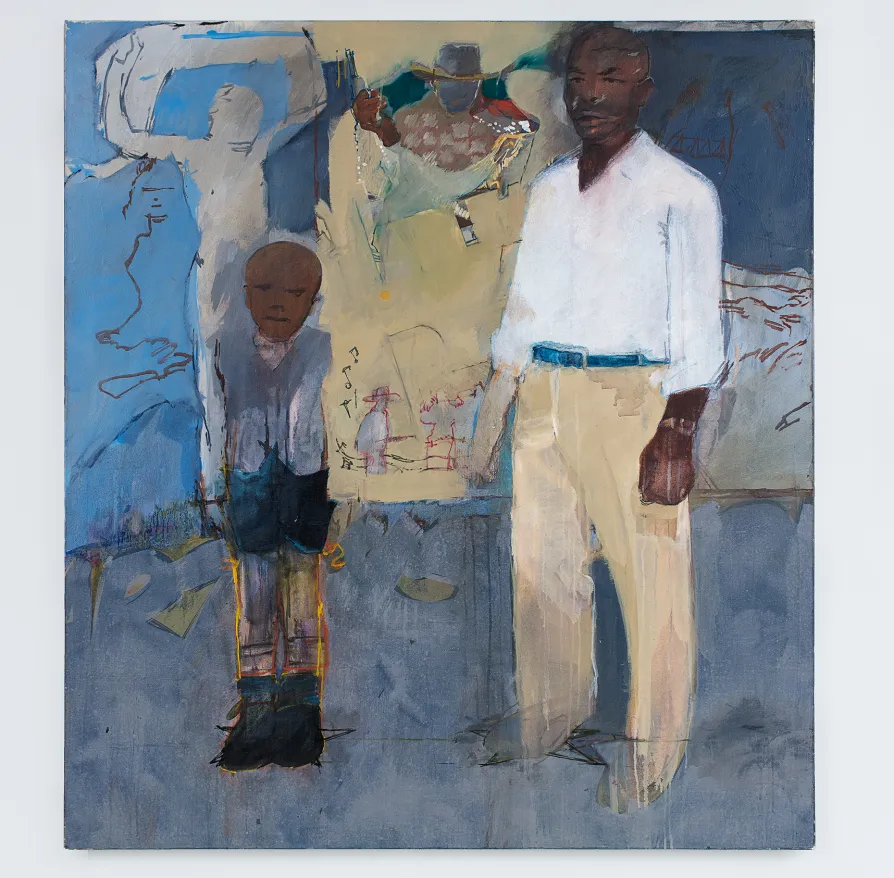
An initial emotional reaction to the painting might be to see it as sad, with something distant between the father and son. However, there is a faint smile on the boy’s face, and he appears to be literally supported by a lightly sketched figure standing to his right. The ambiguity is exciting. Are we being shown at the start of the retrospective that even as a child, the artist was being protected and supported, not only by his father and the cowboy, but a phantom spirit?
In the first room, there are several paintings of the artist’s sister, Bev. In these her floral dress and the floral background gradually meld, turning her into a flower-laden plant. One of the paintings is almost black with the abstract shape of flowers.
This suggests the loss of the vibrant flora and fauna in the Caribbean. However, much stronger than that is the sense that this vibrancy was not only internalised but can be seen to burst its bounds, taking over his sister’s body and the canvas itself.
The two small pieces called Arrival and Arrival II give the room its title. This suggest the viewer is to read them as foundational in some way. They depict an aeroplane, focusing on the empty steps in one painting, then showing two figures at the bottom of the steps in the other.
Apparently, this references the arrival of Anderson’s family in Britain. However, is there something problematic about suggesting that arrival for black people is linked specifically to Britain? In leaving out the Caribbean as the point of departure is there a suggestion that black life only really began in Britain or in relationship to whites?
Image
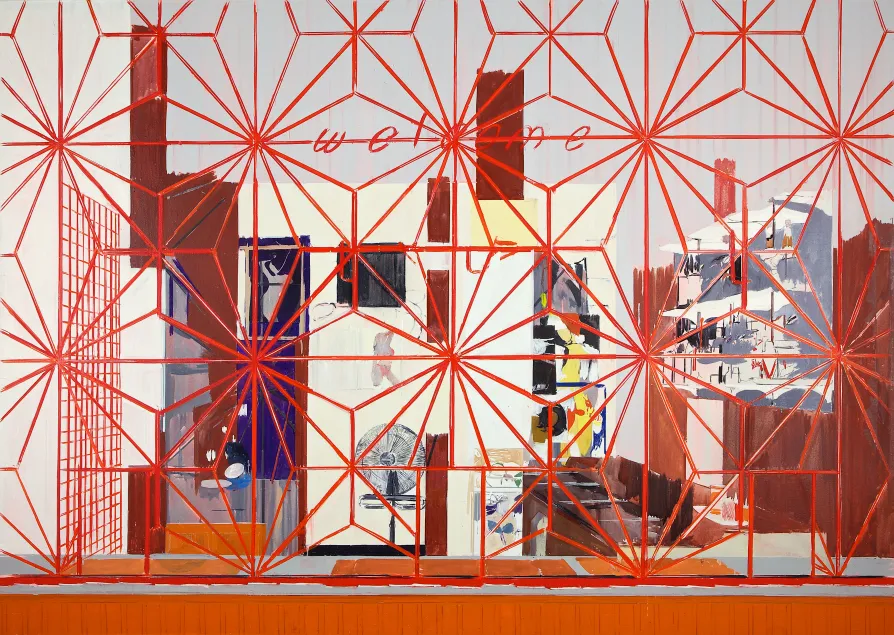
This question could also be asked of Passenger Opportunity, a monumental 16-panel piece that examines the journey from British transatlantic enslavement to the arrival of the so-called Windrush generation.
The African continent is only depicted as a place ruled by whites with black people in chains. Does this suggest the latter had no lives before they were loaded onto ships, whether chained in a hold or onto the Windrush?
There are dozens of other paintings in the exhibition, some of which have broken records for the amount of money paid for work by an artist of African-Caribbean descent. These painting are undoubtedly vibrant, skilled and appealing. They might also hold something back or lack the emotional depth of the earlier work.
However, the exhibition comes highly recommended for the questions it helps to open up about the long history between Britain and the Caribbean, and the role of the art establishment in deciding what stories are told.
Runs until August 23. For more information see: tate.org.uk.
