


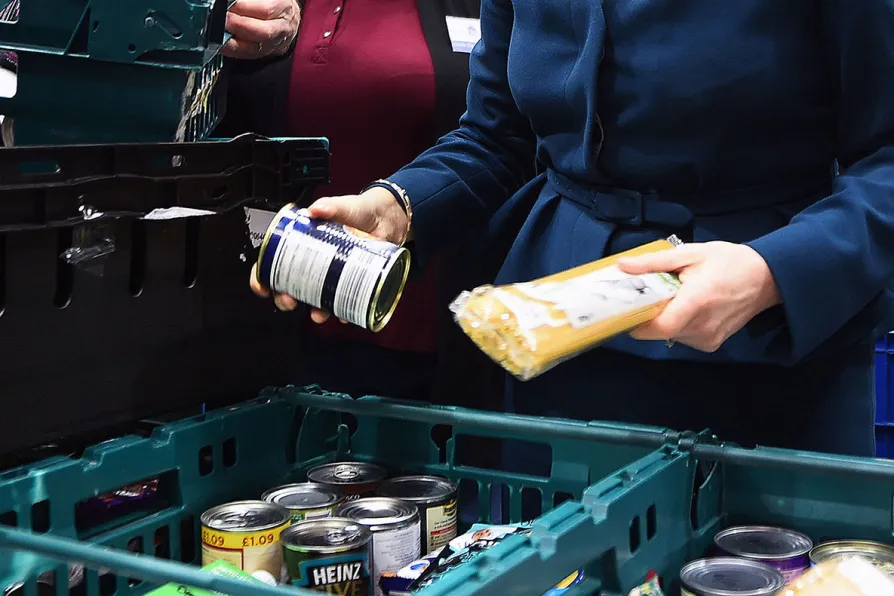
 Goods at a food bank





WORKING people are already being presented with the bill for imperialist war in Iran. Today the country was told to prepare for food shortages if the conflict caused by the US-Israeli aggression continues.
The blockade of the Straits of Hormuz, presently being enforced by the US military, is cutting off vital supplies of carbon dioxide (CO2). This is needed for the storage of packaged meats and salads, and for brewing.
CO2 is also critical for a number of other vital processes, including water purification, nuclear power and MRI scanning.
Ultra-Blairite Business Secretary Peter Kyle was deployed in an effort to reassure the public that the Starmer Cabinet has the situation under control.
His version of “keep calm and carry on” was to reveal that Keir Starmer “is going through personally and driving deep dives into lots of areas of resilience throughout our economy.”
Given Starmer’s cynical involvement in Donald Trump’s aggression against Iran, allied to his general mishandling of every project he touches, this announcement may not have the effect Kyle hopes. Even Corporal Jones of Dad’s Army might allow it is time to panic.
The prospect of food shortages comes on top of massively escalating fuel bills as a result of the war.
Allied to these direct consequences there is the mounting pressure for accelerated military spending. This primarily comes from those elements within Labour who are also for unequivocal backing for any US war, no matter how illegal or even deranged it may be.
Thus George Robertson’s intervention. When he was defence secretary under Tony Blair he authorised a military strategy focused not on defending Britain but on acting as first accomplice to Washington in its “world policeman” role.
To maintain that privileged position he made it clear that the people’s welfare must be sacrificed.
Starmer is far from being as distant from that approach as he likes to appear. He is enabling the US-Israel aggression in every way possible whole continuing to declare “this is not our war.”
The Prime Minister is apparently taking inspiration from Bill Clinton who admitted to smoking marijuana as a youth but insisted that he “did not inhale.”
And, of course, he is planning huge military spending increases, just not fast enough for the bellicose Robertson.
There is possibly more genuine dismay in Chancellor Rachel Reeves’ increasingly voluble outrage at the conflict, which has further upended an economic strategy that wasn’t going very well in any case.
She has become outspoken in condemning the folly of the war. But her words will butter no parsnips, the more so if none are available to be buttered.
Likewise, Kyle dangles soon-to-be out-of-stock carrots before the public, claiming government readiness to cope with any eventuality, while Cabinet colleagues Steve Reed and Shabana Mahmood, both of Labour Together, prepare the stick in the form of repression of the inevitable mass protests.
The programme needed is to firstly, withdraw all support, including arms, use of bases and diplomatic cover from the US and Israeli war.
Then emergency control must be established over the fuel and food sectors, vital for the life of the community as they are.
Punitive taxes should be levied on the energy giants, and on the finance sector speculators who are making a killing from the war, as was exposed this week.
And the plans for the militarisation of the economy should be scrapped, with the resources poured into meeting the people’s needs, as well as restoring the overseas aid budget.
This is indeed “not our war.” Nor is the system of capitalist imperialism which has led to it our system. We must break with both.
