DAVE CALFE, general secretary of Aslef, the train drivers’ trade union, writes exclusively for the Morning Star as the union’s five-day annual conference opens in Birmingham


 Latest editorial

Chile: inertia prevails as the state begins to crumble
The former minister of the interior and former president of the Socialist Party GERMAN CORREA speaks with Hugo Guzman about his fears for a rapidly deteriorating Chile plagued by institutional, political and social degradation
 [Elias Almaguer / Creative Commons]
Election of a new leadership at Hadash’s convention signals a renewed effort to forge a broad Arab-Jewish alliance in Israel, says AMNON BROWNFIELD STEIN
HENRY FOWLER, national co-ordinator for General Strike 100, continued his nationwide tour of partner organisations by joining campaigners and trade unionists in Brighton for the unveiling of a new blue plaque and a full day of commemorative events marking the centenary of the ‘Battle of Lewes Road’
The FBU leader speaks to Ben Chacko about cuts, collapsing Starmerism and confronting the far right
The collapse of Streeting’s leadership challenge and an opening for Burnham’s potential path back to Parliament have accelerated the battle over what – if anything – Labour still stands for, writes ANDREW MURRAY
ANSELM ELDERGILL examines the relationship between law and the humanities





Hugo Guzman: What is happening on the right of the political scene?
German Correa: The whole of the right is just radicalised conservatism, programmatically the differences are negligible, it is more about the competing egos.
They did well in the elections for constitutional councillors and are looking ahead to the municipal elections.
In Chile, the three-way split of the electorate persists. The support for Gabriel Boric and the ruling coalition stands at 30 per cent, the right wing remains at 30 per cent and then there are the centrists.
Can the right win the municipal and gubernatorial elections on October 27 2024?
This is open to debate. Because municipal elections have their specificities, unlike parliamentary and presidential elections, they are less politicised and less partisan, and voters are more concerned about what is or is not being done in the daily life of an area — people are more alert to the management of local affairs than to political definitions.
How do you see the ruling coalition’s local electoral pact with the Christian Democrats (DC)? Would we see a similar agreement for the parliamentary and presidential elections in November 2025?
I see the pact for the municipal elections as positive, but I don’t know if they will go that far in the parliamentary and presidential elections. If they don’t reach an agreement it would make things far easier for the right especially as the political centre is very fragmented, however, but extended fragmentation also affects the left and the right.
Furthermore, there is a deeper phenomenon of institutional, political and social degradation, which became evident with the social revolt in 2019 and which has not been resolved.
In response to said fragmentation, should the Communist Party, the Frente Amplio (Broad Front) and an alliance around democratic socialism unite and co-ordinate their strategies?
The centre-left often favours difference and disagreement over focusing on interests that can unite them. It seems to me that those sectors you mention have no choice but to reach electoral agreements, at least to avoid being swept away. I think such agreements will be reached.
We have two coalitions in government for the first time in our history, and the truth is that they have never really stuck together. There are many tensions and that makes the political and electoral base more complex and precarious. But it also has its strengths.
Is there a certain deficit in promoting a coherent narrative to reach out to the people?
Certainly, because in my opinion the left, in general, is not getting its message over to ordinary people. We see “salonised” politics being carried out by party elites in both chambers of the parliament in Valparaiso. Little of this nonsense matters to the people and solves none of the problems they face.
I think that politics has become even more dominated by hollow performances, in a theatre with a stage and an audience outside, in the real world, that watches but has stayed silent for now.
In the midst of this lurks “Octoberism,” a reference to the unrest of 2019, which the conservative elite, including the traditional oligarchy, managed to bury and is now rapidly repackaging in their favour.
And how do the left and progressives rescue the ethos of that social revolt?
In my opinion, there is hardly any left any more. What prevails is a generalised conservatism in different guises — there is the right-wing conservatism but also the left-wing conservatism. The political elite has not at all taken up the social demands that came to the fore so forcefully in 2019.
I believe that nothing happens without a social movement. But the elitist logic is imposed on political work. With a silent public, a mass that does not speak out, and a mass that suffers, that is trying to survive, that suffers from a stagnant economy.
Work is difficult to find, wages are desperately low — the businessman has forgotten that workers’ wages need to be improved. The 2019 social outburst did not ask for a socialist revolution, what it demanded was that the ruling elite should not screw the people so much, that they should not abuse them, that they should not speculate on their livelihoods, that they should stop offering miserable pensions and bad salaries, that they should not cross these red lines.
However, there has been no positive response to that.
Are the social movements and civil society in retreat?
Of course they are. The social movement has been hit hard by the economic aftermath, the social costs on top of the devastating pandemic [by October 2023 the death toll stood at 62,000] which was devastating, especially for the social sectors that were weakest and not adequately supported.
The economy is in recession, inflation had risen to 11.6 per cent in 2023, and speculation with inflated prices ensued. I see people mostly concerned about how to survive; there may be awareness of the problems, but not the energy to get active, to speak out massively or widely.
What is your position on political reform?
What they are discussing are technicalities that solve the problems of representation of the political parties. There is no intention to reform the political system in any way. These are issues that are of interest solely to the parties and their elected representatives. And yet there is so much to discuss regarding the political system, participation, decentralisation, presidentialism, and the role of regional governments to mention just a few things.
Look, we have not salvaged anything from the initial or repeated constituent process where these things were raised as constitutional matters — such as the strengthening of the regions, such as decentralisation and the participation of the people. The system of justice is politicised and people distrust it.
All of this is the result of institutional degradation and we have to take seriously the major issues and problems that lie ahead of us and not get sucked into the pit of mediocrity.
We are facing an extremely challenging world and if, as a small country, we have at heart the development of our people, we must adopt a different, in-depth vision of how to arrest the discrediting of our institutions
Hugo Guzman is the editor-in-chief of El Siglo (the Century) newspaper of the Communist Party of Chile.
The Socialist Party of Chile was founded in 1933 by, among others, Salvador Allende.

Similar stories
Far-right forces are rising across Latin America and the Caribbean, armed with a common agenda of anti-communism, the culture war, and neoliberal economics, writes VIJAY PRASHAD
In the run-up to the Communist Party congress in November ROB GRIFFITHS outlines a few ideas regarding its participation in the elections of May 2026
Communist Party presidential candidate JEANNETTE JARA challenges the Chilean left to stop talking only among comrades and reach out to angry voters abandoned by politics in the race against the far right this November
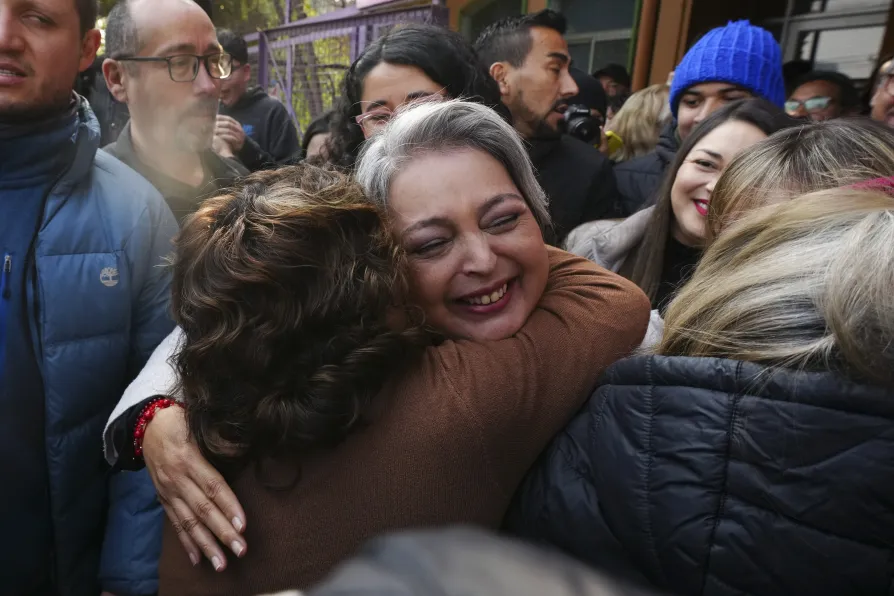
For the first time in years, the dominant voice within Chile’s official left comes not from neoliberal centrists but from the world of labour, writes LEONEL POBLETE CODUTTI