ROB WARZYNIAK recalls the emblematic 1906 book, The Jungle, in its analysis of the crisis presently engulfing the US Food and Drug Administration


 Latest editorial

Alex Gordon: Break with Washington to open the path to socialism
Communist Party of Britain general secretary ALEX GORDON speaks to Ben Chacko about the coming economic storm, the relentless drive to war and the prospects of fighting back
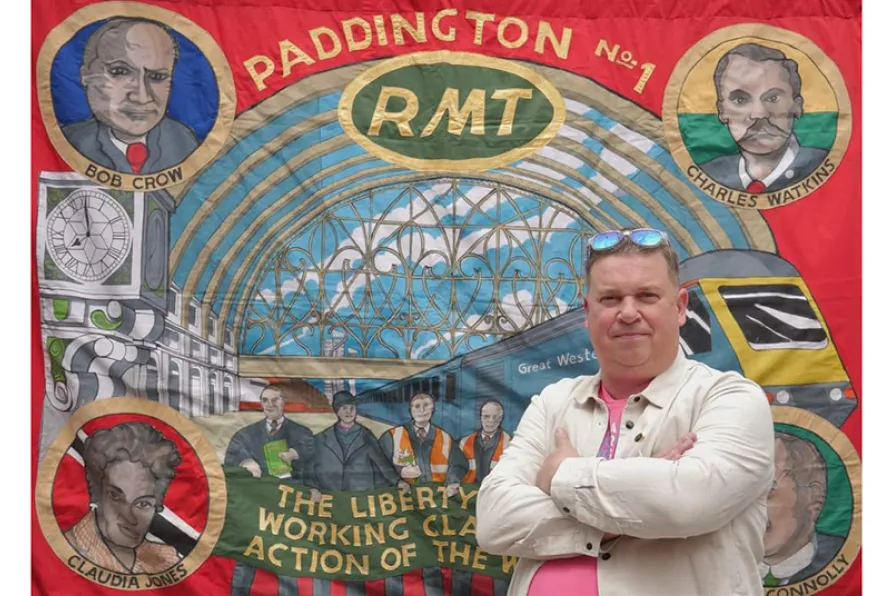 Alex Gordon, former RMT president, is now general secretary of the Communist Party

Welsh wanderings showcase fiery destruction, alternative water ways and revive memories of a local mining legend, writes MARK SEDDON
As thousands die in the eastern DRC, a global health emergency is being starved of funds, says S KRISHNASWAMY
MAT COWARD explains how in the 17th century a row over whether to kneel at communion became a battle over religion, class and royal power
Renewed illusions in social democratic reformism are sprouting as a result of Andy Burnham’s rhetoric, but material conditions are already intruding into the debate, argues NICK WRIGHT
Andy Burnham could learn a few lessons from a previous Labour government in the pre-privatisation era on how to tackle water shortages, writes KEITH FLETT





“BIG things are about to happen.” Alex Gordon, the new leader of the Communist Party of Britain (CPB), says the government’s current troubles are nothing compared to the crisis to come.
“UK plc is the weakest link in the G7. Britain’s economy is more reliant on financial services than any other, more than France, more than Germany. Britain is most exposed to US capital and US banks at a time when US capitalism is on the brink of the biggest crash in capitalist history.
“Even the Bank of England is warning that more likely than not, there will be a spectacular crash — or ‘correction’ — in the US stock market.
“There’s massive fears about the AI bubble but also about the expansion of private credit and the shadow banking sector. And when those crises hit, the City of London is going to go down like a house of cards.”
Economic crisis will precipitate political crisis: “The City will run to the Exchequer and demand that we pay for it by bailing them out, as in 2008. But does any party have the political authority to deliver that today?” When Gordon Brown bailed out the banks, he was backed by the Conservative opposition.
Today’s government and opposition both lack credibility, and there is no ruling-class consensus on how to respond to Britain’s protracted economic decline.
The increasingly erratic conduct of US imperialism has prompted some European countries — Spain most obviously — to look at strengthening economic relations with China. “If such a pivot away from Atlanticism became a broader trend, it would cause a deep crisis in the British state.”
For many people in Britain today, the time has come to break with the US imperialist alliance: Donald Trump’s constant insults, his government’s undisguised support for far right political forces and its reckless war with Iran are building momentum behind demands that were unthinkable till recently — like the ejection of US troops from British soil.
“It’s crucially important that we make that break. The so-called special relationship, based on Britain being an unsinkable aircraft carrier for the United States, is the core of the British state’s view of its role in the world.
“If we’re able to challenge the relationship between the US and Britain, we will open up politics for socialism and socialist development in a way that just isn’t possible while we’re shackled to US banks and the US military.”
The break from US imperialism is about self-preservation, too. Gordon notes grimly that Britain is already involved in the Iran war through allowing US long-range bombers use of UK military bases. Conceivably, Britain could end up in a hot war with Russia as a result of NATO expansion, which powerful voices in the UK military and intelligence establishments appear to be lobbying for.
The drive to war is a Europe-wide phenomenon and Gordon stresses the need for international resistance. “Saturday June 20 is a key date — London will host the second International Conference Against War, following the founding conference in Paris last October.
“People will be taking part from across Europe — German school strikers against conscription, Italian and Greek dockers who’ve disrupted arms shipments, Spanish and French trade unionists… this is going to be a big focal point for the peace movement, and will build for a third peace conference in Madrid later this year.”
Bringing together the peace and labour movements to stop the march to world war is a top priority for communists — and the Communist Party will take part in the International Meeting of Communist and Workers’ Parties in Havana, Cuba in August.
The host city would have been appropriate anyway in the centenary year of Fidel Castro’s birth, but Donald Trump’s attempt to strangle Cuba with a total energy blockade makes solidarity still more urgent. The CPB has committed to fundraising for a whole container (costing about £25,000) of medical aid to be shipped via the Cuba Vive appeal.
“The defence of socialist Cuba is critical,” Gordon says. Though Russia succeeded in getting some oil through, and while China is supplying photovoltaic cells, batteries and infrastructure for solar power with the aim of making Cuba energy-sovereign, “the toll the blockade is taking on the Cuban people right now is enormous — leading to premature deaths as clinics and maternity wards run out of power. It’s a societal disaster visited on the Cubans by a vicious, declining US empire.”
The mask-off US aggression under Trump, stripped of window-dressing about democracy or human rights, could be a game changer: “Young people are looking at that today. They’ve seen what happened in Gaza, they see what is happening in Iran.
“The US is losing the propaganda war, and so are the new militarists. People across Europe are not falling for the war mentality being pressed on them by politicians and the press. They don’t want conscription. They want welfare, not warfare.”
And this is a huge opportunity for the left, if it can unite struggles for peace and over the cost of living.
Gordon was elected general secretary of the Communist Party in January. He has big shoes to fill, succeeding Robert Griffiths, who had led the party since 1998.
But the train driver and twice-serving president of the RMT transport union is already a familiar figure in the peace and trade union movements.
A trade union member since his first full-time job working for Calor Gas in Bristol in the 1980s, he became an active trade unionist when he started working as a British Rail Guard in 1989.
In the RMT he met “fantastic, inspirational people” and he attributes his political development to the union and the struggle against rail privatisation, and the fight to maintain railway safety standards, in the 1990s.
Though this was the decade of the “end of history” when advocates of privatising the entire economy were riding high, it was also a time when a generation of militant trade union leaders — including RMT’s Bob Crow — were coming through, and Gordon’s political education was bound up with the rise of these “young Turks.”
“Even as a young man I felt as though my politics were going against the tide of — well, if not history, then polite opinion. Militant trade unionists were told we were dinosaurs, living in the past.
“Neoliberalism was entering its mature phase then, if you like. It seemed all-powerful. It doesn’t now — it’s definitely moved to its decadent phase.
“Neoliberalism’s two conceits — that economic growth could be achieved by wage competition, forcing workers to work longer for less, and that value could be created by exchange, have both proven false, as Marxists knew they would. Trade doesn’t create value, labour does.
“Wage competition doesn’t create efficiency — simply poorer workers. Real wage rates are now below their level a decade ago. The British economy is addicted to cheap labour, which acts as a disincentive to investment in new technologies, which is why the UK economy is characterised by persistent low productivity.”
All around us we see the wreckage caused by that neoliberal consensus: “The Tory dream of a property-owning democracy, of hearth and home, has been broken. The yawning gap between earnings and asset prices means even well-paid professional couples can’t afford to put down a deposit on a house in London or Manchester.
“Housing stock across Britain has deteriorated — in Camden, where I live, the local council is effectively a slum landlord. People live in damp, mouldy homes, in blocks of flats with broken lifts, not just here but all over London and around the country — waiting lists for housing repairs are enormous.
“Our social services and public services can’t deal with the human results. We have people with mental health problems on our streets showing clear signs of distress. We have an epidemic of violence against public service workers — including in the transport industry. I was at Paddington station with my RMT branch this morning leafleting the public about the union’s campaign against assaults on transport workers.”
This bleak reality has broken what passed for the political centre in Britain, at least since the EU referendum result in 2016, when the majority voted against the entire political Establishment to leave the bloc.
“In the last 10 years, we’ve had six prime ministers and we could soon see the seventh. Labour and the Tories are in simultaneous decline, which hasn’t happened before. We’ll likely see evidence of how far the two-party system has broken down at the local elections this week.”
The Communist Party is standing candidates across a number of contests in England, Scotland and Wales, not expecting to win seats, but so as “to be part of the political conversation in working-class communities,” Gordon says.
Though the centre cannot hold, the left is not in great shape to take advantage. Demoralisation and confusion following the sabotage of Jeremy Corbyn’s Labour leadership has lasted several years; current enthusiasm around the Greens looks more like an echo of Corbynism than the beginnings of a new working-class movement.
Gordon is aware that building the Communist Party as the Marxist party of the labour movement, a militant vanguard party of the left, will depend on the role the party plays in the looming battles over the cost of living and to win the argument for peace and against militarism and war.
These battles can be game changers. He points to the words of Robin Page Arnot quoted in the new Communist Party pamphlet on the general strike, which began 100 years ago today: that in the first week of May 1926, there was one communist in Chopwell, the Durham mining village later dubbed “little Moscow;” “three months later there was no hall in Chopwell that could hold the party members, and I had to address the nearly 200 communists in the shallow amphitheatre of a hillside amid the sunshine.”
Big ambitions. But then, we have a world to win.
