Re-releases of the classics Gypsy Rhumba and Buena Vista Social Club, and a stunning album by Palestinian artist Faris Ishaq



Don’t join the lynch mob
ANGUS REID urges us to understand the persecution of Jason Arday from a political and historical perspective, and to see the victim in human terms
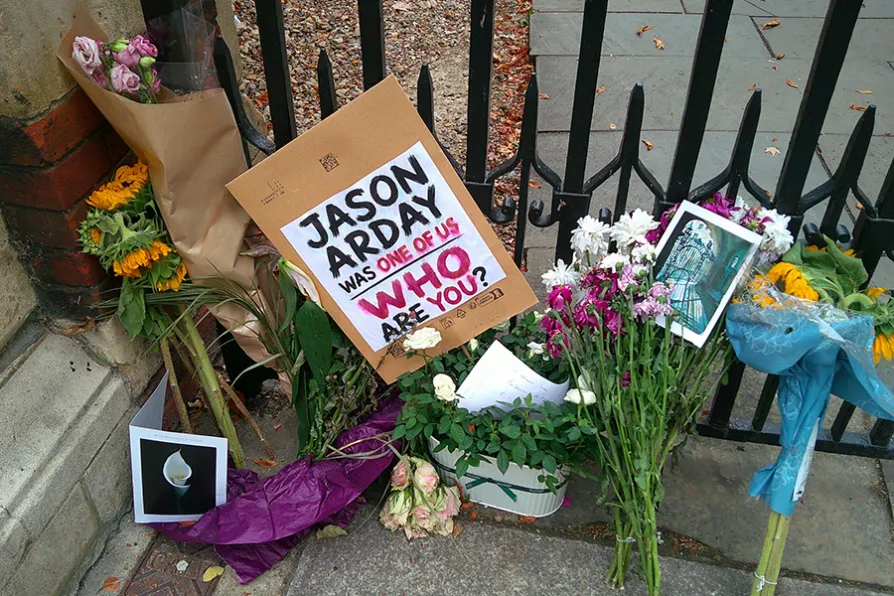
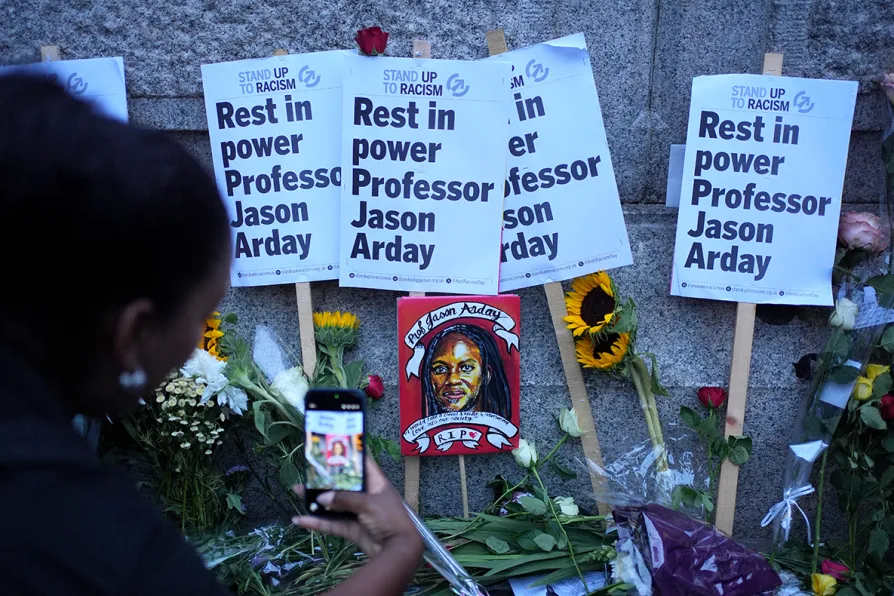
 Jason Arday memorial at the gates of Jesus College, Cambridge, August 18 [Pic: Southdevonian/CC]
Nothing, says ANDY HEDGECOCK, can rescue this undistinguished amalgam of ponderous melodrama and shallow philosophical speculation
JAMIE BRITTON invites readers to visit 3,500 locals as part of a marathon artistic pub crawl
JOHN GREEN welcomes a valuable and incisive analysis of a world become hyperpolitical but without the mass movement institutions to represent it





THE relentless cruelty of the concerted media attack on the work, the reputation and the mental health of Jason Arday is an extremely clear example of a long-standing strategy designed to enforce white supremacy and obedience to so-called “traditional values,” that has a truly terrifying capacity to mobilise the media, and public opinion itself, into a lynch mob.
Why is the right so effective at this kind of instantaneous campaign in a racist anti-progressive cause? How does it create such momentum that it seems to take everyone with it, recruiting us all into an act of flashmob violence against a symbolic individual? How can we identify and oppose this kind of attack?
How, in other words, do we stand up against this fascist tendency in our culture?
Firstly, by recognising that this is nothing new. In order to maintain a culture of racist uniformity and to stamp out individual resistance to that political programme, the Nazis developed the concept of “Cultural Bolshevism,” shorthand for anything that deviated from their own ethno-supremacist agenda. It wasn’t based on clear analysis but rather a vague catch-all that operated as an effective insult, a reactionary banner, and a weapon that that comes easily to hand for those involved in their reactionary totalitarian project. It’s there to animate the flashmob.
The method for manipulation was developed by Hitler in Mein Kampf, when he wrote that the masses “more readily fall victim to the big lie than to the small lie,” and to target the emotions of the public rather than their intellect. Such propaganda relies on simplicity, repetition, and appealing to the lowest common denominator.
Nazism was defeated, but its methods of cultural control persist. “Cultural Bolshevism” is the precedent used by the reactionary right in the US in the 1960s and ’70s to develop its own effective insult, namely “Cultural Marxism.” It too was developed as the rallying cry for media flashmobs to be mobilised around a reactionary and racist agenda.
Its proponents came from the violent fringe of politics, and figures that switch from far-left to far-right activism: frustrated middle-class intellectuals such as the conspiracy theorist Lyndon LaRouche, and the so-called “palaeoconservative” polemic of William Lind. In the justification for his own act of “flash violence” the Norwegian mass-murderer Anders Breivik quoted — one might even say plagiarised — the texts of Lind. In Germany the late Horst Mahler has had a similar influence over the AfD.
But what was a fringe, lunatic tendency 20 years ago has moved to the centre of conservative politics. “Cultural Marxism” is now a derogatory term employed in public speeches not just by the Trump administration, but by a whole array of Tory and Reform politicians in Britain, such as Suella Braverman, Michael Gove, Nigel Farage, former Ukip leader Paul Nuttall, and others. The campaign against Arday demonstrates the effectiveness of its deployment to rally the media into a murderous witch hunt.
Similar campaigns were used to suspend Harvard University President Claudine Gay in January 3, and Kathleen Stock from the University of Sussex in 2021.
You can see how it happens. Disregarding the fact that accusations of plagiarism in Arday’s Phd thesis had already been resolved in his favour by John Moores University, the avowedly racist postdoctoral researcher Nathan Cofnas nevertheless re-published the accusations and, leaking them to the Daily Telegraph, framed the story not in an academic context but a “Cultural Marxist” context for that first poisonous headline, a sneering putdown of Arday as “Diversity poster-boy.” Cofnas was suspended on Thursday from Ghent University “for discriminating against Arday.”
But at the time, the hundreds of articles that followed in the right-wing press repeated the Cofnas framing: Arday is not an individual case, but the symptom of the influence of Cultural Marxism, and must be purged to purify our pristine universities.
None of this will have been unfamiliar to a sociologist like Arday, but this particular speculative attack achieved what many others don’t, namely: to exponentially increase the numbers in the mob, reaching into centrist print media like The Guardian, proliferating widely on social media, and causing those institutions that owed him duty of care and had benefited from his teaching and scholarship to suspend him and question his credentials.
Many thought that they were being responsible journalists, looking for facts and questioning statements, but they were all doing it within the anti-Cultural Marxism framing, seeing Arday not as a human, but as a liability to the supposed values of the university and therefore, wittingly or not, joining the lynch mob.
How should we, on the left, react to this tsunami of reactionary falsification? I suggest that we should be able to understand what this kind of attack is in cultural and historical terms, and not the individual terms on which it was made. We need to stand in solidarity with the victim, the scapegoat, and to point out what is really going on: the persecution of a symbolic individual by a neo-fascist agenda.
Despite the shock of Arday’s story there’s nothing new in this, and readers can refer to a number of excellent books that have been reviewed on these pages that demonstrate this neo-fascist tendency, and in particular AJA Woods recent publication The Cultural Marxism Conspiracy (Verso, 2026) that was reviewed both by Gavin O’Toole in The Morning Star and by Alexander Howard in The Conversation.
It is our responsibility to bring a political and historical perspective to bear on this appalling, racially motivated and reactionary act of character assassination; and also to bring a humanist perspective that is entirely absent from all coverage hitherto. If Arday is unusual it is partly because his work shone a light on the nature of neurodivergence. This is not something to mock as the campaign did, but something to treasure for the new understanding we might be able to glean for those who have such gifts.
Next time we must be ready.

Similar stories
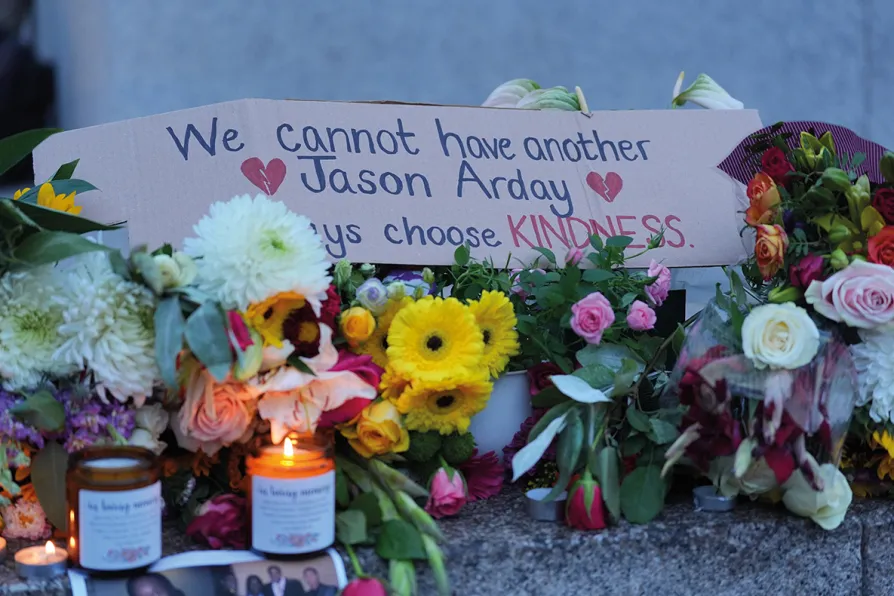
The hounding of the late Jason Arday is an all too familiar experience for many black people. ROGER McKENZIE calls for collective action to combat what can feel like personal isolation
CLAUDIA WEBBE speaks out against the lethal mechanics of Britain’s culture-war press