
The US administration is endangering lives by reversing environmental protection laws, CHAUNCEY K ROBINSON argues

The Trump-Xi summit: stalemate or stabilisation?
JENNY CLEGG looks at the key points that defined the China-US relationship, for now
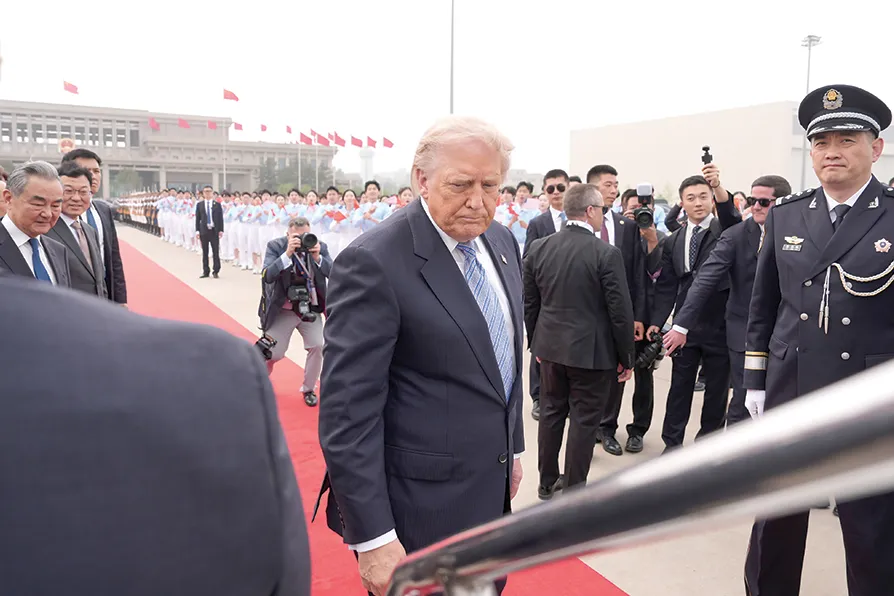
 MUCH TO PONDER: President Donald Trump boards Air Force One on May 15 2026, at Beijing Capital International Airport - first from the left is China's Foreign Minister Wang Yi

It’s time to stop retreating and go on the offensive to promote working-class interests, argues DOUG NICHOLLS
Marco Rubio wants to defeat socialism in Nicaragua, not restore ‘democracy,’ writes JOHN PERRY
Believe it or not, there was a time when the US government built beautiful homes for working‑class Americans to deal with a housing shortage, writes ERAN BEN-JOSEPH
DIANE ABBOTT provides an analysis of the reasons for EU and British voters’ dramatic swing to the right
Train drivers’ union Aslef general secretary DAVE CALFE speaks to Ben Chacko about his hopes that Burnham’s devolution agenda will include the importance of the railway





THE eyes of the world were on Beijing and the much-hyped Xi-Trump meeting last week, but for all the ceremony and general bonhomie there seemed in the end to be little for Trump — who asked for the meeting in the first place — to show for it.
It is of course a good thing that the leaders of the two largest economic powers met, and Trump’s invitation to Xi to visit the White House in September – which Xi accepted — indicates a certain degree of stability amid the international chaos he has wreaked elsewhere. So rather than pass by on the event as much ado about nothing, it is worth taking stock.
As a gesture to ease the proceedings, Trump put a billion-dollar arms sales package to Taiwan on hold, but typically he could not refrain from his habit of issuing threats to gain concessions, firing off for the first time the Philippines-based US Typhon missile launcher, with a range of 2,000km in reach of China.
Xi’s opening remarks were then apposite, warning in no uncertain terms about the dangers of war as he referenced the Thucydides Trap — the scenario when a rising power and a declining power go to war — the subject of much debate recently in US foreign policy circles.
Xi then drew the red line on Taiwan, his eyes on Trump in an effort to impress upon him the importance of laying off the island. He, in effect, was telling Trump: don’t make a mess of relations with China like the mess you’ve made in the Middle East.
Instead, Xi proposed a new style of major power relations: one of “constructive strategic stability.” He was making clear Trump had a choice: be rivals with China or be partners.
Any economic agreements or commitments followed from this.
In the nine years since the last visit by a serving US president, which also happened to be Trump, China has been on the receiving end of that first administration’s trade and tech war which ratcheted up into a New Cold War as confronting the supposedly existential threat of the Communist Party of China was declared “the mission of our time.”
Then came Biden’s decoupling drive backed by the “alliance of democracies” against autocracy.
All these, together with the provocative visit to Taiwan of Nancy Pelosi, Speaker of the House of Representatives, whipped up great hysteria over “Chinese spying,” which saw the closure of the Chinese consulate in Houston in 2020 and a media frenzy over a stray Chinese weather ballon in 2023.
Then came Trump again with his “liberation day” tariffs clearly directed to enforce decoupling where Biden’s approach had failed.
During these nine years, China has grown stronger and more confident: Huawei survived the US tech clampdown to now out-compete Apple; China’s EVs have burst onto global markets; Deep Seek and open access AI have greatly accelerated the development of China’s domestic semi-conductor industry.
Meanwhile China‘s popularity with the American people has grown even as Trump’s approval rating drops: 72 per cent of the US public now say they don’t see China as an enemy.
Looking for a deal
Accompanying Trump were the CEOs of Tesla, Nvidia, Meta, Apple, Boeing, Cargill, Blackrock, Goldman Sachs, the New York Stock Exchange and more besides. Seeing China’s technological advance ratcheting up international competition, these companies are now more desperate for access to China’s market.
While Biden pursued decoupling, Musk, and other big name CEOs headed off in the opposite direction, flying to China to receive the red carpet treatment. So ended the Biden approach.
Now these companies are getting hit both by Trump’s tariffs and China’s export restrictions on critical minerals and rare earths. For China then, their appetite to profit in Chinese markets is an insurance policy against US damage, a protection against its war drive.
The fact that Trump, fielding the better part of the top echelons of the US ruling class, came away with so little is remarkable.
More than anything he was looking for a big economic win to take back to the US electorate — but discussions about China’s purchase of Boeing aircraft and those millions of tons of soya beans are only “preliminary.” Such was the disappointment that as the summit ended Boeing’s shares fell.
Trump tried to make the most of things, claiming he had China’s agreement that the Hormuz strait must reopen and Iran should not have nuclear weapons — as if this was anything new.
What he failed to mention was that Xi made plain he thinks the war should never have been started and that it is Trump’s mess to sort out.
On China’s part, Xi was looking for a stronger statement of US opposition to Taiwan independence. The leader of the Kuomintang (KMT), the leading opposition party, had just completed a successful “journey of peace” to China and Xi was seeking to further narrow the space for independence.
While such a statement was not forthcoming, any wavering by Trump, for example on arms sales, will raise doubts in Taiwan about the reliability of US support against the mainland, tilting opinion instead in favour of the KMT’s call to reopen dialogue.
So where does the summit leave the US and China?
Gone are the lectures on human rights; gone too is the extreme decoupling agenda — at least for the time being.
The US no longer dictates the terms of the relationship. It cannot force concessions — but will it give up trying?
The fact that Trump came back with so little is remarkable. Will he think again about arms sales to Taiwan? Weakened by inflation at home and declining support in the polls, Trump will need to find his way to a better economic deal in September when he meets Xi again, just before the mid-term elections.
Does all this mean we have reached peak Trump? Biden’s world leadership was to peter out midterm as his coalition to support Ukraine ran aground in the face of rejection by the global South.
Trump came storming back onto the international stage with his threats and interventions just months ago but now we see leading US foreign policy analysts penning articles entitled The US has Lost its Leverage over China and America’s Strategic Defeat in the Persian Gulf. Some panic here among the US ruling class about Trump’s “might is right” approach.
Stability in the US-China relationship is by no means guaranteed — Trump is only refraining from the escalation of economic war.
The US China containment strategy has narrowed down to an attempted block on the country’s technological progress using export controls so as to maintain the US lead in AI.
Meanwhile China’s recently initiated 15th five-year plan prioritises lifting the quality of its productive forces using innovation to advance semi-conductor technology. And while China uses its control of critical minerals as leverage, the US has commenced a frantic pursuit of new supply chains around the world.
These endeavours could take years: it seems that both sides have stalled at stalemate in a protracted war of attrition as they race to see who can break through in the other’s choke points first. But a fragile truce at least gives both sides some breathing space.
Clearly a constructive partnership — working together on the UN security council, reforming the rules of the world economy — remains in the realms of fantasy. Frictions and countermeasures will not end but the question is: can the risks be managed without tipping into war?
The trajectory of US-China competition may not have changed but there is a sense in which the world is reaching a turning point.
The US is still the world’s largest military power and will remain so for years to come but China’s confidence in standing up to US pressure has grown.
Trump’s threats and wars may continue and even intensify elsewhere, but greater stability in relations between the world’s two major powers may also create breathing space in other areas, easing pressure on countries to choose between the US and China.
As space for manoeuvre among global South countries increases, their growing autonomy will keep driving the multipolar trend forward.

Similar stories
CARLOS MARTINEZ responds to liberal hawk Simon Tisdall’s evidence-free China-bashing and asks whose agenda it really serves
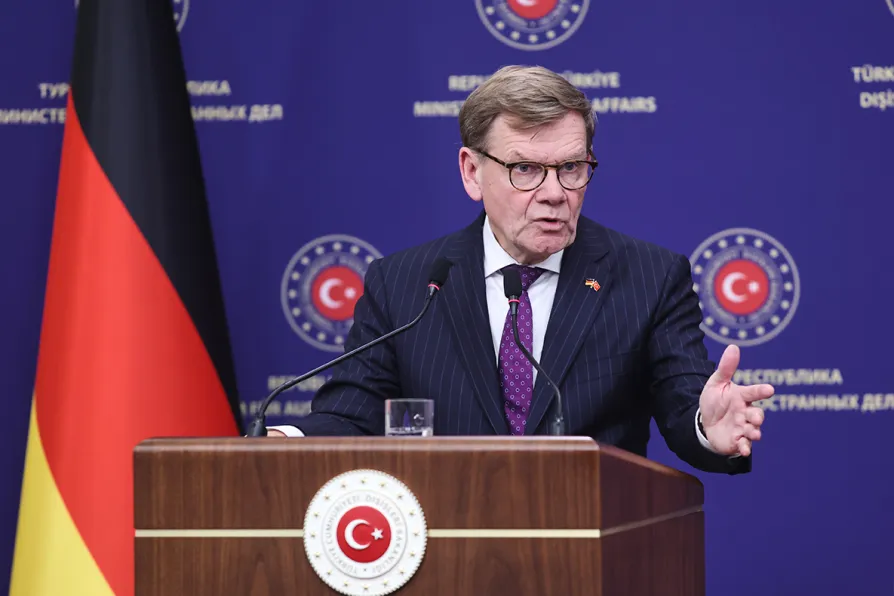
The cancelled China trip of the German Foreign Minister marks a break with Helmut Schmidt’s China policy and drives Germany further into Washington’s confrontation course, warns SEVIM DAGDELEN